Editor’s Note: All tools, features, and pricing limits listed below were independently verified and re-tested in April 2026 to ensure accuracy regarding watermark policies, pricing, and commercial usage rights.
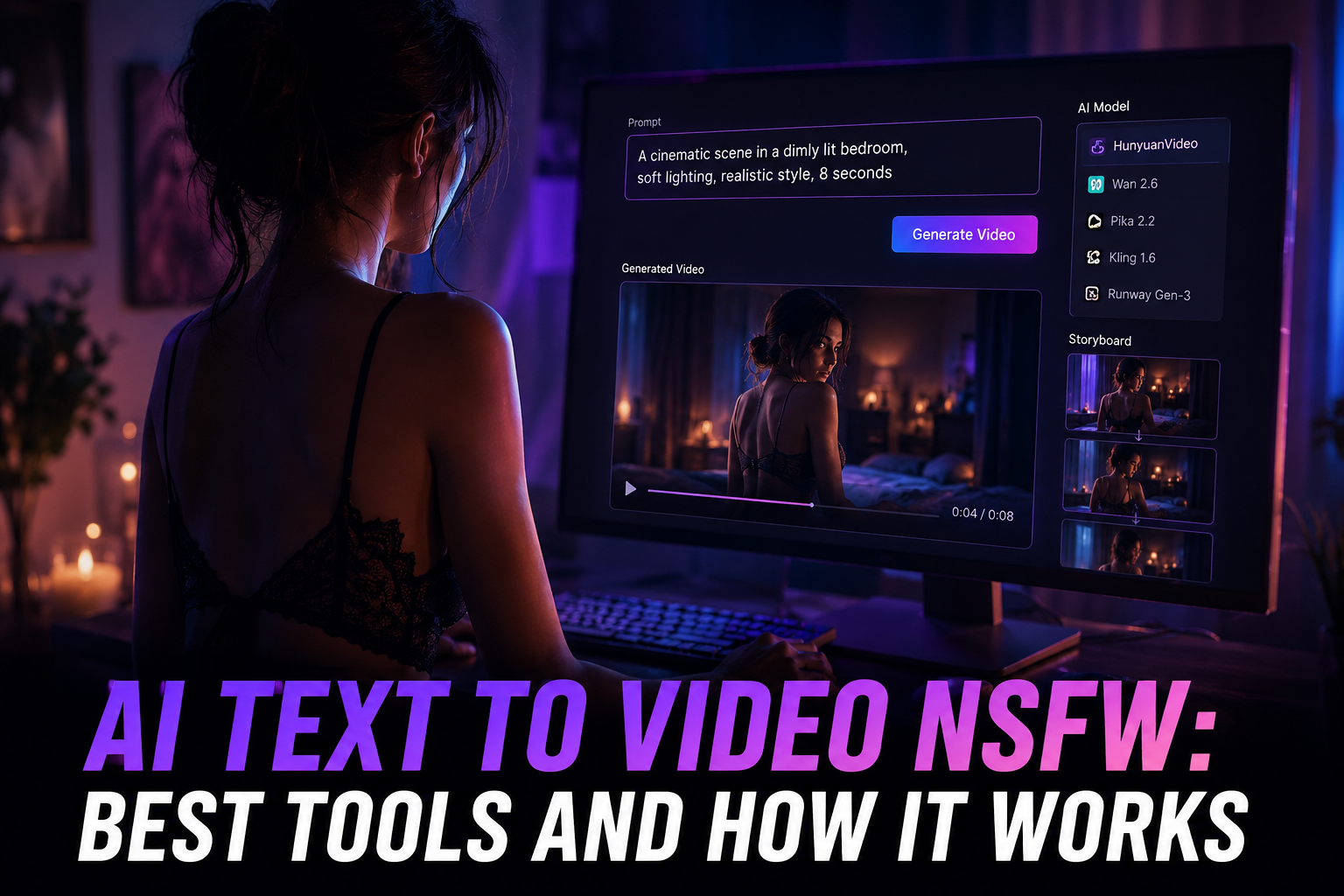
Creating adult-oriented AI video from text sounds simple: type a prompt, choose a style, and generate a clip. In reality, ai text to video nsfw workflows are more complex than image generation because the model must understand motion, timing, character consistency, camera movement, and platform safety rules at once. Mainstream video models often block adult prompts, while open-source and relaxed-policy tools vary widely in quality. In this guide, you will learn how text-to-video NSFW works, which tools are worth testing, how prompts should be structured, and where legal boundaries must stay clear.
Image description: Screenshot of CrePal’s AI video creation interface showing prompt input, model selection, and video generation workflow.
CrePal is an AI Director Agent that helps creators turn text ideas into structured video workflows. Unlike single-model generators that produce one isolated clip, CrePal can help plan scenes, refine prompts, select video models, and guide edits through conversation. For creators comparing AI video tools, CrePal is useful because it focuses on workflow control, not just one-time generation. You can also explore a broader NSFW AI video generator comparison if you want to compare text-to-video with other generation paths.
What Is AI Text-to-Video NSFW
AI text-to-video NSFW means using a written prompt to generate adult-oriented or mature-themed video content directly. The key difference is that the workflow starts from text only. There is no source image, no uploaded reference frame, and no existing video required.
This makes text to video nsfw ai useful for creators who want fast ideation. A prompt can define the scene, character type, setting, lighting, motion, camera angle, and visual style. The model then attempts to produce a short video based on that description.
However, this format also creates more risk. A text prompt can request a real person’s likeness, describe illegal content, or imply minors. Those areas are not just platform-policy issues. They are legal and consent issues.
Image description: Visual example of a text-to-video workflow showing a prompt turning into a short generated video sequence.
t2v vs i2v vs v2v – when each fits
T2V, or text-to-video, starts from written instructions. It works best for concept exploration, quick scene testing, abstract visuals, fictional characters, and short clips where exact identity is not required.
I2V, or image-to-video, starts from a still image. It is better when visual consistency matters. For example, creators may use one approved character image and animate it. If you want that route, compare this with an NSFW image-to-video guide.
V2V, or video-to-video, transforms an existing video. It is useful for style transfer, motion preservation, or editing footage. It is also the most sensitive route when real people are involved because the source footage may require permission.
Why mainstream t2v models block NSFW
Mainstream text-to-video systems usually restrict adult content because video is harder to moderate than images. A generated clip can include identity misuse, coercive scenarios, realistic deepfake harm, or age ambiguity.
This is why tools like Sora, Veo, Runway, and many enterprise video systems usually block explicit adult prompts. Their policies are designed for broad commercial use, brand safety, and regulatory compliance. For mature content creators, this means general-purpose cloud tools may reject prompts even when the intent is fictional.
Models That Support NSFW t2v
The data in this section reflects hands-on testing conducted in April 2026. Platform policies, pricing, and free-tier limits may change over time, so always verify final licensing terms on the official website before commercial use.
Open-source – HunyuanVideo, Wan 2.6, etc.
Open-source models are often the most flexible route for nsfw t2v, but they require technical setup. HunyuanVideo and Wan-family video models are frequently used in local or custom workflows because they support text-to-video generation and can be integrated into community pipelines.
HunyuanVideo is a text-to-video model family released by Tencent, with later versions focused on stronger motion quality and lower hardware barriers. Wan video models are also commonly used in T2V and I2V workflows, depending on the specific release and interface. Before building a workflow, check the model card, license, and supported tasks on Hugging Face or GitHub.
The important point: not every “NSFW model” is true text-to-video. Some only support image-to-video. Others require a reference image even if the UI accepts text. Always confirm whether the model supports native T2V.
Image description: Screenshot of a HunyuanVideo model page showing text-to-video model information, files, and usage notes.
Hosted platforms with relaxed policies
Hosted platforms are easier for non-technical creators. They usually provide a browser interface, credits, model menus, and export options. The trade-off is that their policies can change quickly.
CrePal should be considered first if the goal is a structured video workflow. It is not just a prompt box. Its AI Director Agent can help users shape a video idea into scenes, adjust tone, refine generation instructions, and iterate through conversation. This is especially helpful for T2V because video prompts need motion, timing, and visual continuity.
Mage offers browser-based AI image and video generation with a wide model selection. Venice focuses on private AI access and includes creative generation features. BasedLabs provides many AI video tools, including text-to-video pages. PixelBunny offers AI image and video tools with prompt-based editing and generation.
Image description: Screenshot of Mage’s AI image and video generator interface showing model options and prompt input.
ComfyUI custom pipelines
ComfyUI is the advanced route. It allows users to connect text encoders, video diffusion models, LoRAs, motion modules, upscalers, frame interpolation, and post-processing nodes.
This route gives the most control, but it also requires the most testing. A creator may need to tune frame count, resolution, sampler, seed, guidance scale, and negative prompts. It is powerful for fictional adult content workflows, but it should never be used to create non-consensual real-person likenesses.
Image description: Screenshot of a ComfyUI-style node workflow for text-to-video generation, showing prompt, model, sampler, and output nodes.
How to Run NSFW t2v – Step-by-Step
Prompt structure for video: motion + scene + style
A strong ai nsfw text to video prompt needs more than visual description. It should tell the model what moves, where the camera goes, and how the scene feels.
A safe structure looks like this:
Subject + action + scene + camera + lighting + style + duration.
For example, keep characters fictional, adult, and non-identifiable. Avoid naming celebrities, private people, influencers, classmates, coworkers, or anyone whose likeness you do not have rights to use.
For deeper prompt formatting, read an NSFW AI prompt guide for video creators. The key rule is simple: write for motion, not just appearance.
Image description: Workflow visual showing a structured video prompt divided into subject, motion, camera, lighting, style, and duration.
Frame count, duration, resolution choices
Most T2V clips work best when they are short. A 4–8 second clip is easier to generate cleanly than a long sequence. Shorter clips reduce motion glitches, identity drift, and warped anatomy.
For early tests, use lower resolution and fewer frames. Once the prompt works, upscale or regenerate at higher quality. For social platforms, vertical formats may be better. For website banners or cinematic previews, horizontal output is usually easier to compose.
Seed and reproducibility
A seed helps reproduce similar outputs. If a platform exposes seed control, save it when a clip looks promising. This makes iteration easier.
However, video generation is still less predictable than image generation. The same seed may not always preserve every motion detail across model updates, platform changes, or different resolutions.
Common failure modes: motion glitches, identity drift
T2V models often fail in four ways. First, motion may look unnatural. Second, hands, faces, or clothing may distort across frames. Third, character identity may drift. Fourth, the camera may ignore the prompt.
CrePal’s workflow helps here because users can revise through conversation instead of rewriting everything from scratch. For example, a creator can ask the AI Director Agent to simplify the camera move, reduce scene complexity, or split one difficult clip into two easier shots.
t2v vs i2v Trade-offs for NSFW
T2V is faster for ideation. It does not require a source image, so users can start from a blank concept. This is useful for testing visual direction, camera movement, and short fictional scenes.
I2V is better for consistency. If a creator already has a legally safe source image, I2V can preserve character design more effectively. This matters when building a series or a recurring fictional persona.
For NSFW use cases, the biggest difference is control. T2V gives freedom but can drift. I2V gives visual stability but depends on the safety and consent status of the source image. Real-person source images require permission, even if the final output is synthetic.
Free vs Paid Options
Free options are useful for testing, but they are rarely enough for serious production. Free tiers may include watermarks, limited credits, lower resolution, queue delays, or strict content rules.
CrePal is a strong starting point for creators who want a guided workflow rather than a raw model interface. Its value is strongest when a user wants to move from idea to scene plan to generated clips without jumping across multiple tools.
Mage and BasedLabs are useful for quick browser testing. Venice may appeal to users who care about privacy and flexible AI access. PixelBunny is better for creators who also need image editing, upscaling, and prompt-based visual tools.
Image description: Screenshot of Venice’s video or creative generation page showing private AI generation options.
Comparison Table
The data in this section reflects hands-on testing conducted in April 2026. Platform policies, pricing, and free-tier limits may change over time, so always verify final licensing terms on the official website before commercial use.
| Tool | Best For | T2V Support | NSFW Flexibility | Main Limitation |
| CrePal | Guided AI video workflow, scene planning, prompt refinement | Yes, through AI video workflows | Relaxed creative use, subject to platform rules | Best results require prompt iteration |
| Mage | Browser-based image and video generation | Yes, model-dependent | More flexible than mainstream tools | Quality varies by selected model |
| Venice | Private AI access and creative generation | Yes, via supported video models | Flexible, privacy-focused | Credit and model availability may vary |
| BasedLabs | Fast online AI video tools | Yes | Flexible tool ecosystem | Many tools have different limits |
| PixelBunny | Prompt-based image and video tools | Yes, depending on tool | Relaxed creative workflows | Less transparent model-level detail |
| ComfyUI local setup | Maximum control and custom pipelines | Yes, if model supports T2V | User-controlled environment | Technical setup and hardware burden |
CrePal stands out because it is not only a generator. It behaves more like a video creation partner. For T2V, that matters because good clips depend on planning, shot design, and iteration. A single raw prompt often fails. A guided AI Director Agent workflow can turn a vague idea into a cleaner sequence.
Image description: Screenshot of BasedLabs’ text-to-video generator page showing prompt input and generated video preview area.
Legal and Compliance
18+ – universal rule
All NSFW text-to-video workflows must be limited to adult subjects and adult audiences. Prompts, outputs, thumbnails, captions, and distribution pages should clearly avoid age ambiguity.
If a character appears young, the content should not be generated or published. “Fictional” is not a defense when the output suggests minors.
No minors in prompts or outputs
Never include minors in NSFW prompts. Do not use school settings, teen-coded wording, childlike body descriptions, or age-ambiguous characters. If a generation accidentally creates a young-looking subject, discard it.
This rule applies across T2V, I2V, V2V, and editing workflows.
Real-person likeness via prompt = same consent rules
A text prompt can still create a real-person likeness. Writing “an actress who looks like X” or “a person resembling X” can create consent problems.
For nsfw video from text, treat likeness prompts as if you used a real photo. Celebrities, influencers, employees, classmates, and private individuals require clear consent. Do not generate adult content based on someone’s identity without permission.
Platform distribution restrictions
Even if generation is allowed, distribution may not be. Social platforms, ad networks, hosting services, and payment processors often restrict explicit adult content.
Creators should review platform policies before publishing. This is especially important for paid content, affiliate campaigns, and commercial licensing. A video that is allowed in one generator may still violate another platform’s rules.
Image description: Screenshot of PixelBunny’s AI tools page showing video, image editing, upscaling, and prompt-based creative tools.
FAQ
What is AI text-to-video NSFW?
AI text-to-video NSFW is the process of generating adult-oriented video clips directly from written prompts. The prompt defines the subject, action, scene, camera movement, lighting, and style.
Is text-to-video better than image-to-video for NSFW content?
Text-to-video is better for fast concept testing. Image-to-video is better for visual consistency. For recurring fictional characters, I2V usually gives more stable results.
Can I use real people in NSFW T2V prompts?
No, not without clear consent. A prompt that imitates a real person’s likeness creates the same consent risk as using their photo.
Which tool should beginners try first?
CrePal is the best first option for users who want a guided workflow. Its AI Director Agent helps structure scenes, refine prompts, and iterate through conversation.
Are free NSFW T2V tools reliable?
Free tools are useful for testing, but they often have limits. Expect lower resolution, fewer credits, watermarks, slower queues, or changing policy rules.
Conclusion
AI text-to-video NSFW is moving fast, but it is not just image prompting with motion added. T2V requires stronger prompt structure, clearer scene planning, and stricter legal awareness. CrePal is the strongest starting point for creators who want a guided AI Director Agent rather than a raw generator. Mage, Venice, BasedLabs, PixelBunny, and ComfyUI workflows can also be useful, depending on control, privacy, and budget needs.
For creators building mature video workflows, the safest path is simple: use fictional adult characters, avoid real-person likenesses, verify platform rules, and test short clips before scaling. To compare this workflow with other AI video paths, read the full AI video generator guide.