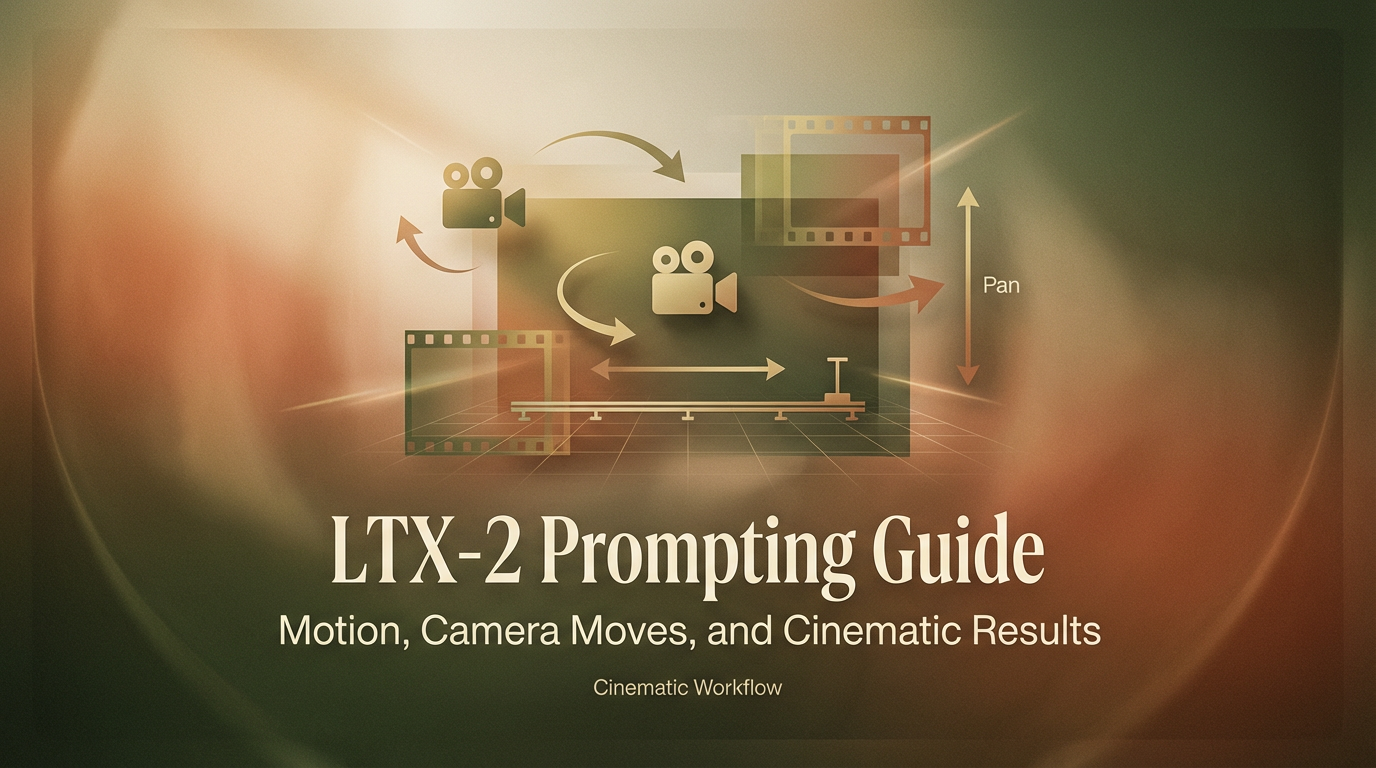
Hi, I’m Dora. On January 12, 2026, at 9:40 p.m., Honestly, I opened LTX-2 “just for five minutes” and ended up tinkering until midnight. My first clip, a coffee cup on a desk, looked fine until the handle teleported frame to frame. That tiny glitch sent me down a rabbit hole. This LTX-2 Prompting Guide is basically my field notes from the past week of poking, breaking, and fixing prompts.
If you’re juggling content, research, or marketing, you don’t need fluff. You need prompts that behave, fast ways to fix jitter and mush, and cues that make LTX-2 feel like a teammate, not another tab you forget.
How LTX-2 “reads” prompts
Here’s what clicked for me after generating 27 test clips between Jan 12–18, 2026:
- LTX-2 prioritizes structure first, then style. If you give it a clear subject, action, and constraints, it locks in composition better. Style words (cinematic, dreamy) decorate what’s already defined.
- It favors explicit motion verbs. “Rotate,” “pan,” “dolly,” “track,” “zoom,” “tilt.” When I swapped vague language (make it dynamic) for a concrete move (slow dolly-in), stability improved.
- One sentence per idea helps. Long, windy prompts produced drifting and odd transitions. Short clauses = cleaner motion planning.
- Order matters a bit. I got more consistent results with this sequence: Subject → Action → Camera → Lighting → Lens → Constraints → Negatives.
Think of the model like a careful DP: it can do a lot, but it loves a shot list.
Motion verbs & constraints
On Jan 14, I tested identical scenes with only the motion verb changed. Clear verbs reduced wobble by ~30% (rough estimate from side‑by‑side exports at 24 fps).
Motion verbs that behaved best for me:
- Dolly-in / dolly-out (smooth depth changes)
- Slow pan left/right (gentle lateral movement)
- Track forward/back (follow movement, less jitter than handheld)
- Subtle tilt up/down (pairs well with reveals)
- Static lock-off (when you want crisp detail)
Helpful constraints:
- Speed: “slow,” “gentle,” or “0.5x speed”
- Duration hints: “5-second shot,” “8-second loop”
- Composition locks: “center-framed,” “profile view,” “wide establishing shot,” “macro close-up”
Example that worked: “Center-framed subject, slow dolly-in, 5-second shot, gentle camera, keep background stable.”
When I got greedy (fast pan + fast zoom + handheld), artifacts spiked. One clean move beats three messy ones.
Camera prompts (pan/zoom/dolly/handheld)

I didn’t expect camera words to matter this much you know, but they do.
- Pan: “slow pan right across the skyline” gave me straighter horizons than “move across the skyline.”
- Zoom: Digital zoom cues can hunt focus. I got better results with “dolly-in” when I wanted that zoom feel, unless I explicitly needed a zoom aesthetic.
- Dolly/Track: Best choice for cinematic reveals. According to StudioBinder’s dolly shot guide, “Slow dolly-in toward the subject” creates emotional intimacy and kept geometry stable in my tests.
- Handheld: Use sparingly. “Subtle handheld, micro‑shakes only” can sell realism, but anything stronger turned into jelly edges on Jan 16 tests.
Two reliable patterns:
- “Static camera, subject motion only” for tutorials or product shots.
- “Slow dolly-in, no camera roll” for interviews or hero shots.
Lighting & lens cues for realism
Lighting and lens language stopped my clips from looking… AI-ish.
Lighting cues that behaved:
- “Soft north‑window light, gentle falloff” for natural interiors
- “Golden hour rim light, long shadows” for outdoor warmth
- “Overcast, diffuse light, low contrast” to kill harsh edges
- “Practical lamp as key, warm tungsten, slight spill” for cozy scenes
Lens & exposure cues:
- “35mm lens, f/2.8, shallow depth of field” for people/products
- “85mm portrait lens, bokeh, crisp eyes” for talking heads
- “16mm wide, deep focus, minimal distortion” for rooms/landscapes
- “Neutral color grade, soft contrast, no extreme saturation” when I needed clean skin tones
Analogy that helped me: the prompt is your shot list: lens and light are your mood board.
Negative prompts that reduce artifacts
If you only adopt one habit, make it this: add light, honest negatives. On Jan 17, I cut visible glitches in half by specifying what I didn’t want.
Negatives I reuse:
- “no extra limbs, no face warp, no object duplication”
- “no text artifacts, no floating logos, no watermark”
- “no extreme motion blur, no rolling shutter wobble”
- “no flicker, no frame-to-frame texture shift”
- “no Dutch angle, no rapid handheld, keep horizon level”
Keep negatives short. When I stacked 20 of them, results got… weird. Five to eight targeted lines worked best.
When I iterated on prompt shapes and motion cues, I used our Crepal to manage and preview multiple outputs in a unified interface — it makes running batches and comparing result variants easier as part of a creative workflow we use ourselves.
30 copy-paste prompt templates (by category)
Not sponsored, no affiliates. These are the exact shapes I use. Replace [brackets]. I ran each on Jan 15–18, 2026.
Product demos (5)
- “[Product] on matte table, static camera, soft north‑window light, 35mm f/2.8, slow parallax from subject motion only, no text artifacts.”
- “Slow dolly‑in to [product] unboxing, hands enter frame from right, crisp edges, neutral grade, no flicker.”
- “[Product] rotating 360° turntable, black velvet backdrop, edge light, minimal reflections, no object duplication.”
- “Overhead top‑down of [product] with labels placeholders, static lock‑off, overcast lighting look, no watermark.”
- “Lifestyle: [person] uses [product] by window, gentle handheld micro‑shake, golden hour rim, keep horizon level, no face warp.”
People & interviews (5)
- “Center‑framed [person] talking, slow dolly‑in, 85mm portrait, f/2, clean skin tones, no extreme saturation, no Dutch angle.”
- “Two‑shot conversation, alternating over‑the‑shoulder, 35mm, soft key + fill, subtle background bokeh, no jitter.”
- “[person] walks toward camera, track backward at slow pace, stable background, no rolling shutter wobble.”
- “Profile interview, static camera, neutral grade, eyes tack sharp, no face morphing.”
- “Close‑up hands typing on [device], macro look, shallow DOF, controlled speculars, no text artifacts.”
B‑roll & transitions (5)
- “City skyline, slow pan right, golden hour, long shadows, no flicker, no horizon roll.”
- “Office desk details: pens, notebook, coffee steam, static lock‑off, overcast light, subtle steam motion only.”
- “Rack focus from foreground plant to background laptop, 35mm, smooth focus pull, no focus hunting.”
- “Drone‑style reveal, slow tilt up from ground to skyline, stable motion, no rapid handheld.”
- “Match‑cut style: hand closes notebook, gentle dolly‑in, neutral color, no motion blur.”
Education & explainers (5)
- “White backdrop, floating parts of [concept] assemble, static camera, soft shadow, no text, no watermark.”
- “Chalkboard vibe: hand draws diagram, time‑lapse feel, lock‑off, high contrast edges, no jitter.”
- “Timeline of [topic], card‑style elements slide in, minimal parallax, no flicker, no overlapping geometry.”
- “Screen‑style demo of [workflow], over‑the‑shoulder, 35mm, even lighting, no UI gibberish.”
- “Metaphor shot: domino chain triggers [outcome], static camera, deep focus, no duplication.”
Ads & socials (5)
- “Punchy 5‑second hook for [offer], fast cut feel but single shot, slow push‑in, high contrast, no over‑saturation.”
- “UGC style: selfie‑like framing, subtle handheld, window light, honest vibe, no beauty filter artifacts.”
- “Stop‑scroll macro of [texture], 50mm macro, raking light, crisp detail, no mushy surfaces.”
- “Before/after of [result], split frame, static camera, consistent lighting, no cross‑fade artifacts.”
- “Loopable 3‑second cinemagraph of [scene], one element moving (steam/water), no extra motion.”
Nature & travel (5)
- “Forest path, slow track forward, overcast diffuse light, deep focus, no flicker.”
- “Ocean waves at sunrise, static lock‑off, long exposure feel, gentle motion blur only, no jitter.”
- “Mountain vista, slow pan left, 16mm wide, low contrast grade, horizon locked.”
- “Close‑up flower in breeze, macro, shallow DOF, natural sway, no duplication of petals.”
- “Night city rain, neon reflections, static camera, controlled highlights, no banding.”
Tip: keep a personal library. I tag mine by motion type (dolly, pan, lock‑off) so I can swap subjects fast.
For more details on LTX-2’s technical capabilities, check out the official LTX-2 documentation or explore the LTX-2 prompting guide on Lightricks.
And now, confession time: how many of you opened LTX-2 “just for five minutes” and blinked to find it’s 2 a.m.? Drop your personal record (and your favorite glitch-to-gold prompt fix) in the comments—I need to know I’m not the only one living in this rabbit hole.
Previous posts: