Editor’s Note: All tools, features, and pricing limits listed below were independently verified and re-tested in May 2026 to ensure accuracy regarding watermark policies, pricing, and commercial usage rights.
You want to create adult-oriented AI video, but every platform describes its rules differently. One tool says “uncensored,” another says “mature themes,” and a mainstream model may generate suggestive fashion clips while blocking explicit output. That confusion matters because account safety, commercial rights, and legal risk are not the same thing. This guide explains which AI video generator NSFW allowed platforms are more permissive in 2026, which mainstream models block NSFW, and how to verify policies before you spend credits or publish anything.
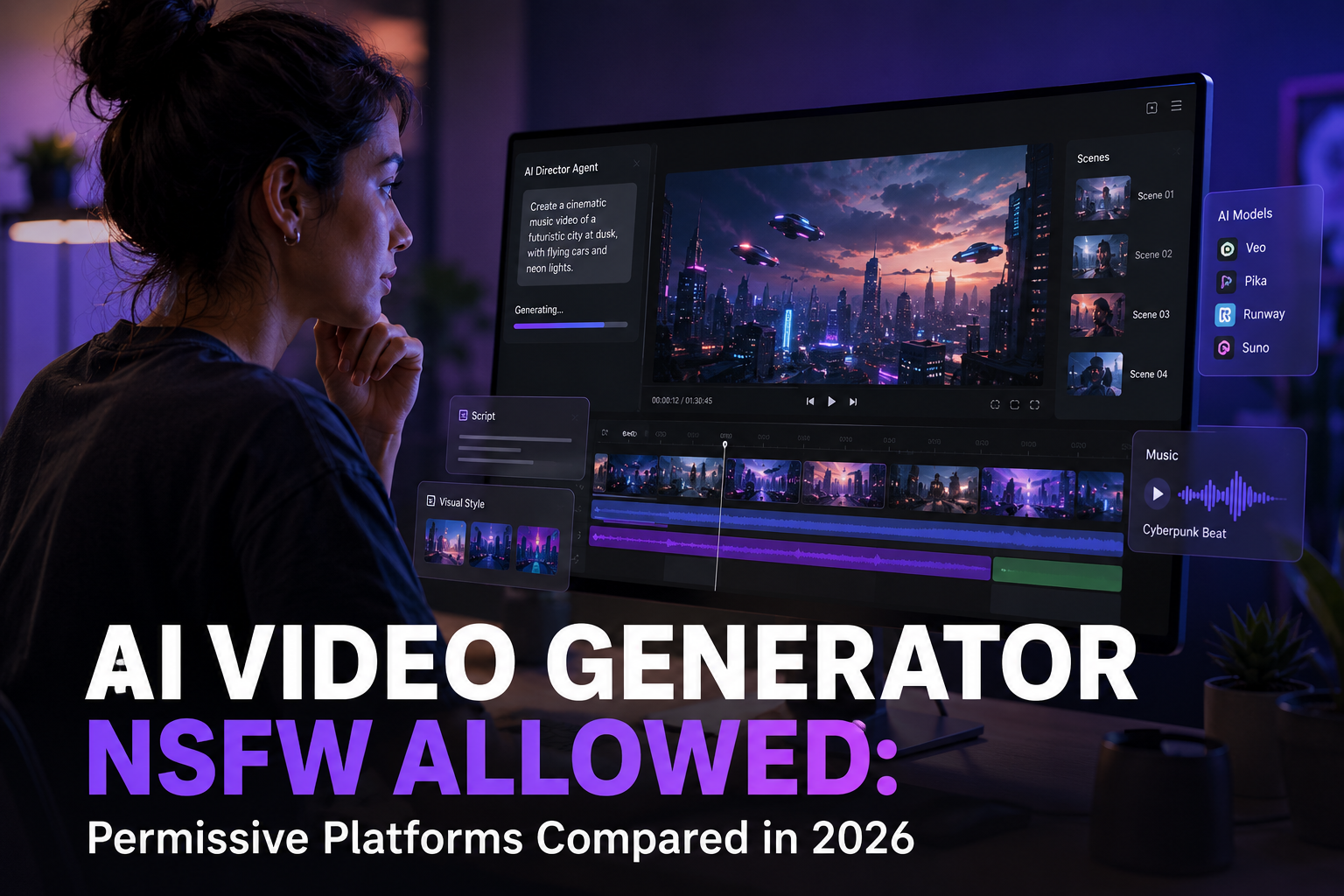
CrePal is an AI Director Agent built for end-to-end video creation, not just isolated clip generation. Unlike single-model tools that only turn one prompt into one short output, CrePal helps creators plan, generate, revise, and assemble video through a guided workflow. For creators comparing platform rules, CrePal is useful because it puts video generation into a broader production process: concept, scene planning, editing, and final output. For a wider tool ranking, see our best NSFW video AI guide.
Image description: Screenshot of CrePal’s official website showing the AI video creation agent interface, prompt workflow, and video creation positioning.
Why “NSFW Allowed” Is the Right Question
Many creators ask, “Can this model generate NSFW video?” That is the wrong starting point. A model may be technically capable of producing mature content, but the platform running it may still prohibit that output.
The better question is: Does the platform allow NSFW content under its Terms of Service, content policy, and commercial-use rules?
That is why this article focuses on platform policy, not only output quality. If you want a quality-first comparison, use our AI video tools comparison alongside this policy guide.
ToS vs technical capability – they’re not the same
A video model can have broad visual capability while the platform blocks certain prompts. That happens often with cloud AI tools. The underlying model may understand adult themes, but the product layer may filter nudity, sexual content, celebrity likenesses, or realistic people.
This is why “the model can do it” does not mean “your account is safe doing it.” A platform can reject prompts, remove outputs, throttle your account, block publishing, or suspend access.
What “allowed” actually means (account safe vs warning)
“Allowed” has levels. Some platforms clearly market themselves as NSFW friendly. Some allow mature or suggestive content but block explicit sexual output. Others tolerate fictional adult themes but prohibit real-person likeness, public figures, minors, non-consensual content, and commercial sexual exploitation.
For creators, the practical question is simple: can you generate, save, and commercially use the video without violating the platform’s rules? If the answer is unclear, treat the platform as restricted.
AI Video Generators That Allow NSFW
The data in this section reflects hands-on testing conducted in May 2026. Platform policies, pricing, and free-tier limits may change over time, so always verify final licensing terms on the official website before commercial use.
Permissive platforms are not all the same. Some are self-hosted workflows. Some are hosted tools that openly market NSFW support. Some are mature-content-friendly but still moderate heavily.
Open-source self-host – fully permissive
Self-hosted video workflows are usually the most flexible option because you control the environment. Common routes include open-source video models, local ComfyUI workflows, and community model pipelines hosted through GitHub or Hugging Face.
But “fully permissive” does not mean risk-free. You still need to follow local law, copyright law, privacy law, likeness rights, and platform rules where you publish. Self-hosting only reduces platform-level moderation. It does not erase legal responsibility.
Self-hosting also requires more skill. You may need GPU access, model setup, workflow nodes, prompt testing, frame interpolation, upscaling, and editing. It gives control, but it is not the easiest path for everyday creators.
NSFW-explicit hosted platforms
Some hosted platforms clearly position themselves as more permissive. In this category, CrePal, Mage, Venice, BasedLabs, and PixelBunny are the key tools to check.
CrePal should be considered first if your goal is not only to generate clips but to build a usable video workflow. Its AI Director Agent approach helps creators move from idea to scenes, then into revision and final assembly. That matters for adult-oriented creators because policy checks are only one part of the process. You still need consistent characters, coherent scenes, framing control, and post-generation editing. CrePal’s strength is orchestration: it helps you think like a director rather than a prompt spammer.
Mage is more direct. It markets itself around uncensored AI image and video generation and is useful for fast experimentation. It fits creators who want quick generation rather than a full production workflow.
Venice is positioned around privacy and less restrictive AI access. Its video generation feature is relevant for creators who value private or anonymized workflows. However, Venice still has terms against harmful or illegal use, so it should not be treated as “anything goes.”
BasedLabs offers AI image and video tools with content rules that prohibit illegal, obscene, exploitative, or harmful activity. It can be useful for broader creative workflows, but creators should read its blocked-content policy before adult use.
PixelBunny combines AI image, video, and editing tools with a flexible credit-based approach. It is often discussed among creators looking for less restrictive visual generation. Still, creators should verify the latest content rules before publishing or selling output.
Image description: Screenshot of Mage’s AI image and video generator page showing its uncensored positioning, model selection area, and video generation entry points.
Image description: Screenshot of Venice’s AI video generation guide or product page showing its video workflow and privacy-focused positioning.
Mainstream platforms that permit “mature” content with caveats
Some mainstream tools may allow mature aesthetics, dramatic romance, swimwear, lingerie-like fashion, or non-explicit sensual scenes. But that is not the same as explicit NSFW.
Pika’s public rules position the service as PG-13 and family-friendly. Luma’s Dream Machine content moderation guidance prohibits NSFW and explicit material. Runway’s policy is also strict on nudity and sexually explicit content. In practice, these platforms are better for brand-safe, cinematic, fashion, product, or storytelling videos.
If your content needs to remain account-safe, do not assume “mature” means explicit. Read the policy page, then test carefully with non-explicit prompts.
Image description: Screenshot of BasedLabs’ AI video or tool interface showing video generation options and creator workflow controls.
AI Video Generators That Block NSFW
Mainstream AI video platforms usually block explicit adult content because they serve broad consumer, enterprise, education, and brand markets. Their policies also reduce risk around non-consensual intimate imagery, deepfakes, and child safety.
Sora / Veo / Runway / Kling – current policies
As of May 2026 verification, Sora should not be treated as an NSFW-friendly video tool. OpenAI’s Sora safety materials describe stronger safeguards for video, including scanning feed content and filtering unsafe or age-inappropriate material. OpenAI also announced changes to Sora availability in 2026, so creators should verify its current status through official OpenAI sources.
Google Veo is also not an NSFW-friendly option. Google’s generative AI use rules and product safety systems are built for responsible, mainstream use. Creators should expect sexual explicitness, non-consensual imagery, and unsafe content to be restricted.
Runway is explicit in its policy. It prohibits sexually explicit content, adult nudity, non-consensual intimate imagery, and in some cases limits suggestive content. For creators, that means Runway is strong for cinematic and commercial video, not explicit NSFW.
Kling is widely used for AI video generation, but it should be treated as restrictive for NSFW workflows. Creators should expect explicit prompts to be blocked or filtered.
Pika positions its service around PG-13 and family-friendly output. Luma prohibits NSFW and explicit material in Dream Machine guidance. Both can still be useful for non-explicit creative video.
Image description: Screenshot of Runway’s usage policy page showing restrictions around sexually explicit content, nudity, and non-consensual intimate imagery.
What gets your account flagged
The most common account-risk triggers are explicit sexual acts, adult nudity, non-consensual intimate imagery, celebrity or real-person sexual likenesses, minors, sexualized youth-coded characters, sexual violence, trafficking themes, and attempts to evade filters.
Even on permissive platforms, these areas are high risk. On mainstream platforms, they can lead to prompt rejection, output removal, warnings, credit loss, or account suspension.
Policy Comparison Table
The data in this section reflects hands-on testing conducted in May 2026. Platform policies, pricing, and free-tier limits may change over time, so always verify final licensing terms on the official website before commercial use.
Platform / NSFW status / explicit allowed / restrictions / commercial use
| Platform | NSFW Status | Explicit Allowed? | Key Restrictions | Commercial Use Notes |
| CrePal | Permissive workflow focus | Check current ToS | Must avoid illegal, non-consensual, minor-related, or rights-violating content | Best for full video workflows; verify licensing before client work |
| Mage | NSFW-friendly hosted tool | More permissive | Still subject to law, consent, and platform restrictions | Useful for quick generation; confirm output rights |
| Venice | Mature / less restrictive | Context-dependent | No illegal, harmful, privacy-violating, or abusive use | Strong privacy positioning; verify video rights |
| BasedLabs | Mixed / policy-limited | Not broadly explicit | Blocks illegal, obscene, exploitative, and harmful activity | Read blocked-content policy before commercial use |
| PixelBunny | More permissive creator tool | Check current rules | Avoid illegal, non-consensual, minor-related, and rights-violating use | Flexible for image/video workflows; verify license terms |
| Sora | Restricted | No | Unsafe and age-inappropriate content filtered | Not recommended for NSFW |
| Veo | Restricted | No | Google safety and generative AI restrictions apply | Best for mainstream creative use |
| Runway | Restricted | No | Blocks sexually explicit content and adult nudity | Strong for brand-safe video |
| Kling | Restricted | No | Filters adult and explicit material | Better for general AI video |
| Pika | PG-13 / restricted | No | Family-friendly positioning, blocks harmful use | Better for social-safe video |
| Luma | Restricted | No | Blocks NSFW and explicit material | Better for cinematic non-explicit content |
Image description: Screenshot of PixelBunny’s AI video generator page showing text-to-video or image-to-video controls and editing workflow.
What “Allowed” Doesn’t Cover
Allowed by platform does not equal legal. This is the biggest mistake creators make.
A platform can permit mature content and still leave you responsible for consent, likeness rights, copyright, distribution rules, and local law. A video can be allowed inside the generator but banned on the site where you post it.
18+ universal rule
Adult content should only involve adults. That means all depicted characters, source references, performers, and implied identities must be 18 or older.
If the platform has age-gating, follow it. If your distribution channel has age restrictions, follow those too.
Minors – illegal everywhere, regardless of platform policy
Do not create sexual content involving minors, youth-coded characters, school-age framing, childlike bodies, or ambiguous age cues. This is illegal and harmful regardless of the platform’s marketing language.
This also applies to fictional, animated, and stylized outputs. If age is unclear, do not generate or publish it.
Real-person likeness consent
Real-person sexual likeness is one of the highest-risk areas in AI video. Do not create adult content using a real person’s face, voice, body, name, or recognizable identity without explicit consent.
This includes celebrities, influencers, classmates, coworkers, ex-partners, and private individuals. Consent must be specific to the use case.
Distribution platform rules (where you POST the video)
A generator may allow content that TikTok, Instagram, YouTube, Reddit, X, Patreon, or ad networks restrict. Commercial creators need to check both sides: generation rules and publishing rules.
For example, a mature AI video may be allowed by a generator but blocked from paid ads. It may also be demonetized, age-restricted, or removed.
How to Verify Platform Policy
Policies change often. Pricing changes. Watermark rules change. “NSFW allowed” can change after app-store review, payment processor pressure, legal updates, or moderation incidents.
Read the ToS, not the marketing copy
Marketing pages are written to attract users. Terms of Service pages define what you are actually allowed to do.
Look for words like “sexually explicit,” “adult nudity,” “obscene,” “non-consensual intimate imagery,” “public figures,” “commercial use,” “user content,” and “output ownership.”
Community reports for shadow-bans
Community reports can reveal practical enforcement. Users often notice when a platform quietly blocks prompts, changes filters, or reduces account visibility.
But do not rely only on Reddit or Discord. Treat community reports as early warnings, then verify them against official policy.
Test-prompt protocols
Use safe, non-explicit tests first. Check whether the platform allows mature tone, adult character framing, romance, body visibility, or suggestive styling before moving closer to restricted areas.
Do not test illegal content. Do not test minors. Do not test real-person sexual likeness. If a tool only works by bypassing moderation, it is not account-safe.
Image description: Screenshot of a creator workflow showing ToS review, prompt testing, output review, and final publishing checks before commercial use.
FAQ
What does “AI video generator NSFW allowed” mean?
It means the platform’s rules permit some form of adult or mature content generation. It does not mean all explicit content is allowed. It also does not mean the content is legal to publish or sell.
Which AI video platforms are more NSFW friendly in 2026?
CrePal, Mage, Venice, BasedLabs, and PixelBunny are the main platforms creators should compare. CrePal is especially useful when you need a broader AI Director Agent workflow rather than a single prompt-to-clip tool.
Do Sora, Veo, Runway, Kling, Pika, and Luma allow explicit NSFW video?
No. These mainstream platforms should be treated as restricted for explicit adult content. Runway, Pika, and Luma publish clear restrictions. Sora, Veo, and Kling also operate with strong safety filters.
Is self-hosted AI video safer for NSFW content?
Self-hosting can reduce platform moderation, but it does not remove legal or ethical responsibility. You still need consent, age compliance, copyright clearance, and safe distribution.
Can I use NSFW AI video commercially?
Sometimes, but only if the platform license allows it and the content is legal. You also need rights to all inputs, likenesses, voices, music, and final distribution channels.
Conclusion
The safest way to compare NSFW AI video tools is to separate three questions: what the model can generate, what the platform allows, and what the law permits. Those are different layers.
For creators who need a production workflow, CrePal stands out because its AI Director Agent supports planning, generation, revision, and final video assembly in one place. Mage, Venice, BasedLabs, and PixelBunny are also worth checking when your priority is more permissive generation. For free-tier comparisons, read our free NSFW AI video generator guide.
Always verify the latest ToS before publishing. Platform permission is not legal permission. Good creators protect consent, rights, and distribution safety before they export.
Image description: Screenshot of CrePal’s video creation workflow showing how creators can move from prompt to scenes, revisions, and final output.