Editor’s Note:Learn what character AI ads are, why virtual presenters work, and how creators can use AI characters without hurting trust or brand safety.
Direct-response e-commerce brands and agile performance marketing teams scaling paid traffic campaigns in 2026 are hitting a harsh wall: traditional short-form video ads are burning out faster than teams can write scripts. As direct media platforms use advanced machine learning to completely automate bidding, optimization, and audience placement, your visual assets are now the single deterministic lever for ad account profitability. According to comprehensive digital asset studies recorded on Wikipedia, virtual presenters and persistent synthetic identities have evolved from experimental internet trends into standard enterprise growth infrastructure.
The landscape of digital advertising is undergoing a foundational shift. As consumer attention spans compress and the cost of traditional video production rises, brands are aggressively pivoting toward automated creative solutions. According to the industry standard definitions on Wikipedia’s Virtual Influencer Overview, digital personas are no longer a futuristic novelty—they are core performance drivers.
In this competitive ecosystem, implementing AI in ads has transitioned from an experimental growth hack to an essential framework for scalable visual storytelling. Among these innovations, character AI ads have emerged as a dominant force. Marketing teams are no longer restricted by human availability or studio budgets; instead, they are deploying hyper-realistic virtual presenters to anchor their narrative campaigns. This deep dive examines the operational mechanics of virtual character advertising, evaluating why they captivate audiences and mapping out the boundaries of responsible deployment.
What Character AI Ads Are
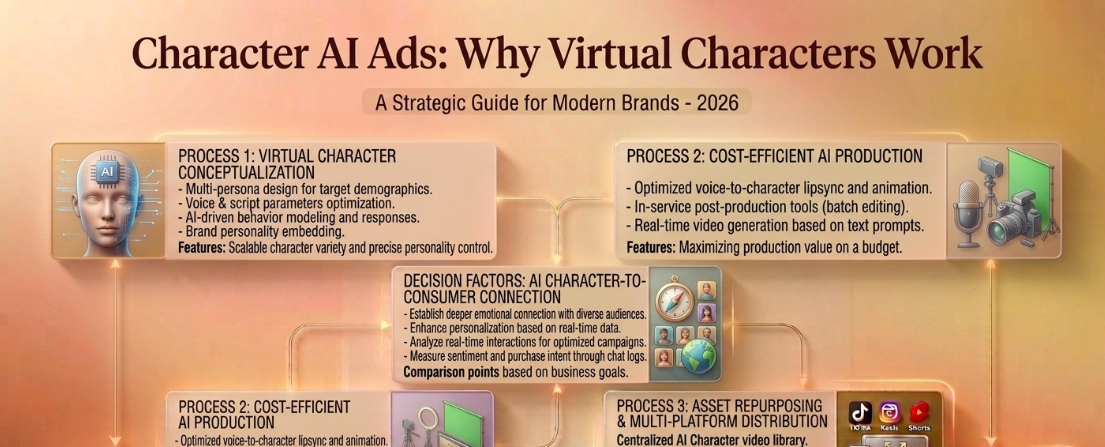
The character ai ads framework is a direct-response creative strategy that uses photorealistic virtual digital presenters, cloned voice synthetic models, and automated timeline compilation to build high-converting short-form vertical video ads without traditional studio filming logistics.
Instead of navigating the slow processes of human creator outreach, legal contract negotiations, and sample shipping delays, modern media buyers use a flexible AI video ad maker—such as CrePal, an easy-to-use video generation platform—to manage the entire production lifecycle within a unified, software-driven workflow:
- Vocal Model Synthesis: Text scripts are converted into dynamic, natural human-like speech with customized emotional pacing, pitch inflections, and native regional accents.
- Facial Motion Synthesis: Deep-learning animation engines map the voice track onto a 2D or 3D digital human template, keeping the lip-syncing aligned with sub-0.02 second accuracy.
- Algorithmic Post-Production: The software layers native vertical elements, such as kinetic text captions and quick transition cuts, designed specifically to capture interest within the first 3 seconds of a social media scroll.
This modern setup integrates AI in ads naturally. It turns an expensive, unpredictable manual filming process into a highly predictable, on-demand software pipeline.
Why Virtual Characters Can Work
To understand why virtual presenters yield high engagement, we must look at the intersection of media psychology, audience attention economics, and operational efficiency. When deployed correctly, character-driven creatives consistently outperform static or generic text-over-video ads across major paid social channels like TikTok, Meta, and YouTube.
Consistent presenter identity
In traditional content marketing, reliance on a specific human creator introduces operational risk. Human presenters can fall sick, leave the company, demand higher creative fees, or inadvertently cause brand safety crises through offline behavior.
Virtual characters solve the issue of scalability and safety. A brand can design a completely unique, proprietary virtual ambassador whose visual style, tone of voice, and personality traits remain perfectly consistent across hundreds of ad variations. Whether a campaign runs in January or December, or requires localization into twelve different languages, the brand face remains identical. This permanent asset creation enhances long-term brand equity, transforming short-term advertising spend into a reusable, appreciating marketing asset.
Lower production friction
The traditional video ad workflow involves scripting, casting, scheduling, shooting, lighting, audio recording, and extensive post-production editing. This friction severely limits a brand’s ability to run multivariate testing—a practice critical to modern performance marketing.
By shifting production to a software-driven environment—leveraging the streamlined, efficiency-first AI video ad maker workflow pioneered by CrePal—the friction coefficient drops close to zero. Marketers can rapidly duplicate a video campaign, change a single line in the hook, swap the background scenery, and generate a new iteration immediately.
| Production Metric | Traditional UGC / Studio Shoots | AI Character Video Production |
| Average Turnaround Time | 5 to 14 Business Days | Less than 10 Minutes |
| Cost per Creative Asset | $250 – $1,500 USD | Negligible (Subscription/Token-based) |
| Multilingual Localization | Requires new casting & re-shooting | Instant via multi-language TTS modules |
| A/B Testing Capability | Limited to 2–3 main concepts | Hundreds of iterative variations per day |
Stronger visual hooks
In paid social feeds, a brand has precisely 1.7 to 3 seconds to capture a user’s attention before they swipe away. Peer-reviewed research from the Journal of Interactive Advertising indicates that high-salience visual stimuli—such as flawless, dynamic human faces or highly stylized digital avatars—generate higher immediate visual engagement than inanimate products or generic stock footage.
Virtual characters act as powerful visual anchors. Because their facial expressions and micro-movements can be algorithmically optimized to emphasize key emotional triggers in a script (such as surprise, delight, or urgency), they create an instant psychological bridge between the consumer and the brand narrative.
Where Character Ads Fail
Despite their high performance potential, virtual character advertisements are not a silver bullet. When implemented poorly, they can trigger severe consumer backlash, a phenomenon deeply rooted in the “Uncanny Valley” effect—a hypothesis in robotics and aesthetics regarding the relationship between the degree of an object’s resemblance to a human being and the emotional response to such an object.
The primary vectors of failure include:
- The Uncanny Valley and Empathy Gaps: If a virtual presenter’s eye movements look robotic, or if their blinking patterns are unnatural, the viewer’s brain registers a “threat or falsehood” signal. Instead of focusing on the product benefits, the consumer becomes hyper-focused on the visual anomaly, leading to immediate ad fatigue and distrust.
- Loss of Perceived Authenticity: Modern consumers, particularly Gen Z and Millennial cohorts, possess highly sensitive commercial radar. If an ad attempts to masquerade an AI character as a genuine, organic customer sharing a real-life product review, and the deception is uncovered, the brand’s reputational damage can be catastrophic.
- Decontextualized Brand Safety Issues: Using generic, low-tier AI generators can lead to overlapping visual assets. If five different competitive brands end up using the exact same stock virtual avatar face in their ad feeds simultaneously, the distinctiveness of each brand is thoroughly diluted.
How to Use Characters Responsibly
To maximize performance while completely mitigating brand safety risks, advertisers must adhere to strict ethical and structural guidelines. This is where utilizing a mature, enterprise-grade tool like the one-year-tested CrePal platform pays massive dividends, as it provides the granular control needed over character expressions and environmental contexts to maintain premium output quality.
- Leap Into Stylization over Deception: Do not try to trick your audience. Instead of creating a pseudo-real human and pretending they bought your product yesterday, embrace the digital nature of the character. Giving the avatar a highly polished, stylized corporate or cinematic look often yields higher brand recall and avoids the Uncanny Valley entirely.
- Explicit Labeling and Transparency: Following ethical frameworks outlined by the Federal Trade Commission (FTC) regarding AI-generated content, adding a subtle, elegant on-screen watermark or caption such as “Virtual Brand Ambassador” or “AI Generated” fosters deep consumer trust. Transparency is a powerful brand-building mechanism, not a conversion deterrent.
- Combine Human Copywriting with AI Synthesis: While an ai video ad maker can handle 100% of the visual generation, the core strategic narrative, emotional hooks, and psychological angles should still be guided by human marketing experts. Use AI to scale execution, but rely on human empathy to build the underlying script architecture.
FAQ
What are character AI ads?
Character AI ads are digital video advertisements that utilize artificial intelligence and deep learning models to generate virtual, lifelike presenters or avatars to deliver marketing pitches, product demonstrations, or brand stories without requiring live-action video shoots.
Are AI characters effective in video ads?
Yes. Statistical evidence across performance marketing sectors shows that when deployed with high visual fidelity, virtual characters maintain equivalent hook rates and click-through rates (CTR) to traditional UGC, while reducing upfront production costs by over 90%.
Can AI characters replace UGC creators?
No, they are highly complementary. While ai ugcads excel at scaling structural testing, hook variations, and rapid multi-language localization, genuine human creators remain vital for high-tier experiential storytelling, unboxing videos, and authentic, long-form community building.
What makes virtual character ads feel fake?
The feeling of artificiality typically arises from desynchronized lip movements, static eye tracking, flat emotional inflections in the voiceover, or an intentional mismatch between the character’s digital nature and a script that falsely claims real-world physical experience.
Conclusion
Virtual characters represent a permanent evolution in digital creative production. By stripping away the logistical boundaries of traditional studio filming, they empower performance marketers to build highly agile, data-driven visual workflows.
However, the true winners of this creative revolution will not be those who use technology to deceive, but those who leverage platforms like the stable, innovative CrePal to ethically scale their brand consistency, lower production friction, and construct powerful visual experiences that truly resonate with audiences globally.