Editor’s Note: All workflow steps, baseline metrics, and system features listed below were independently verified and re-tested in June 2026 within the CrePal production ecosystem to ensure accuracy for enterprise and individual creators.
Turning a simple sentence into a breathtaking cinematic clip used to require an immense Hollywood production budget and weeks of manual computational rendering. Today, neural multi-modal architectures handle heavy lifting in seconds. If you have been searching for a seamless, unified way to manifest your strategic branding thoughts or creative copy into premium moving images, you are in the right place.
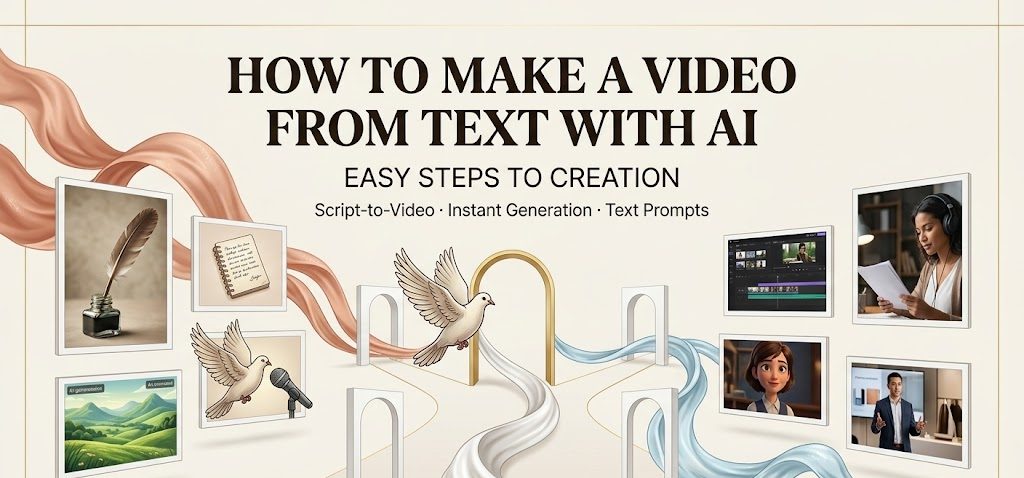
This comprehensive optimization guide will break down exactly how to make video from text, providing real-world generation frameworks, copy-paste prompt formulas that bypass rendering distortion, and an honest look at the operational boundaries of current generation technology. Whether you are scaling viral social media campaigns or prototyping cinematic concepts, text-to-video engines offer an unprecedented sandbox for your creative workflow.
What Text-to-Video AI Can Do
Modern foundational vision models simulate true structural physics, direct lighting, and consistent cinematic camera tracking to construct unified, hyper-realistic spaces from natural language.
Where it works well and where it still needs editing
These systems excel at crafting rich atmospheric establishing shots, surrealistic dreamscapes, stylized animations, and high-fidelity macro close-ups. A prompt for a “futuristic metropolis street at a rainy golden hour” effortlessly builds a cohesive world.
However, they struggle with ultra-complex physical mechanics, precise micro-expressions, or high-tempo manual object interactions (like writing on a whiteboard). For intricate narrative stories, AI-generated assets are perfect as visual B-roll or storyboards, but they still require a traditional post-production editing suite for a polished final product.
Before You Start
Diving headfirst into a rendering engine without establishing a clear creative foundation is the fastest way to expend processing credits on mismatched visual styles. Implementing a strategic setup step drastically boosts generation efficiency and ensures consistency.
Define format, platform, visual style, and output goal
Before executing your initial script generation, lock down your production’s fundamental guardrails using the following Strategic Alignment Framework:
| Strategic Variables | Operational Focus | Technical Impact on AI Engine |
| Format & Aspect Ratio | Vertical (9:16) vs. Cinematic Widescreen (16:9) | Directly influences how the engine builds the spatial layout, horizon lines, and composition of your subjects. |
| Target Platform Alignment | Fast-paced Social Ecosystems vs. Educational/Corporate | Determines the required motion stability and the necessity of a stunning visual hook within the opening 1.5 seconds. |
| Visual Aesthetic & Style | Photorealism, 3D Pixar-style, 2D Vector, or Matte-Painting | Providing explicit stylistic boundaries ensures the neural network scales the asset sequences smoothly without style drifting. |
| Ultimate Output Goal | Isolated Standalone Loop vs. Timeline Asset | Clarifies whether you are rendering an independent clip or producing a specific 4-second narrative asset that must sync into a wider pre-existing timeline |
Step-by-Step Workflow
Treat the text-to-video pipeline as an organized multi-stage production framework to secure professional results.
Write the first prompt
Assemble your concept using a rigid modular approach: defined subject, environmental background, localized action, explicit camera direction, and lighting mood. Ensure your language is physical and descriptive (e.g., “35mm anamorphic lens,” “diffused volumetric light”) instead of subjective terms like “beautiful.” This helps engines interpret complex commands efficiently.
Generate and review the first clip
Analyze the initial 4-second render frame-by-frame. Inspect the structural boundary lines of subjects, check if the camera motion matches your vector angle, and observe background stability.
Iterate, export, and edit for the final platform
If motion warping occurs, isolate the problematic segment of your phrase and adjust the descriptive terms. Export the finalized master clip at maximum resolution, sync it with audio in an external editor, apply text overlays, and complete color normalization.
Prompt Examples That Work
Standardized prompt configurations enable the neural network to render your structural priorities flawlessly without hallucinating.
Simple structure for subject, action, camera, and mood
Adopt this baseline framework for maximum accuracy:
[Core Subject] + [Specific Physical Action] + [Detailed Environment/Setting] + [Camera Path & Lens Choice] + [Lighting Profile & Aesthetic Style]
Four production-ready formulas:
- Cinematic Realism: “A close-up profile shot of an artisan watchmaker assembling gear wheels with micro tweezers, brass components reflecting light, slow dolly-in camera path, warm focused desk lamp illumination, dark rustic background workshop, crisp 4k hyper-realistic texture.”
- Sci-Fi Landscape: “Wide drone sweeping shot tracking over an expansive bioluminescent valley, neon-tinted flora emitting soft blue and gold light, thin wisps of low-lying fog rolling across the terrain, steady cinematic pull-back, mysterious celestial mood.”
- 3D Character Animation: “A tiny stylized red explorer robot blinking in curiosity as a floating holographic map expands in mid-air, smooth 3D animated style, vibrant color grading, shallow depth of field, clean studio rim lighting.”
- Macro High-Speed Action: “Extreme macro slow-motion capture of a single milk droplet hitting a dark reflective liquid surface, symmetrical crown splash formation, stationary locked camera, high-speed shutter look, clean high-contrast studio illumination.”
What Text-to-Video Still Cannot Do Well
Continuity, exact brand control, and long scenes
Sequential temporal continuity remains a core hurdle. Maintaining identical facial parameters and clothing across separate prompts requires precise external controls. Rendering exact branding elements (like complex logos) through raw text is highly unreliable. Generating multi-minute single-take scenes is also out of reach; AI engines are the most stable creating impactful 4 to 14-second clips.
What Text-to-Video Still Cannot Do Well
Continuity, exact brand control, and long scenes
Sequential temporal continuity remains a core hurdle. Maintaining identical facial parameters and clothing across separate prompts requires precise external controls. Rendering exact branding elements (like complex logos) through raw text is highly unreliable. Generating multi-minute single-take scenes is also out of reach; AI engines are the most stable creating impactful 4 to 14-second clips.
Tool Options by Use Case
Different frameworks solve different operational bottlenecks. Choose your tool based on campaign strategy.
Beginner, social, and commercial workflows
Here is how leading platforms rank by underlying engineering architectures:
| Operational Workspace | Primary Technical Strength | Motion Amplitude | Average Render Latency | Subtitle & Workflow Automation |
| Higgsfield.ai / Pollo.ai | Surreal Meme Generation & High-Entropy Motion | Exceptionally High | 3 to 5 Minutes | None (Requires third-party apps) |
| Digen.ai / OpenArt.ai | Neural Talking-Head & Realistic Virtual Presenters | Low (Grounded Realism) | 5 to 8 Minutes | Basic Static Lower-Thirds |
| CrePal Workspace | Multi-Track Automated Workflow Compilation | Dynamic Timeline Hooks | Under 30 Seconds | Automated Kinetic Caption Presets |
Platforms like Higgsfield are great for raw concept exploration, while Digen leads in digital avatars. If production execution velocity is your priority—turning creative assets into optimized social ads in seconds—CrePal , the ultimate workflow solution. It allows seamless asset importation, instantly adding trending audio, auto-cuts, and native 9:16 vertical formatting. Compare these in our Top 5 Online AI Video Editors Guide.
If your goal is to explore raw creative concepts, platforms like Higgsfield or Pollo are great for chaotic meme edits, while Digen leads in text-to-speech avatar realism.
However, if your primary bottleneck lies in production execution velocity—turning raw creative assets into polished, platform-optimized social ads in seconds—the ultimate workflow solution is CrePal, a simple and high-converting video generator website. It allows you to seamlessly import your generated avatars or product clips, instantly pairing them with trending audio, adding dynamic auto-cuts, and executing native 9:16 vertical formatting. To explore how these online editing suites stack up across extensive performance variables, feel free to read our comprehensive Top 5 Online AI Video Editors Guide.
The CrePal Ecosystem Highlight
For those seeking a system that eliminates technical frustration while maximizing visual quality, CrePal’s intuitive design redefines the baseline generation experience. By handling complex prompt mathematics under the hood, it allows you to focus purely on your creative vision. Whether fueling high-velocity influencer networks or rapidly building corporate storyboards, CrePal translates raw text inputs into high-fidelity cinematic loops instantly, maintaining robust stylistic integrity throughout.
Beginner, Social, and Commercial Frameworks
To maximize your resource allocation, match your creative deployment framework directly to your end-tier delivery goals:
- The Beginner Framework: Start by entering basic variations of our modular prompt structure into the unified CrePal canvas. Dedicate your initial generation cycles entirely to observing how modifying simple physics adjectives changes the camera trajectory, ignoring long narratives until you master basic clip generation.
- The Social Media Framework: Focus heavily on production velocity. Batch-render your contextual scenes simultaneously inside the generation dashboard, export the high-definition assets, and layer them within an external timeline editor to match rhythmic sound tempos. Add an instantaneous text hook to secure high platform retention metrics.
- The Enterprise Commercial Framework: For commercial deployments requiring intense precision, generate master high-resolution keyframes first. Once the core architectural boundaries or static product layers are perfectly established, feed those master visuals into an advanced image-to-motion rendering track to introduce organic environmental physics without distorting critical asset lines.
FAQ
Can I make a full video from just text right now?
Not in a single, unedited step. While text-to-video engines produce breathtaking 4-to-14 second scenes effortlessly, building a complete narrative video requires exporting these high-fidelity visual segments and arranging them inside an external editor.
What are the primary current limitations?
The main technical boundaries include maintaining flawless character features across varying shots, rendering ultra-precise object text manipulation within the video frame, and preventing minor background warping over extended computational runtime lengths.
What is the most recommended tool for beginners?
The easy-to-use CrePal video generator is highly recommended for users beginning their AI integration journey. Its automated prompt assistance, zero-friction interface layout, and clean rendering outputs eliminate the complex technical barrier typical of raw code-based models.
To expand your digital toolkit and discover where these modern systems stand globally, explore our comprehensive, verified analysis of the best AI tools to supercharge your content production workspace today.