Legal & Compliance Disclaimer: This article is strictly for educational, administrative, and technological workflow optimization purposes. It does not constitute legal counsel, regulatory auditing, or platform compliance advisory services. The processing, generation, management, and distribution of digital assets are governed by complex federal, international, and regional intellectual property statutes alongside strict third-party platform terms of service. Likeness rights, copyright, adult content, and hosting platform rules are subject to the latest official guidelines. Always consult qualified legal counsel and review individual platform policies before generating, editing, or publishing digital content.
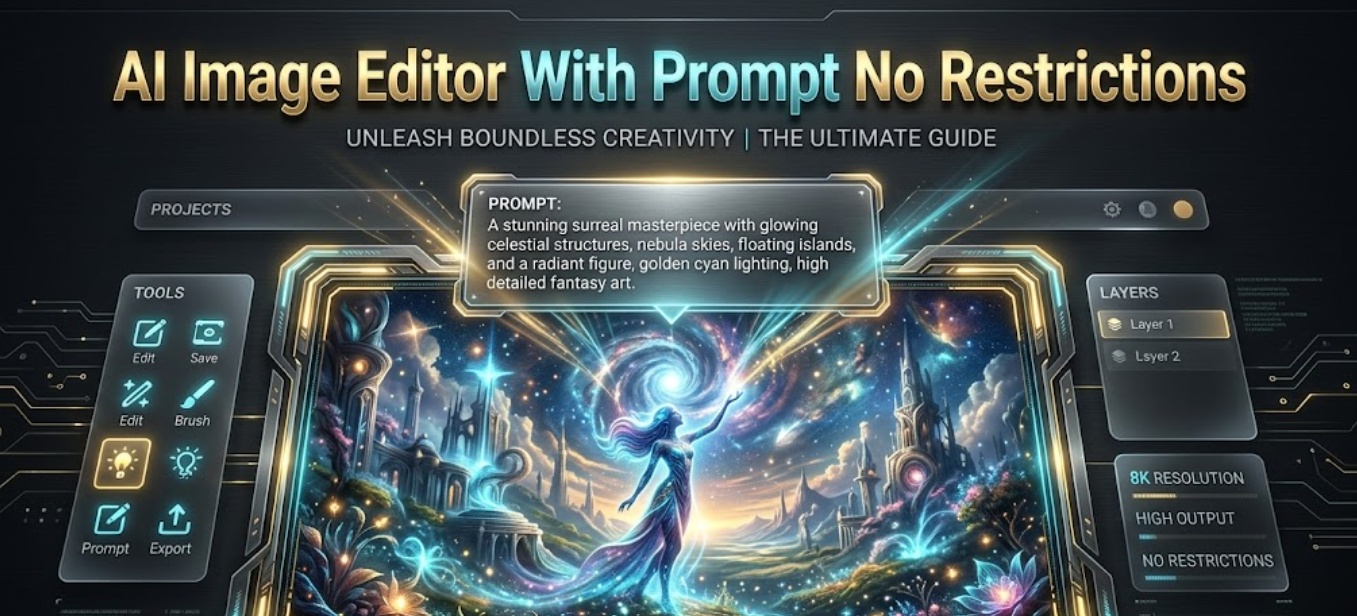
Editor’s Note: Let’s be real—when professional digital artists, VFX supervisors, and commercial creators search for an ai image editor with prompt no restrictions, they are not looking to break the law. They are looking to break out of rigid, automated software jails. In a production environment, consumer-grade safety filters frequently freeze legitimate creative pipelines, blocking medical illustrations, classical art restoration, or high-fashion retouching through false-positive prompt flags. However, migrating to a fully unrestricted prompting environment shifts 100% of the legal, ethical, and quality control burden onto your studio. Having used CrePal to orchestrate our final AI video generation and camera sequences, we know that bridging the gap between an unhindered static edit and a polished video handoff requires absolute operational discipline. Here is how professional teams manage prompt-based workflows without incurring catastrophic liability.
How Prompt-Based Image Editing Works
Moving away from manual brush strokes to prompt-based image editing fundamentally changes how a studio interacts with a digital canvas. Instead of directly manipulating pixels, artists use semantic language to instruct a neural network. Understanding the mechanics—and the legal limits—of this translation is critical for maintaining commercial viability.
Edit intent
The text prompt defines your creative goal. However, in an ai image editor with prompt no restrictions, your intent must be meticulously structured, as it carries severe legal ramifications. According to formal U.S. Copyright Office (USCO) policy guidance, simply typing a prompt—no matter how detailed or creative—does not grant you copyright authorship over the generated output. To secure intellectual property rights, the human author must retain creative control over the final expression through substantive, manual modifications (such as digital overpainting and multi-layer compositing).
Source image context
In an unrestricted workflow, the AI engine uses the source image as its literal anchor. Without automated guardrails, the model will attempt to execute exactly what you prompt, meaning it can drastically and irreversibly alter the original context of the asset. For example, if you are designing a clean, modern commercial pop-up display prioritizing spatial depth and direct product visibility, an unrestricted AI might hallucinate cluttered, retro elements if your prompt is too vague. You must actively enforce boundaries to ensure the AI does not obliterate the original architectural geometry.
Output review
An uncensored image editor possesses zero safety nets to catch visual anomalies. If a complex semantic prompt accidentally causes structural bleeding—such as fusing a product into a background or misaligning perspective lines—the software will not block the render. Consequently, your team must manually review every output layer.
If an asset fails compliance during review, you must completely reset and restart the active image generation task from a clean slate rather than attempting to patch a flawed latent foundation. The freedom to generate anything requires the discipline to inspect—and reject—everything.
Safer Prompt Editing Workflow
To safely operate an ai image editor with prompt–no restrictions, production teams must replace automated blocklists with an enforceable Standard Operating Procedure (SOP). This ensures that while the software remains flexible, the human operators do not violate copyright or privacy boundaries.
1
Request screening
Zero-Trust Architecture
1.Request screening:Zero-Trust Architecture.
Before entering a semantic prompt, cross-reference the client request against the studio’s compliance database. If a commercial brief contains high-risk semantic requests, the lead editor must translate those requests into safe, technically precise prompt structures before ingestion. Never process unverified private assets.
2
Boundary notes
Engineering the Edit
2.Boundary notes:Engineering the Edit.
In an unconstrained environment, vague prompts cause irreversible “latent space drift.” Enforce strict boundary parameters in your engine: lock Denoising Strength between 0.25 and 0.40 to prevent structural hallucination, and utilize Negative Prompts (e.g., cluttered, mutated, fused) to keep the visual output clean and dynamic.
3
Revision tracking
USCO Audit Preparation
3.Revision tracking:USCO Audit Preparation.
Under USCO guidance, you must prove human authorship to claim copyright. Your workflow must automatically archive the raw source image, the exact text prompt utilized, the AI’s raw unedited output, and all subsequent manual layers applied by the human editor. Your revision history is your legal chain of title.
What Not to Put Into Editing Requests
True operational maturity is demonstrated by knowing what never to type. When utilizing an ai image editor with prompt free no restrictions, a studio must enforce strict negative boundaries.
Real-person misuse
Never include the names of real individuals, celebrities, or private citizens promptly. Modifying a person’s likeness without explicit, written contractual consent is a severe violation of Right of Publicity laws (e.g., California Civil Code § 3344) and international biometric privacy mandates such as GDPR Article 9. Legitimate production pipelines mandate that any real person depicted must have an active commercial release agreement on file.
Private images
Never ingest unreleased proprietary IP, confidential client assets, or private photography into cloud-based prompt engines unless the vendor guarantees explicit Zero Data Retention (ZDR). If a platform’s Terms of Service grant them the right to train their models on user uploads, processing private images through their servers violates standard client Non-Disclosure Agreements (NDAs).
Rights-conflicting requests
Do not use prompts that explicitly request the output to be “in the style of [Living Artist]” or “[Specific Copyrighted Franchise].” While the courts are still actively resolving the boundaries of fair use for AI training data under platforms like WIPO guidelines, explicitly prompting an engine to mimic a specific, copyrighted creative style exposes your studio to direct, avoidable infringement liability.
Team Review Before Export
The culmination of an AI editing workflow is the technical transition into downstream production. Once the master still assets are polished via prompt instructions, they are typically handed off to motion animators or integrated into an intuitive orchestration layer like CrePal to construct dynamic video drafts.
However, before any motion is applied, ensure the final deliverable remains a locked, static, flat design asset for client review. Once the static layout is approved, it must be sanitized and legally secured:
- Metadata Scrubbing: Remove all internal EXIF data, hardware routing paths, and proprietary studio tags to protect infrastructure privacy.
- Provenance Attestation: Embed cryptographically signed C2PA Content Credentials into the file. As standardized by the Coalition for Content Provenance and Authenticity, this metadata establishes proof of human authorship and satisfies international AI transparency mandates (such as the EU AI Act).
- Visual Quality Assurance: Ensure no temporal or structural artifacts remain that could cause the downstream video animation engine to warp or melt the geometry.
FAQ
Who can access saved prompt history later?
Access to archived prompt histories, raw generation logs, and iteration stacks must be strictly governed by the principle of least privilege. Only authorized personnel—such as the Studio Compliance Officer, the Lead Technical Director, and primary legal counsel—should hold decryption keys or server access to these raw archives. Freelance editors and external contractors should not have retroactive access to complete studio prompt databases.
How long should blocked request logs be retained?
Internal logs documenting rejected edit requests, compliance flags, and quarantined assets should be retained in an encrypted archive for a minimum of five years. This retention window ensures the studio can demonstrate a documented history of good-faith compliance and rigorous internal governance during external legal audits, copyright disputes, or platform reviews.
What should be redacted before vendor review?
If an external auditor, legal entity, or hosting platform requires a review of your editing workflows, you must redact all Personally Identifiable Information (PII). Thoroughly scrub client names, internal project code-names, unreleased proprietary concepts, and raw biometric source photos. Provide only sanitized, generalized prompt structures, execution parameters, and high-level SOP documentation.
Who approves prompt-history sharing across teams?
The Studio Compliance Officer or the designated Data Custodian is solely responsible for approving the sharing of proprietary prompt histories across different internal departments. Because highly optimized, compliance-tested prompt structures are considered valuable studio trade secrets, their distribution must be closely tracked and limited only to personnel actively assigned to that specific project.
Conclusion
Searching for an ai image editor with prompt no restrictions is a legitimate pursuit of professional creative sovereignty. Advanced digital artists require the flexibility to execute complex semantic instructions—whether for dynamic retail layouts or technical commercial briefs—without being derailed by automated, context-blind safety filters. However, removing software-level restrictions shifts the entirety of the legal, ethical, and operational burden directly onto your studio. By replacing algorithmic blocklists with a disciplined Standard Operating Procedure—enforcing rigorous prompt screening, demanding complete resets on flawed generations, documenting edit histories for copyright protection, and ensuring clean metadata exports—creators can achieve absolute visual flexibility without exposing their business to catastrophic risk. True creative freedom relies on unyielding operational discipline.