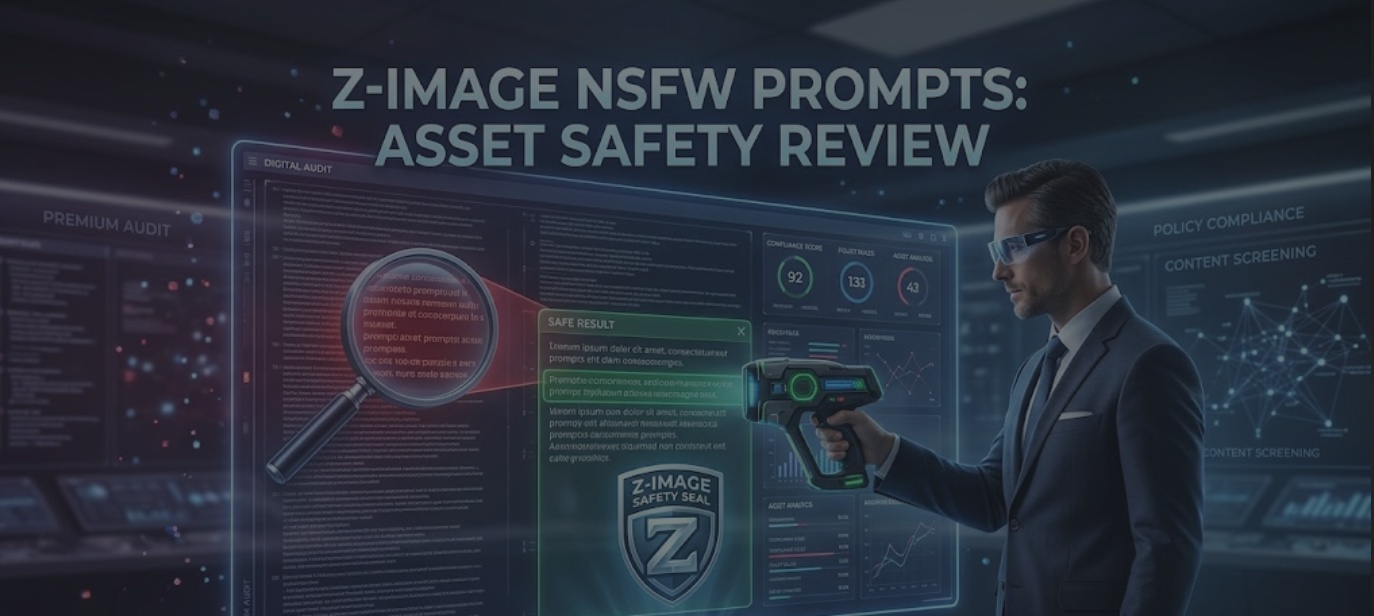
Compliance & Legal Disclaimer : This article explores workflow optimization and risk management for professional production studios. It does not constitute legal counsel or regulatory advice. Z-Image’s official Terms of Service strictly prohibit the generation of sexually explicit, pornographic, or non-consensual adult content. Generating, modifying, or distributing mature digital content using open-source iterations of the model is governed by federal intellectual property laws, the right of publicity, and platform compliance mandates. Always consult qualified legal counsel and review host policies before generating or publishing sensitive commercial content.
Editor’s Note: Z-Image has rapidly become a powerhouse in the AI generation space. Built on a 6-billion parameter Scalable Single-Stream DiT (S3-DiT) architecture and utilizing the Qwen-3-4B text encoder, it excels at producing photorealistic assets from complex, bilingual (Chinese and English) prompts in as few as 8 steps.Because open-source weights are available, professional art directors frequently search for z-image nsfw prompts not to produce illicit material, but to execute high-fashion swimwear campaigns, anatomical illustrations, or dark fantasy concepts without being blocked by consumer-grade API filters. However, generating an adult-style asset is only the first hurdle. Bridging the gap between an unhindered static edit and a compliant downstream video orchestration tool like CrePal requires extreme operational discipline. Here is how professional teams manage the boundary workflow when evaluating whether an adult picture prompt asset can safely enter the video pipeline.
Why Z-Image NSFW Prompt Searches Need Review
When a studio leverages local ComfyUI installations or unrestricted third-party APIs to bypass Z-Image’s official safety filters, they assume 100% of the legal and technical liability. Before a prompt is even typed, the production team must evaluate the underlying intent and the downstream lifecycle of the asset.
Adult image generation intent
In commercial pipelines, “NSFW” typically translates to provocative, adult-style creative intent. Z-Image’s architecture processes prompts as cohesive natural language sentences rather than disconnected tag lists. This means the model acts as an incredibly obedient camera crew. If an art director uses vague NSFW image prompts, the model will improvise based on its latent training data, often resulting in exaggerated anatomy or policy-violating imagery that is completely unusable for brand-safe campaigns.
Visual asset reuse
An image generated for a specific moodboard or internal reference may accidentally be repurposed for a public-facing ad campaign. If the original prompt contained unsanctioned likenesses or copyrighted phrasing to achieve a specific “sexy” aesthetic, reusing that asset exposes the studio to immediate infringement liability.
Downstream video risks
A prompt that generates a stunning, compliant static frame can become a massive liability when animated. Video generation relies on temporal interpolation. Because Z-Image natively lacks classifier-free guidance at inference (meaning it has no built-in negative prompt function), controlling structural consistency is notoriously difficult. If an adult-style asset lacks rigid geometric boundaries, the character’s clothing or anatomy may shift inappropriately during video motion, resulting in an explicit hallucination that violates hosting platform rules.
Asset Safety Checks Before Prompt Testing
To protect the studio’s intellectual property, every prompt risk checklist must enforce rigid administrative boundaries before the Z-Image generation engine is initiated.
Fictional-only framing
Studios must verify that the prompt requests a fully synthetic, fictional entity. Incorporating phrases like “in the style of [Living Artist]” or referencing specific copyrighted franchises to achieve a mature aesthetic exposes the studio to direct litigation. Under United States Copyright Office (USCO) guidance, the prompt must not rely on third-party intellectual property to generate the core aesthetic of the work; furthermore, the AI generation itself lacks copyright protection without substantial human intervention.
No real-person likeness
The absolute red line in any adult image prompt safety review is the unauthorized simulation of real humans. Prompts must never include the names of private citizens, public figures, or celebrities. Generating a real person’s likeness in a provocative context without contractual consent violates federal and state Right of Publicity laws (such as California’s AB 2602 and AB 1836, which regulate digital replicas of living and deceased individuals).
No private source material
If the prompt utilizes an Image-to-Image (I2I) workflow—where a real photograph is fed into the engine alongside the Z-Image prompts—the studio must maintain strict consent records. The project manager must attach an unexpired commercial talent release explicitly granting AI manipulation rights to the specific source file. Without this release, the workflow must be halted.
From Image Prompt to Video-Ready Asset
The physical handoff from a static visual asset into a dynamic video timeline is the most fragile phase of production. To execute this conversion successfully, teams must standardize their scene construction methodology.
Visual consistency notes
Because Z-Image is a distilled model, negative prompts do not work natively.() To achieve the visual consistency required for video handoff, technical directors must implement custom community nodes (such as the comfyui-negpip-zimage node) within their ComfyUI workflow.() This node patches the text encoder, allowing editors to inject negative weights (e.g., blurry, mutated anatomy: -1.0) directly into the positive conditioning stream. Documenting these precise parameter adjustments is essential for downstream animators to maintain the character’s structural integrity.
Motion suitability
Before dropping a high-fidelity Z-Image render into an animation suite, the technical director must evaluate if temporal motion actually serves the project. If the objective is to design a clean, dynamic, modern commercial display prioritizing spatial depth and direct product visibility, an animated video file is often the wrong choice. Retaining the output as a static, flat design asset preserves the high-impact visual clarity of the Z-Image render without introducing the risk of temporal artifacts, anatomy melting, or frame flickering.
Export and archive rules
Before any asset leaves the studio server, it must undergo a pre-flight compliance check. Under Article 50 of the European Union AI Act, commercial deployers of synthetic media must apply machine-readable transparency labeling. Professional studios satisfy this by embedding cryptographically signed C2PA Content Credentials into their final exports, documenting the asset’s history and explicitly declaring its AI-generated nature.
Limits, Rights, and Policy Risks
Generating an adult-style asset is only the first step; publishing it legally and safely requires navigating strict platform limits.
First, Z-Image’s official Acceptable Use Policy expressly forbids utilizing the tool to generate sexually explicit, pornographic, or nude content.While local, open-source installations bypass the web-hosted API filters, deploying the resulting images on commercial ad networks (like Meta or Google) subjects the assets to rigorous multimodal algorithmic scanning. If a video asset triggers an explicit flag, the merchant account can be permanently suspended.
Second, consider your intellectual property. As established by the USCO, typing a prompt does not make you a copyright holder.To legally own the provocative assets you generate, your workflow must include substantial human authorship. This requires archiving your exact prompt history, manual digital overpainting layers, and specific video physics parameters to prove human control over the final output.
FAQ
Who labels Z-Image outputs before handoff?
The Lead Visual Editor is responsible for labeling all generated outputs before they are handed off to the video animation team. This includes tagging the asset with its exact prompt history, the ComfyUI node configuration used (such as NegPiP parameters), and verifying that the C2PA provenance manifest has been successfully embedded into the metadata.
What should be removed from shared prompt notes?
When sharing prompt histories with external contractors, downstream video orchestration teams, or software vendors, all Personally Identifiable Information (PII) must be strictly redacted. Scrub client names, internal project code-names, unreleased proprietary concepts, and raw biometric source photos. Provide only the sanitized semantic structures and parameter data.
When should an image asset stay out of video workflows?
An image asset should be permanently excluded from video workflows if it features highly complex, overlapping anatomy that the base Z-Image model struggled to render consistently, or if the source image relies heavily on unverified third-party likenesses. Attempting to animate a structurally unstable asset will amplify the flaws, resulting in policy-violating body horror or temporal hallucination.
How should disputed adult visuals be archived?
Visual assets that fail internal quality control, violate likeness boundaries, or suffer rejection from external hosting platforms must be moved to an isolated, encrypted quarantine archive. They should be renamed using a standardized convention (e.g., REJECTED_20260728_LikenessDrift.png) and retained for a minimum of five years to demonstrate a documented history of good-faith risk management during potential legal disputes.
Conclusion
Searching for z-image nsfw prompts highlights a legitimate need for precise, unhindered creative control over mature, commercial visual concepts. Z-Image’s powerful 6B parameter architecture delivers incredible photorealism, but its lack of native safety constraints and negative prompting demands industrial-grade operational discipline. By enforcing a strict prompt safety checklist—screening for likeness violations, applying third-party negative conditioning nodes, consciously choosing flat static designs over forced video animations when appropriate, and embedding verifiable C2PA metadata—studios can produce breathtaking, provocative campaigns safely. In the landscape of unconstrained AI generation, operational control is the ultimate safety filter.