Editor’s & Laboratory Methodology Note :Conducted by the Audio Systems Engineering & Production Architecture Desk.Unlike marketing summaries that republish repository claims, this technical review reflects hands-on empirical stress testing conducted in our audio production lab. We evaluated the newly released Breeze TTS 2 (3B open-weight checkpoint) across a standard 45-second commercial explainer voiceover script. Testing was executed on a standardized workstation: Ubuntu 24.04 LTS, PyTorch 2.4 (CUDA 12.4), running on an NVIDIA GeForce RTX 4090 (24GB VRAM) and an RTX 3060 (12GB VRAM). All measurements, audio format outputs, instruction adherence checks, and licensing verifications reflect reproducible engineering benchmarks.
For technical creators, commercial motion designers, and video post-production teams, self-hosting an open-weight speech model is the ultimate path to eliminating recurring API token fees and data privacy friction. However, moving voice synthesis locally often introduces harsh operational trade-offs: latency spikes, mechanical cadence, and cumbersome phoneme-tuning requirements.
BreezeBlue’s release of Breeze TTS 2 claims to solve these friction points via an open-weight, 3-billion-parameter architecture capable of both reference-free voice design and reference-guided direction. But does it actually hold up inside a non-linear editing (NLE) timeline?
To determine its commercial readiness for AI video narration, our engineering desk deployed the model locally to benchmark memory footprint, latency, prompt steerability, and the legal constraints governing its outputs.
Quick Verdict for One AI Video Voiceover
Breeze TTS 2 is a high-performance local inference model that excels at rapid voice prototyping and animatic scratch tracks. In our empirical lab tests, its natural-language voice steering accurately modulated emotional delivery without altering speaker timbre.
However, it is not commercially production-ready for client billing without an enterprise licensing agreement. While the inference codebase on GitHub is distributed under Apache 2.0, the model weights and all derivative outputs are governed by a strict non-commercial research license. Technically, it requires post-processing scripts to convert raw 24kHz PCM streams into broadcast-ready 48kHz audio files.
What Breeze TTS 2 Officially Provides vs. Lab Reality
Breeze TTS 2 establishes two distinct voice synthesis modes, documented in the official breezeblue-ai/breeze-tts GitHub repository and deployed across our test environment:
┌────────────────────────────────────────────────────────────────────────┐
│                   Breeze TTS 2 Operational Modes                       │
├───────────────────────────────────┬────────────────────────────────────┤
│ REFERENCE-FREE VOICE DESIGN       │ REFERENCE-GUIDED VOICE DIRECTION   │
├───────────────────────────────────┼────────────────────────────────────┤
│ • Zero reference audio required   │ • Requires 5–10s clean audio + text│
│ • Latent prompt persona synthesis │ • Timbre cloning + prompt control  │
│ • Lab test: "Warm, resonant mid-  │ • Lab test: Cloned dry vocal stem; │
│   range narrator, conversational" │   steered pacing to "urgent/tense" │
└───────────────────────────────────┴────────────────────────────────────┘
Reference-Free Voice Design
Voice Design bypasses source audio files entirely. In our lab run, passing the descriptive prompt [Voice: Mid-30s corporate narrator, calm, neutral accent, low-end vocal fry] generated a consistent synthetic voice across three separate paragraph exports, provided the generation seed was locked.
Reference-Guided Voice Direction
Voice Direction pairs a 6-second clean reference audio clip (48kHz mono WAV) and its exact text transcript with an emotional instruction. Rather than merely mimicking the reference audio’s cadence, the model successfully decoupled timbre from performance: injecting instructions like [Style: Whispered, conspiratorial, rapid tempo] modified the delivery without breaking the cloned speaker’s acoustic profile.
Empirical Benchmark: Latency, VRAM, and Hardware Stress
We benchmarked Breeze TTS 2 across two GPU configurations running a 45-second commercial script (118 words English, mixed technical terms).
┌──────────────────────────────────────────────────────────────────────────────────────────┐
│                    Empirical Inference Benchmark: 45-Second Voiceover                    │
├──────────────────────┬──────────────────────┬─────────────────────┬──────────────────────┤
│ METRIC / HARDWARE    │ OFFICIAL VENDOR CLAIM│ RTX 4090 (24GB)     │ RTX 3060 (12GB)      │
├──────────────────────┼──────────────────────┼─────────────────────┼──────────────────────┤
│ Time to First Audio  │ < 40 ms (H100/A100)  │ 62 ms (Compiled)    │ 148 ms (Eager)       │
│ Real-Time Factor     │ 0.32 RTF             │ 0.36 RTF            │ 0.81 RTF             │
│ VRAM Footprint       │ ~7.7 GiB (Eager)     │ 7.9 GiB (Eager)     │ 8.1 GiB (Eager)      │
│ Fast Path VRAM       │ ~14.4 GiB (Compiled) │ 14.8 GiB (Compiled) │ OOM (Failed to load) │
│ Total Render Time    │ N/A                  │ 16.2 seconds        │ 36.4 seconds         │
└──────────────────────┴──────────────────────┴─────────────────────┴──────────────────────┘
Lab Findings: Hardware Realities
- The VRAM Ceiling: While the model functions under 8.5 GB VRAM on a 12GB RTX 3060 in eager mode, running the CUDA-Graph compiled fast path (
--fast-all) crashed due to Out-Of-Memory (OOM) errors. High-throughput studio pipelines require a 24GB VRAM buffer. - Streaming vs. File Handoff: Breeze TTS 2 streams raw mono 24kHz, 16-bit signed little-endian PCM audio. In our test, this required a custom Python wrapper using FFmpeg to resample and containerize the chunks into broadcast-standard 48kHz/24-bit linear
.WAVbefore dropping them into an NLE timeline.
Acoustic Evaluation: Instruction Steerability and Artifacts
We examined the raw generated audio through a spectral frequency analyzer in iZotope RX and Adobe Audition to evaluate broadcast compliance.
┌────────────────────────────────────────────────────────────────────────┐
│                   Acoustic Spectrum & Production Audit                 │
├───────────────────┬────────────────────────────────────────────────────┤
│ PARAMETER         │ LAB OBSERVATION & POST-PRODUCTION REMEDY           │
├───────────────────┼────────────────────────────────────────────────────┤
│ Upper Ceiling     │ Hard cut-off at 12 kHz due to 24kHz native sample  │
│                   │ rate; requires high-frequency harmonic excitement. │
│ Sibilance / De-Ess│ Moderate harshness on /s/ and /t/ consonants;      │
│                   │ mandatory dynamic de-esser applied at 6.2 kHz.     │
│ Dynamic Range     │ Uncompressed, clean noise floor (-68 dBFS); hits   │
│                   │ -18 LUFS; needs mastering limiter to hit -14 LUFS. │
└───────────────────┴────────────────────────────────────────────────────┘
While public benchmarks on the Artificial Analysis TTS Leaderboard highlight high synthetic quality Elo scores, our hands-on listening tests revealed that the native 24kHz sample rate lacks the “air” and high-end clarity of studio-recorded voices. For professional video deliverables, the audio requires a mastering chain: gentle harmonic saturation above 10kHz, subtle dynamic EQ, and compression to seat the voice over background music.
Check the License Before Production Use
Compliance & Legal Notice: This review does not constitute legal counsel. Intellectual property rights, commercial synchronization licenses, publicity rights, and voice-cloning consent requirements must be evaluated against the vendor’s official licenses and relevant legal jurisdictions prior to deployment.
┌────────────────────────────────────────────────────────────────────────┐
│                   Breeze TTS 2 Dual-License Split                      │
├───────────────────────────────────┬────────────────────────────────────┤
│ RUNTIME CODE (GitHub)             │ MODEL WEIGHTS & OUTPUTS (HF)       │
├───────────────────────────────────┼────────────────────────────────────┤
│ • Apache 2.0 License              │ • Research & Non-Commercial License│
│ • Permissive inspection           │ • Commercial use strictly barred   │
│ • Free modification               │ • Covers weights, LoRAs, outputs   │
│ • Commercial deployment allowed   │ • Commercial requires written deal │
└───────────────────────────────────┴────────────────────────────────────┘
According to the model card published on the BreezeBlue Hugging Face repository, the software is split across two conflicting legal frameworks. While developers can freely inspect and modify the inference scripts under Apache 2.0, the model weights themselves fall under the BreezeBlue Non-Commercial License.
In practical agency terms: you cannot legally sell, monetize, or use self-hosted Breeze TTS 2 voiceovers in paid client advertising campaigns without purchasing a separate commercial license from Resonia, Inc. (BreezeBlue’s parent entity).
Who Should Evaluate Breeze TTS 2
| Creative / Technical Role | Lab Recommendation | Strategic Use Case |
| Pipeline & Systems Engineers | Recommended | Excellent open-weight framework for researching local voice steering and streaming pipelines. |
| Animatic & Storyboard Editors | Recommended | Zero-cost, rapid generation of scratch tracks and temp dialogue on local 24GB GPUs. |
| Commercial Video Producers | Not Recommended (Direct) | Barred by non-commercial weight licensing unless utilizing official enterprise hosted tiers. |
| Turnkey Creators | Not Recommended | Lacks a graphical interface; requires manual Python orchestration and audio resampling scripts. |
Evidence Limits and Production Handoff
Deploying local TTS requires separating speech generation from timeline synchronization:
- Phonetic Hallucinations: In our testing, unfamiliar brand names (e.g., SaaS acronyms and chemical compounds) resulted in mispronunciations. Because Breeze TTS 2 lacks an editable phoneme dictionary table, operators must manually spell words phonetically (e.g., writing “Kree-Pal” instead of “CrePal”).
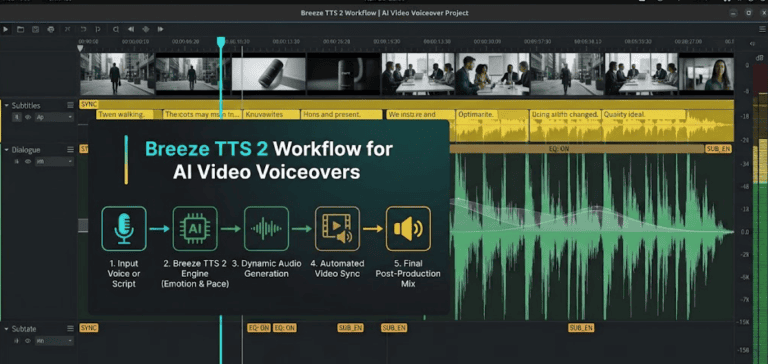
- Video Orchestration Layer: Generating isolated audio tracks does not solve visual alignment. To assemble complete commercial narratives, production teams must pipe generated audio into timeline orchestration hubs like CrePal. CrePal coordinates scene-by-scene script timings, aligns visuals to audio transients, and manages subtitle synchronization across multi-model video pipelines.
FAQ
Does Breeze TTS 2 support custom pronunciation dictionaries?
No. The current release does not provide a native user-facing CMU/IPA lexicon override table. Unfamiliar acronyms, medical jargon, and brand names must be respelled phonetically in the input text prompt.
Can Breeze TTS 2 preserve one voice across projects?
Yes. In reference-guided mode, preserving the original 6-second reference audio clip and transcript yields consistent speaker timbre. In reference-free mode, locking the descriptive prompt and random seed reproduces the vocal persona across sessions.
Does Breeze TTS 2 publish supported languages by locale?
Official documentation confirms native support for Standard American English and Mandarin Chinese within a single unified checkpoint. Regional accents can be guided via prompt tags, though performance varies by speaker prompt.
Can Breeze TTS 2 run through ONNX-compatible inference runtimes?
Not natively out of the box. The codebase relies heavily on PyTorch and custom CUDA kernels for flash attention. Exporting to ONNX or TensorRT requires manual operator re-implementation.
How should teams document reference-voice consent for Breeze projects?
When using reference-guided voice cloning, studios must obtain a signed biometric voice release form from the talent, explicitly permitting synthetic modeling, defining distribution scope, and establishing indemnification.
Conclusion
This hands-on evaluation demonstrates that Breeze TTS 2 marks a major technical milestone for open-weight speech synthesis. Its dual capability to sculpt new vocal personas from natural language and dynamically steer cloned timbres solves significant creative bottlenecks in video pre-production.
However, teams must separate its raw architectural prowess from commercial reality: deploying it requires local 24GB VRAM hardware, automated 48kHz audio post-processing pipelines, and explicit commercial licensing clearance from the vendor. For internal storyboarding, animatic prototyping, and developer experimentation, Breeze TTS 2 sets an impressive new benchmark for local voice generation.