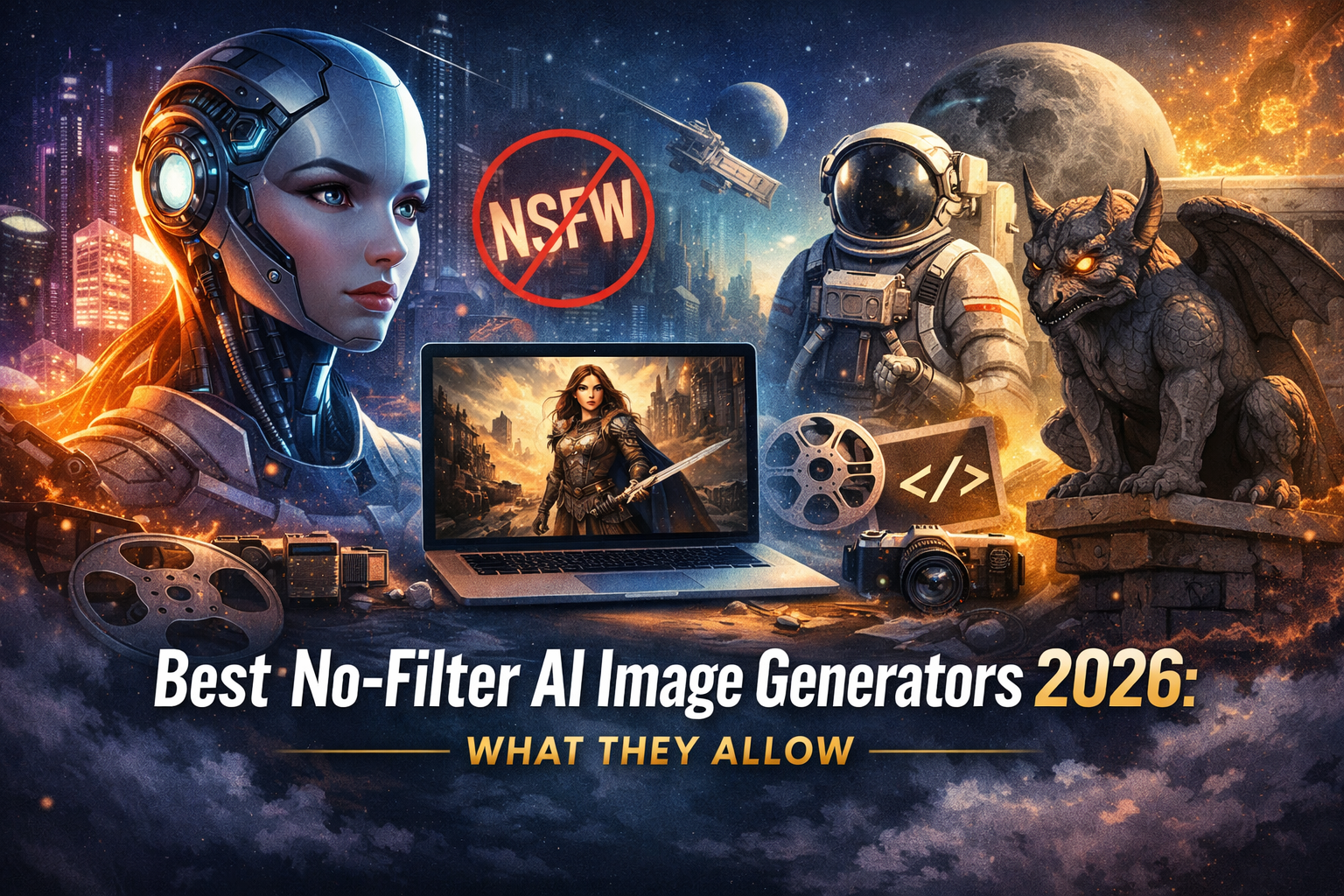
Meta Description: No-filter AI image generators in 2026 compared by real access, free tiers, and output quality. See what each tool actually allows before you choose.
Looking for an ai image generator no filter usually means you are tired of hitting vague moderation walls, unclear export rules, and prompts that fail before you even start. The frustration is real because the difference between a useful image tool and a dead-end one often has less to do with pure model quality and more to do with how much the platform filters, logs, or blocks. CrePal is one of the strongest places to start because it combines broader open-model access with a workflow that can move from image creation into larger creative production instead of trapping you in a single prompt box. In this guide, you will see what “no filter” really means, why platforms enforce different limits, which tools are actually usable in 2026, and where the legal hard stops still apply.
CrePal is not just another single-model image site. It is an AI Director Agent platform that brings multiple image and video models into one place, while still giving users a free plan and a broader creative workflow than most standalone generators. Unlike simple image tools that stop at one render, CrePal is built more like an orchestrator: generate, refine, extend, and move into story or video production from the same ecosystem. The practical upside is speed and flexibility, especially for creators who do not want to rebuild their workflow later.
If you want a wider starting point, you can explore CrePal’s no-restrictions image coverage or compare CrePal pricing and credits before choosing a workflow. For a more policy-first view, it also helps to review Stability AI’s acceptable use policy and the FTC guidance on intimate-image abuse.
What “No Filter” Means vs “No Restrictions” vs “Uncensored”
Terminology map — same user intent, different words
Most users treat no filter, no restrictions, and uncensored as the same search intent. They are usually not asking for three different technical categories. They are asking one question: Will this tool let me generate the image I want without aggressive cloud moderation getting in the way?
That said, the wording still matters.
“No filter” usually means the user expects fewer prompt refusals and less visible moderation friction.
“No restrictions” usually suggests broader prompt acceptance plus fewer export or watermark constraints.
“Uncensored” is the strongest term, and it usually signals that the user expects mature-content access or open-model behavior.
In practice, cloud platforms often use these phrases loosely in marketing, while their actual rules live in policy pages, credit rules, model licenses, or community moderation systems. That is why a search result can sound permissive while still blocking certain content classes or hiding commercial-use details later. CrePal’s own positioning is useful here because it sits closer to the “broader access plus workflow flexibility” end of the spectrum rather than the “single uncensored model” end.
How Content Filtering Works in AI Image Tools
Why most cloud tools filter
Most hosted image tools filter for a simple reason: liability. If a company runs the model, stores the prompts, processes uploads, and handles payments, it also inherits legal and trust-and-safety risk. Stability AI says it enforces policy through prompt filters, NSFW classifiers, uploaded-image checks, and human review for flagged content. OpenAI’s current usage policies also explicitly prohibit sexualizing minors, deceptive likeness abuse, and other harmful use cases.
That is why even strong mainstream image models can feel inconsistent to users. A platform may allow a general artistic request one day, then reject a nearby prompt later because the moderation layer is tuned around risk rather than around user intent. For commercial platforms, “filtering” is not just a moral choice. It is a product, compliance, payments, and brand-survival choice.
How local/open-source models avoid this
Local and open-source workflows work differently. When you run a model on your own machine through tools like ComfyUI or another self-hosted stack, there is usually no cloud moderation gate blocking the prompt at generation time. The model weights may still come with licenses and usage restrictions, but the runtime experience is far less controlled because there is no central platform reviewing each input. Stability’s policy even notes that its acceptable use rules apply across self-hosted use under its licenses, but enforcement is naturally different from hosted products with direct moderation systems.
That is the real split in this space: cloud tools optimize safety and operational control; local/open tools optimize flexibility and user control. Users searching for an unfiltered ai image generator are usually reacting against the first category and moving toward the second.
Best No-Filter AI Image Generators Tested
Option 1: CrePal
CrePal is the most practical featured pick for users who want broader image freedom without locking themselves into a dead-end interface. It is best understood as an AI Director Agent ecosystem rather than as a single uncensored image-only app. On the official site, CrePal highlights unified access across planning, imaging, and video generation, and its free plan includes 200 credits per month. Its recent image-focused content also shows that the platform now covers a wide range of open-source and stylized image workflows.
What makes CrePal stand out is not that it claims “no rules.” It is that it gives creators more room than typical closed image apps while remaining easier to use than a raw model directory. That matters if your workflow starts as ai art no filter exploration but later expands into edits, variations, storytelling, or video. For creators, marketers, and mixed-media users, that broader path is more valuable than a one-off uncensored render button. You can also see how CrePal connects stills to larger projects in its image-to-video and creation ecosystem.
Option 2: Mage
Mage is the clearest “yes, this platform openly markets creative freedom” option on this list. Its homepage describes the service as a free AI image and video generator, says NSFW content is allowed within clear boundaries, and states that created content can be used commercially. It also lists a free plan, then paid tiers starting at $10 per month for users who want unlimited generations, faster speed, and more advanced models.
For users who want a no filter ai image tool without local setup, Mage is one of the most straightforward choices. The tradeoff is that its freedom is still framed by platform terms, so “uncensored” does not mean lawless. It means permissive inside a clearly hosted system.
Option 3: Local open-source stack
If your priority is maximum control, local open-source still wins. Running models locally avoids the typical cloud prompt filter experience and gives you direct control over checkpoints, LoRAs, negative prompts, resolution, and workflow logic. This is the route that best matches users searching ai image without filter or ai image generator unfiltered in the strongest possible sense.
The downside is obvious: setup, hardware, updates, and workflow complexity. Local generation is not a better choice for everyone. It is a better choice for users who value control more than convenience. And even here, model licenses and local law still matter. “Local” removes a platform gate; it does not erase legal responsibility.
Option 4: BasedLabs
BasedLabs is useful when speed and low-friction testing matter more than perfect policy clarity. Its homepage advertises free AI image and video creation with no signup required to start, which makes it appealing for quick experiments. That kind of access is rare enough to be genuinely useful when you just want to test whether a style or concept works.
Still, BasedLabs is better treated as an experimentation platform than as the cleanest commercial choice. The product surface is broad, but rights and limits can vary by tool or model. It is easy to try, which is exactly why many users start there.
Comparison Table (Filter Level / Access / Free Tier / Output Quality)
| Tool | Filter Level | Access | Free Tier | Output Quality |
| CrePal | Relaxed compared with mainstream cloud tools | Browser-based platform with broader workflow ecosystem | Yes, 200 free credits/month | Strong overall, especially for users who want image work to extend into video or story workflows |
| Mage | Explicitly permissive within boundaries | Browser-based | Yes, free plan with daily use; paid from $10/month | Strong still-image quality with easy access |
| Local/Open-Source | Lowest platform filtering | Self-hosted / local | No hosted free tier, but no per-generation platform fee once set up | Potentially highest control and best customization |
| BasedLabs | Relaxed / experimentation-friendly | Browser-based, low-friction access | Yes, free access and no-signup entry points | Good for fast drafts and concept testing |
The real pattern is simple. If you want the best balance of usability and long-term workflow value, CrePal is the strongest first recommendation. If you want a more direct “uncensored platform” feel, Mage is easier to classify. If you want absolute control, local open-source is still the power-user answer.
Safety and Platform Risk
The biggest mistake in this category is confusing platform freedom with legal safety. They are not the same. Even if a platform accepts a prompt, you still carry risk around consent, likeness rights, copyright, commercial licensing, and downstream distribution rules.
This matters especially for real-person imagery. OpenAI’s policies explicitly restrict harmful likeness misuse, and regulators are paying more attention to deceptive or abusive synthetic media. The FTC has published consumer guidance on intimate-image abuse, which is a reminder that the enforcement story does not end at the model layer.
There is also a distribution risk many users miss. A payment processor, ad network, app store, client, marketplace, or print vendor may reject content that the generation platform itself allowed. So when people search ai art no filter, the smarter question is not only “Will this render?” It is also “Can I safely publish, monetize, or distribute it later?”
Absolute Hard Limits
This is the part no serious tool gets to bypass.
No legitimate platform allows CSAM or any content involving minors.
No legitimate platform allows non-consensual intimate imagery.
No legitimate platform can override criminal law, privacy law, or victim-rights frameworks.
No legitimate platform removes your responsibility for likeness abuse, fraud, or harmful impersonation.
Stability’s policies, OpenAI’s usage rules, and FTC guidance all point in the same direction here: some lines are product choices, but some lines are legal lines. That distinction matters more than branding language like “uncensored” ever will.
Conclusion
The best ai image generator no filter choice depends on what you actually mean by “no filter.” If you want the easiest browser-based experience with broader creative room and a workflow that can grow beyond static images, CrePal is the strongest overall recommendation. If you want a more direct permissive platform for still-image work, Mage is the clearest alternative. If you want maximum control and can handle setup, local open-source remains the least filtered path.
CrePal stands out because it does not treat image generation as an isolated endpoint. It treats it as the start of a larger creation workflow, which is exactly why it feels more future-proof than many niche unrestricted tools. For creators who want flexibility without rebuilding their stack later, that is the better long-term pick. You can start with CrePal for free, test whether the image workflow fits your needs, and then expand only if your projects demand more.
FAQ
Q: What does “ai image generator no filter” usually mean?
A: In most searches, it means the user wants fewer prompt refusals, fewer moderation interruptions, and clearer access to models that are not heavily restricted by cloud safety layers.
Q: What is CrePal.ai?
A: CrePal.ai is an AI Director Agent platform that unifies multiple creation models in one workflow. While it is best known for video creation, it also supports broader imaging workflows and is especially useful for creators who want images to connect to larger story or video projects.
Q: Is “unfiltered” the same as legal to use anywhere?
A: No. Platform permissiveness does not remove your responsibility around consent, likeness rights, commercial use, and distribution rules. That is true even when a generation succeeds.
Q: Are local open-source models less filtered than cloud tools?
A: Usually yes. Local setups avoid most cloud moderation gates, which gives users more direct control. But licenses, policies, and law still apply.
Q: Which no-filter tool is best for most people in 2026?
A: For most users, CrePal is the best starting point because it balances access, ease of use, and workflow flexibility. Mage is a strong second choice for people who want a more explicitly permissive still-image platform.