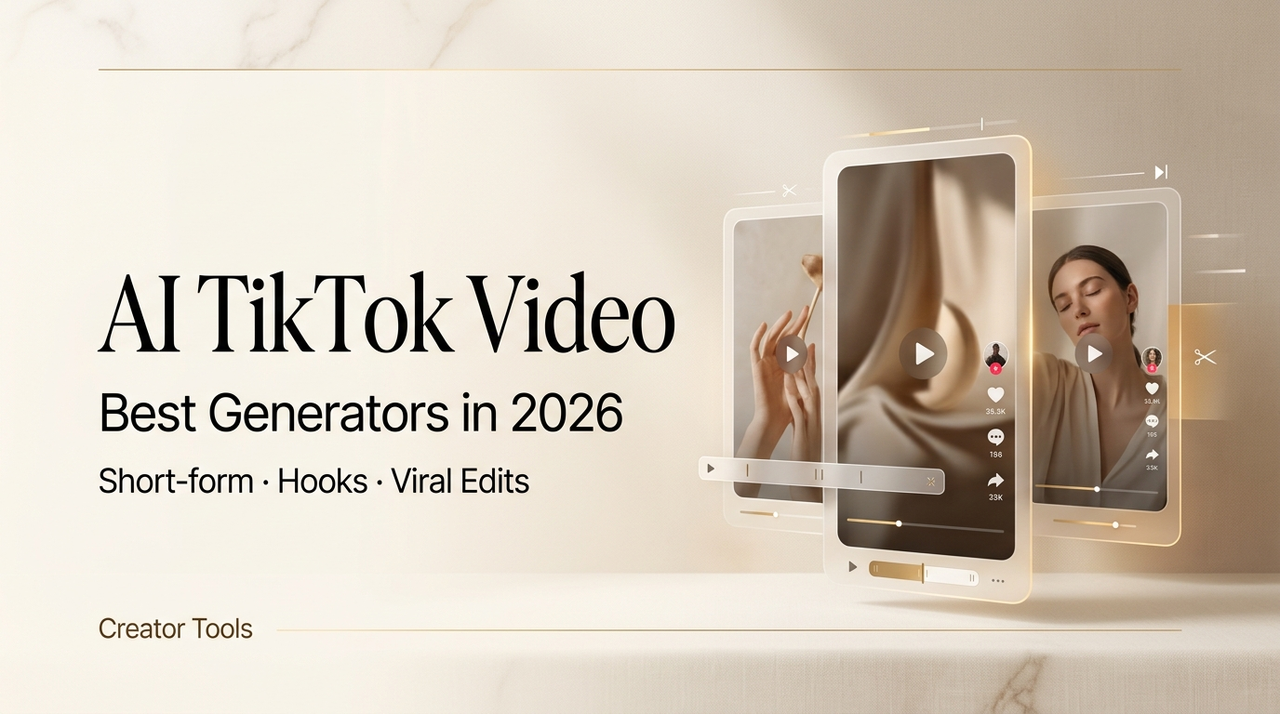
Hey everyone, Dora here. I was deep in edit mode at 1 AM — half-finished TikTok draft, three browser tabs open, two AI tools that kept spitting out 16:9 landscape videos — when it finally clicked: most AI video tools were built for YouTube, not TikTok. And the ones that claimed TikTok support? They’d give you the right ratio and completely wrong energy.
So I actually tested them. Over several weeks, across real TikTok use cases: quick product demos, talking-head explainers, trend-hopping content, and the kind of scroll-stopping clips that get stitched or duetted. Not benchmarks. Not spec sheets. Real tests with real prompts, real outputs, real credit costs — 47 generations total, tracked for speed, first-3-second hook rate, caption accuracy, and post-edit time.
Here’s what I found — including the one thing almost every comparison article gets wrong about AI TikTok tools.
What Makes a Good AI TikTok Video Generator
TikTok has a specific grammar: fast cuts, vertical framing, text overlays that hit in the first 2 seconds, captions (because ~69% of viewers watch without sound in public per Verizon Media’s research), and motion that feels native to a phone screen.
When I evaluated these tools, I asked:
- Does it output 9:16 natively — not as a crop? (Cropping kills composition.)
- How fast from prompt to publishable? (Speed beats perfection on TikTok.)
- Does it handle text and captions natively?
- What’s the actual first 3 seconds like? (Algorithm judges hard on early watch time.)
- Credit cost per usable video? (I tracked redo rates — . Some tools hit 35-40% waste.)
Best AI Tools for TikTok Videos Ranked
Best Free Option: CapCut AI (with caveats)
Here’s the thing about CapCut’s AI video tools: they’re genuinely good for what they are, and they’re free. That’s not nothing.
The AI script-to-video feature works. You paste a script, pick a style, and it assembles a video with stock footage and auto-captions. The output is… fine. Very template-y. The kind of video that looks like every other AI-generated explainer.
But — and this matters for TikTok — CapCut’s templates are built for the platform. Vertical-first. Caption timing that actually matches speech. Trending transition styles.
TikTok’s Creator Academy has noted that the algorithm rewards content matching platform-native formats, and CapCut outputs often clear that bar better than more “cinematic” AI tools, simply because they’re tuned for the environment.
The limitation: you’re working within CapCut’s aesthetic sandbox. Your branded videos will look like CapCut videos. For differentiation, that’s a problem.
Best for: Beginners, low-budget content, or testing formats before investing in paid tools.

Best for Creators Without Editing Skills: Pictory or InVideo AI
I tested both of these back-to-back and the experience was strikingly similar: you paste a script or URL, the tool builds a slideshow-style video with stock footage, adds captions, and you adjust from there.
Neither feels like “AI magic.” Both feel more like a very efficient template system. But if you have zero editing background and need to produce talking-head or educational content consistently, that’s actually fine.
Pictory handles long-form-to-short-form reasonably well — useful if you’re repurposing blog posts into TikTok clips. InVideo has a slightly stronger library of TikTok-oriented templates.
What both lack: anything that feels genuinely generative. You’re assembling, not creating.

Formats and Specs: What TikTok Actually Requires
Per TikTok Video Size & Dimensions Guide (updated 2026) and official upload guidelines:
- Resolution: 1080×1920 px (9:16) recommended; minimum 720p.
- Aspect ratio: 9:16 native vertical (fills screen). Avoid cropping 16:9.
- Duration: 3 seconds to 10 minutes (sweet spot for organic reach: 21–34 seconds).
- File format: MP4 or MOV (H.264 codec preferred).
- Max file size: ≤500 MB recommended for fast uploads (TikTok Studio allows larger for some accounts).
Critical safety zone note: Keep key content (face, text, product) in the central ~70% of the frame — TikTok overlays comments and UI on the edges.
Pricing Comparison
Honest version:
| Tool | Starting Price | Free Tier | Credits per 15-30s Video | My Tested Usable Cost/Video | Best For |
| CapCut AI | Free / $7.99/mo Pro | Yes (unlimited basic) | N/A | $0 | Beginners, native feel |
| Pictory | $19/mo | 3 free videos | ~1 credit | $0.80–$1.20 | Long-form repurposing |
| InVideo AI | $20/mo | Yes (watermarked) | ~1 credit | $0.90–$1.40 | Script-to-video |
| Runway | $12/mo | Limited free | 2–4 credits | $2.50–$4.00 | Premium quality |
A few notes worth making:
Credit systems are tricky. Most tools use credits per generation, not per subscription period — which means power users hit limits faster than the pricing page implies. Before committing to a plan, estimate how many videos you’re making per week and work backwards.
Free tiers are genuinely worth testing. Every tool on this list has some free access. Use it to generate one or two real pieces of content before paying anything.
The cheapest tool per month isn’t always cheapest per usable video. If a tool’s generation quality means you redo 40% of output, math changes fast.
What to Avoid: Common Mistakes with AI TikTok Content
- Generating landscape then cropping (ruins framing).
- Trusting the AI’s default hook — always rewrite the first 3 seconds.
- Skipping captions (huge silent-viewing audience).
- Over-polishing — TikTok rewards authenticity.
- Using the same AI voice everywhere.
Decision Guide
If you’re trying to figure out which tool to actually open right now:
You have zero budget and want to learn the basics → CapCut AI. Free, TikTok-native, usable output. The ceiling is low, but it’s a real ceiling, not a fake one.
You’re repurposing long content (blog posts, podcasts, webinars) into TikTok clips → Pictory or InVideo AI. Both are built for this specific job.
You care most about generation quality and can live with slower output → Runway. The gap in cinematic quality is real; whether it matters for TikTok is a different question entirely.
You want to test a specific aesthetic or motion style → try the free tier of 2–3 tools with the same prompt and compare outputs directly. No article (including this one) beats running your actual use case.
Conclusion
There’s no single “best” AI TikTok video generator — it depends on your workflow, budget, and volume. From hands-on testing: CapCut for zero-budget native content, Runway when quality is non-negotiable.
The one thing none of these tools can do? Figure out what’s actually interesting to say. That’s still on you. AI just packages it faster.
Pick a tool. Test it with a real project today. That 30 minutes of real friction will teach you more than any article.
FAQ
Q: What is the best AI tool specifically for TikTok videos? There’s no single “best” tool for everyone. If you want a free TikTok-native option, CapCut AI is the easiest starting point. For higher-quality visuals, tools like Runway perform better. The right choice depends on your workflow speed, budget, and how much editing you want to do.
Q: Can AI video generators create TikTok-ready content automatically Partially, most tools can generate vertical (9:16) videos, but very few fully optimize for TikTok’s style — like strong hooks, caption timing, and safe-zone placement. You’ll almost always need to tweak the first 3 seconds and text positioning manually.
Q: Do I still need to edit videos after using AI tools? In most cases, yes. Even the best AI tools don’t consistently nail captions, pacing, or hooks. A quick pass in tools like CapCut — especially to refine the first few seconds and add captions — may significantly improve performance.
Previous Posts: