Editor’s Note: If you are running performance marketing for a mobile game or a consumer app (like an AI photo editor, fitness tracker, or tarot app) in 2026, you know the brutal reality of User Acquisition (UA). Winning on TikTok and Reels requires the classic “UGC Split-Screen” format: a real person at the top reacting with wild excitement or frustration, while gameplay or app screen recordings loop at the bottom.
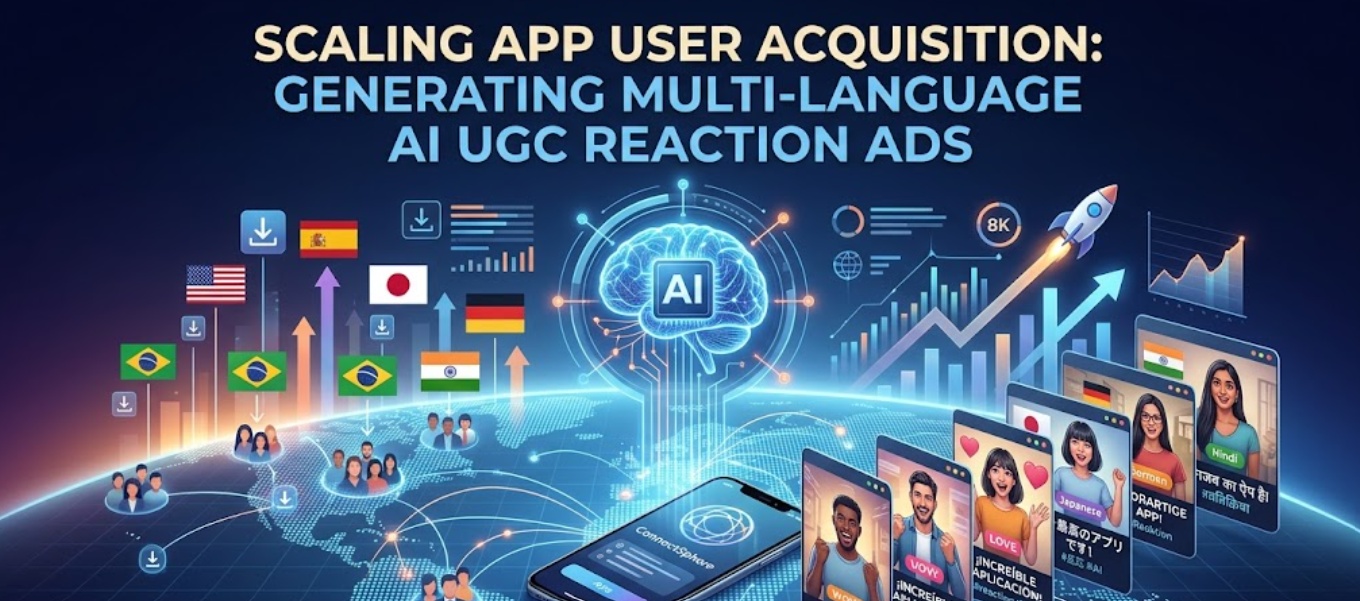
The problem? Hiring actors to shoot hundreds of hook variations is expensive and slow. Even worse, if you want to scale your app into lucrative global markets like Brazil, Japan, or Germany, hiring native-speaking creators for every country will burn through your budget in days. Today, I will show you how top UA teams use an ai ugc ad generator inside CrePal to clone one winning English creator and instantly generate dozens of localized, hyper-realistic reaction ads across 20+ languages.
Why “UGC + Gameplay Split-Screen” Dominates App Install ROAS
Before jumping into AI tools, we need to understand why this specific ad format works so well. When people scroll through vertical video feeds, they have zero patience for polished, corporate TV commercials. They want authentic, relatable, creator-style content.
According to global performance benchmarks published in AppsFlyer’s Mobile App User Acquisition Report, video creatives that look like organic, user-generated content achieve a significantly higher Return on Ad Spend (ROAS) and lower Cost Per Install (CPI) than traditional studio-animated ads. Putting a relatable human face on screen instantly stops the user’s scroll.
The psychology of mirror neurons: Why exaggerated human reactions drive app downloads
There is a scientific reason why watching someone scream at a difficult mobile game puzzle makes you want to download it. It is rooted in what psychologists call “mirror neurons.”
As explained in behavioral neuroscience research published by the National Institutes of Health (NIH), when we watch another person express strong, genuine emotions—like gasping in shock, laughing hysterically, or raging at a Game Over screen—our brains literally mirror those same emotions. We feel their frustration or their joy.
In mobile app marketing, this emotional contagion is your best sales tool:
- The “Fail” Hook: The creator misses an easy puzzle and groans in frustration. The viewer thinks, “I could do that so much better!” and taps Install.
- The “Shock” Hook: The creator gasps as an AI tarot app reveals a terrifyingly accurate prediction about their love life. The viewer thinks, “I need to see what it says about me!”
To make this work at scale, your AI avatar cannot be a stiff, expressionless robot. It must capture the wild, exaggerated facial energy of a real TikTok creator.
The UGC Avatar Fission Pipeline
So, how do you turn one real human actor into a scalable AI machine without losing their human spark? By using an ai ugc ad generator, you can create a digital twin of your favorite content creator. This process is called “Creative Fission”—splitting one video asset into dozens of high-performing variations.
Cloning authentic facial expressions (excitement, frustration, shock) without over-smoothing
Many early AI avatar tools made the mistake of over-smoothing human faces. They removed all wrinkles, freckles, and natural skin textures, leaving the actor looking like a polished mannequin. To win in mobile game advertising, you need to do the exact opposite: preserve the imperfections.
Here is the 3-step recipe for cloning an expressive UGC creator:
- Shoot the “Base Emotion” Training Video: Hire a real creator (or use yourself) to record a simple 2-minute video in a normal bedroom or living room. In this video, explicitly perform three distinct emotional reactions: a huge gasp of surprise, an angry eye-roll/groan, and an excited celebration.
- Turn Off “Beauty Filters” in Your AI Tool: When importing your footage into CrePal’s AI Avatar cloning workspace, make sure you disable any skin-smoothing or artificial beautification settings. You want the algorithm to learn the exact way the creator’s eyebrows raise and how their eyes widen when they act shocked.
- Use the “Reaction Prompt” Matrix: When writing scripts for your new ads, don’t just type plain text. Tell the AI engine which emotional state to trigger during the video!
Copy-and-Paste Script Formulas for Mobile Game Ads:
| Hook Type | What to Type in Your AI Script Editor | Emotional Intensity Setting |
| The Rage Bait Fail | [Emotion: Frustrated Groan] “Are you kidding me?! Why is level 99 physically impossible to beat?!” [Pause 1 sec] “I’ve been stuck on this for THREE hours!” | High (8/10) (Triggers furrowed eyebrows and aggressive head movement) |
| The Shocking Reveal | [Emotion: Extreme Gasp] “Wait, hold on… did this astrology app just guess my exact birth time?! No way!” | Maximum (10/10) (Triggers wide eyes and an open-mouth gasp) |
| The Secret Hack | [Emotion: Smirking Whisper] “If you play this puzzle game, whatever you do, do NOT tap the red gem first. Here is the secret combo…” | Medium (5/10) (Triggers leaning close to the camera with a subtle smirk) |
Hyper-Localizing for Top Tier App Markets (US, LatAm, SEA)
Once you have a winning English ad that is driving cheap installs in the US, your biggest growth opportunity is taking that exact same video and scaling it globally.
According to official creator best practices from TikTok for Business, users almost exclusively engage with ads that sound like a native speaker from their own culture. Dubbing a video with a robotic, monotone computer voice will get your ad skipped instantly. You must hyper-localize your content.
Aligning native slang, vocal fry, and exact micro-visemes across dialects
Localization is more than just translating English words into Spanish or Japanese using Google Translate. To make an app install video ads campaign feel 100% native, you need to master three technical details:
- Use Local Slang and Idioms: Never translate word-for-word. Instead of saying “This game is super fun,” prompt your AI translator to use local Gen-Z slang. For Latin American Spanish (LatAm), use terms like “Este juego está brutal!” For Brazil, use “Mano, esse jogo é viciante!”
- Match Cultural Speech Patterns (Vocal Fry & Pitch): Different cultures speak with different vocal energies. American UGC creators often use “vocal fry” (a raspy, relaxed tone at the end of sentences). Japanese UGC ads, on the other hand, perform best with a higher-pitched, energetic, and polite vocal delivery. Choose an AI voice clone profile that matches these regional norms.
- Lock the Micro-Visemes (Lip-Syncing): Think of a “viseme” as the exact shape your lips make when you make a sound—like touching your lips together to say the letter “M” or making an “O” shape for the letter “O.” When your English avatar speaks German or Portuguese, the reaction video automation tool must physically redraw the avatar’s lips and jaw movement frame-by-frame so the mouth shapes perfectly match the new foreign words.
Real-World Case Study: Scaling an AI Horoscope App to Brazil
To see how much money this saves, let’s look at a recent test for a mobile consumer app—an AI-powered astrology and tarot reading application—looking to expand from the US into Latin America (specifically Brazil and Mexico).
- The Logistical Nightmare: The app’s marketing team needed to test 30 different UGC ad variations in American English, Mexican Spanish, and Brazilian Portuguese. Hiring three separate native-speaking actors, shipping them ring lights, and waiting for them to film 30 scripts would have cost over $18,000 and taken five weeks.
- The AI Fission Solution: The team recorded just one 3-minute video of an American creator reacting to her astrological birth chart. They uploaded this single asset into CrePal’s ugc avatar clone engine. Using automated localization, they translated the scripts into native Mexican slang and Brazilian Portuguese, letting the AI generate 90 total video ads (30 hooks × 3 languages) with full lip-syncing overnight.
- The Payoff:
- 92% Cost Reduction: Total production costs dropped from $18,000 down to less than $1,400 in software usage and translation review.
- Lower Cost Per Install (CPI): By following proven Meta Business performance guidelines for short-form Reels, the AI-localized ads performed identically to real native human actors. In Brazil, the personalized, Portuguese-speaking AI creator drove an 8.4% Click-Through Rate (CTR), slashing the app’s Cost Per Install down to just $0.65.
Quick Fixes for Common AI UGC Glitches
Even the best AI avatar engines need a little human guidance. Here is how to fix the two most common UGC ad glitches in seconds:
- Glitch 1: The creator’s eyes look “dead” or never blink.
- The Fix: If your avatar is staring relentlessly into the camera without blinking, it triggers the “uncanny valley” feeling and scares users away. In your AI script editor, manually insert natural pause tags like
[Blink]or[Look Down at Phone]at the end of every sentence. This forces the avatar to break eye contact naturally, just like a real person reading a screen.
- The Fix: If your avatar is staring relentlessly into the camera without blinking, it triggers the “uncanny valley” feeling and scares users away. In your AI script editor, manually insert natural pause tags like
- Glitch 2: The lip-sync looks delayed or “floaty” on fast words.
- The Fix: When creators speak extremely fast (like reading a quick legal disclaimer or a fast gaming tip), AI lip-syncing can sometimes blur. To fix this, open your audio timeline and lower the speech speed by 5% to 10%. Giving the algorithm just a fraction of a millisecond more time per syllable ensures the lips snap crisply to every consonant!
Frequently Asked Questions
How do I make UGCads for my mobile app without hiring actors? You can create high-converting UGC ads by using an ai ugc ad generator. First, create a digital twin of a team member or use a licensed, expressive AI creator from a pre-built library. Write a punchy script focusing on a common user problem or gameplay hook. Finally, use a split-screen video editor to place your speaking AI creator at the top of the screen and loop your app screen recording or gameplay footage at the bottom.
What is the best AI video generator for mobile game ads? For performance marketers and UA teams, the best platforms are unified suites like CrePal. Unlike standalone tools that only generate voices or only generate faces, integrated platforms allow you to clone an expressive actor, translate their speech into 20+ languages with native lip-syncing, and automatically format the video into a 9:16 vertical split-screen ad all inside a single dashboard.
Can AI avatars really express strong emotions like shock or anger? Yes! Early AI avatars were robotic, but modern 2026 diffusion models are specifically trained on dynamic facial expressions. By instructing the engine with emotion tags (like [Gasp], [Frustrated Groan], or [Excited Scream]), the software dynamically manipulates the avatar’s eyebrows, eyes, and mouth to create authentic, scroll-stopping emotional reactions that mirror real human creators.