Legal & Compliance Disclaimer: This article is strictly for educational, administrative, and technological workflow optimization purposes. It does not constitute legal counsel, regulatory auditing, or platform compliance advisory services. The processing, generation, management, and distribution of digital assets—especially those involving mature themes or human likenesses—are governed by complex federal, international, and regional intellectual property statutes alongside strict third-party platform terms of service. Likeness rights, copyright, adult content, and hosting platform rules are subject to the latest official guidelines. Always consult qualified legal counsel and review individual platform policies before generating, editing, or publishing digital video content.
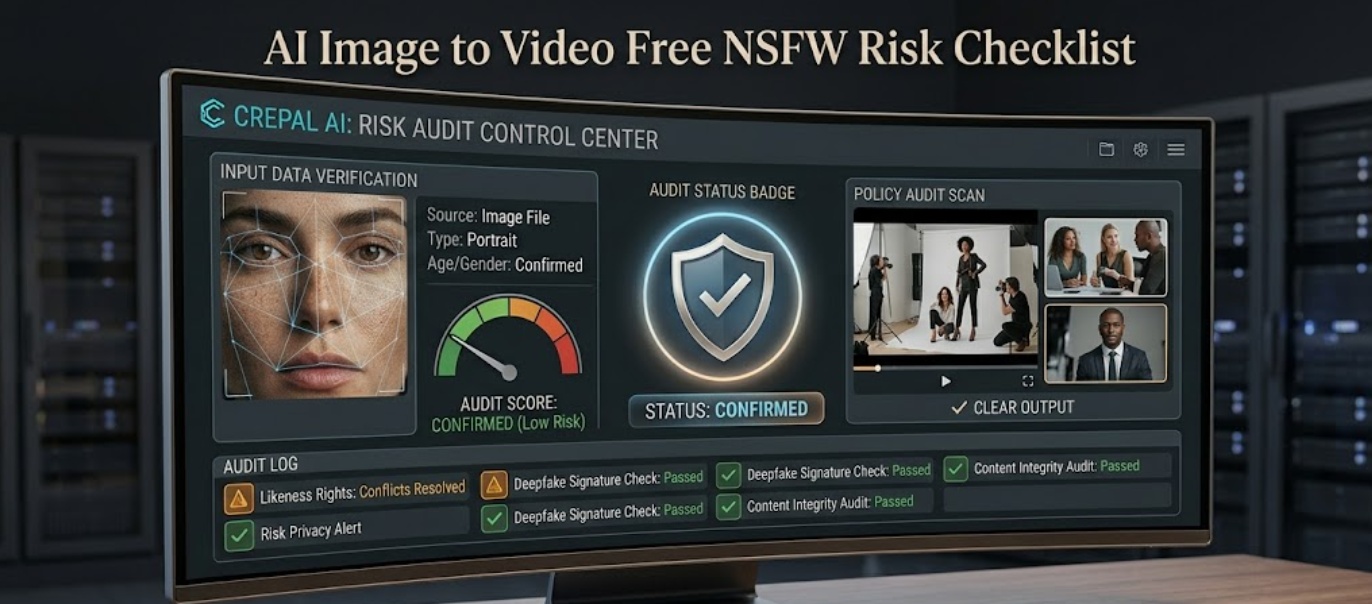
Editor’s Note: Let’s cut straight to the technical reality: searching for an ai image to video free nsfw generator is rarely about causing harm—it is usually an attempt by creators and studios to test latent space boundaries without burning software budget. But in software engineering, “free” is almost always an exchange of currency for risk. Unregulated, zero-cost web platforms frequently offset hosting bills by harvesting user uploads, injecting invisible watermarks, or burying predatory data clauses in their Terms of Service (TOS). At our studio, where we use CrePal to orchestrate guided video drafts and camera sequences, we treat any free, unverified generation tool as a potential data hazard. Here is the commercial risk evaluation checklist every creative team should execute before testing a free image-to-video model.
Why Free NSFW Image-to-Video Tools Need Review
When a studio evaluates an ai image to video generator free no restrictions platform, the initial trial period presents significant hidden vulnerabilities. Unverified, zero-cost web applications operate outside the security standards expected of enterprise media software.
Upload privacy
The moment you drag a source image into an unverified web platform offering free uncensored image to video rendering, you transfer raw data to an external server. Many free utilities lack basic end-to-end encryption (TLS 1.3) and obscure their server infrastructure locations.
Under strict data privacy frameworks like the European Union’s GDPR Article 9 regarding biometric data, processing visual assets containing human facial geometry or personal characteristics requires explicit data protection guarantees. Free tools frequently cache uploads on persistent, unencrypted cloud drives or utilize user-submitted assets to train public machine learning models without consent.
Output ownership
A major hazard when testing a free ai uncensored image to video generator is the ambiguity surrounding intellectual property rights. Under formal policy guidance issued by the United States Copyright Office (USCO) regarding AI-generated works, purely algorithmic outputs lacking substantial human authorship cannot be copyrighted.
Furthermore, many zero-cost platforms hide “User Content Licenses” in their terms of service, granting the platform a perpetual, irrevocable, global license to commercialize, distribute, or publicly display any video draft you render on their servers.
Hidden limits
Marketing claims like “no restrictions” or “no limits” on free platforms rarely hold up during production. Zero-cost tools typically enforce aggressive technical throttling:
- Resolution Downscaling: Forcing 1080p source images down to heavily compressed 480p or 720p video outputs.
- Frame-Rate Skips: Reducing temporal frame generation from a smooth 24fps to a choppy 8fps or 12fps.
- Queue Deprioritization: Artificially delaying render times for hours unless a paid subscription tier is purchased.
Testing Workflow Without Publishing Risk
If your technical team must evaluate a free ai image to video uncensored web tool to benchmark its rendering capabilities, you must execute the trial inside a strict, isolated sandbox.
[Synthetic Test Asset Only] ──► [Isolated Throwaway Account / VPN] ──► [Metadata & C2PA Inspection] ──► [Quarantine or Purge]Synthetic test assets
Never upload proprietary client assets, unreleased concept art, or real performer photographs to an unverified free generator. Perform all benchmark tests exclusively using fully synthetic, non-proprietary baseline images created specifically for testing. This eliminates the risk of leaking sensitive intellectual property or violating third-party Non-Disclosure Agreements (NDAs).
Account separation
Isolate testing environments from your primary business infrastructure:
- Throwaway Credentials: Register test accounts using isolated, temporary email aliases that cannot be linked to your studio’s primary domain or corporate directory.
- Network Sandboxing: Access unverified web tools through isolated virtual private networks (VPNs) or dedicated testing virtual machines (VMs) to prevent browser tracking scripts from accessing internal studio networks.
- Zero Stored Payment Methods: Never enter corporate credit card details on platforms offering “free trials” that require auto-renewing payment authorizations.
Export notes
When downloading a test render from a free ai image to video generator no limits site, immediately inspect the output file before opening it on a shared network drive. Use metadata extraction tools to check for embedded EXIF tags, hidden hardware tracking IDs, or steganographic watermarks. Generate an internal SHA-256 cryptographic hash of the test file to log its exact state during the evaluation.
What Free Tools Often Leave Unclear
Zero-cost platforms frequently rely on vague legal language that creates severe commercial liabilities for creators who attempt to monetize their video drafts.
| Risk Area | Free / Unverified Platforms | Enterprise / Guided Workflows |
| Commercial Usage Rights | Often prohibited or restricted to non-commercial personal use. | Full commercial chain-of-title and clear licensing rights. |
| Data Retention SLA | Indefinite server-side caching and public dataset scraping. | Explicit Zero Data Retention (ZDR) and automated cache purging. |
| Watermark Policy | Visible logo burn-ins or hidden steganographic tracking tags. | Clean, uncompressed exports with opt-in C2PA provenance credentials,. |
Commercial use
Most free AI video generators explicitly forbid commercial exploitation in their fine print. Deploying a video generated on a free tier in a paid advertising campaign or monetized channel can trigger copyright disputes, platform takedown notices under the Digital Millennium Copyright Act (DMCA), or account suspension.
Data retention
Unregulated platforms rarely provide clear data deletion schedules. Even if a user clicks “Delete” on a dashboard, the underlying source images and rendered video drafts often remain stored on cloud backup servers, leaving sensitive visual data vulnerable to third-party data breaches.
Watermarks and attribution
Many free engines inject visible branding watermarks or imperceptible steganographic metadata tags into the video stream. Some platforms enforce compulsory “Public Community Feed” policies, automatically publishing your source images and generated video drafts to a publicly searchable gallery visible to all site visitors.
When Paid or Guided Workflows Are Safer
Testing free, unconstrained tools can offer quick insights into raw rendering speed, but scaling a commercial production pipeline on zero-cost web utilities is unsustainable. When client deliverables, brand reputation, and legal compliance are on the line, paid or guided workflows are vastly superior:
- Contractual Data Protection: Professional platforms provide binding Data Processing Agreements (DPAs) guaranteeing that user uploads will never be used to train public models or cached on unencrypted servers.
- Operational Transparency: Guided tools provide structured AI Director workspaces—such as those integrated into CrePal—allowing teams to manage shot lists, lock camera vectors, enforce visual continuity, and package exports without relying on risky shadow-IT workarounds.
- C2PA Attestation: Enterprise workflows embed cryptographically signed C2PA Content Credentials, establishing clear human authorship and meeting global AI transparency mandates like the European Union AI Act.
FAQ
Who signs off on free-tool experiments internally?
Free-tool evaluations must be formally approved by the Studio Lead Technical Director in consultation with the Compliance Officer. Before any team member registers a test account or uploads a synthetic benchmark file to an unverified third-party platform, the Technical Director must verify that the test environment complies with internal IT sandboxing rules and non-disclosure obligations.
What deletion proof should be kept after testing?
When concluding a trial on a free platform, the evaluator must submit a formal written data deletion request via the tool’s privacy portal. Document the time-stamped deletion request confirmation, export the final session activity log, and archive screenshot evidence showing that all uploaded source files and rendered video drafts have been purged from the platform’s cloud dashboard.
Who can reuse lessons from failed tool tests?
Key technical insights from failed or rejected tool evaluations—such as identified privacy flaws, predatory TOS terms, or poor rendering quality—should be compiled into an internal Software Evaluation Registry managed by the IT/Compliance team. This registry should be accessible to all studio project managers and visual editors to prevent duplicate testing and ensure the team avoids previously flagged high-risk platforms.
When should temporary tester access be revoked?
Access credentials, temporary email aliases, and sandbox permissions created for testing an unverified platform must be revoked immediately upon completion of the evaluation report, or no later than 72 hours after initial account creation. Leaving temporary testing accounts active on external web tools exposes the studio to unauthorized access and security vulnerabilities.
Conclusion
Investigating an ai image to video free nsfw generator can help creative teams benchmark emerging video synthesis models without immediate financial commitment. However, zero-cost web tools carry substantial risks—from unencrypted data pipelines and predatory licensing terms to forced public showcases and hidden watermarks. By implementing a disciplined risk management protocol—testing exclusively with synthetic assets, operating within sandboxed environments, inspecting output metadata, and transitioning commercial projects to guided, professional suites like CrePal—studios can safely evaluate new technologies while keeping their intellectual property, client relationships, and business reputation completely secure.