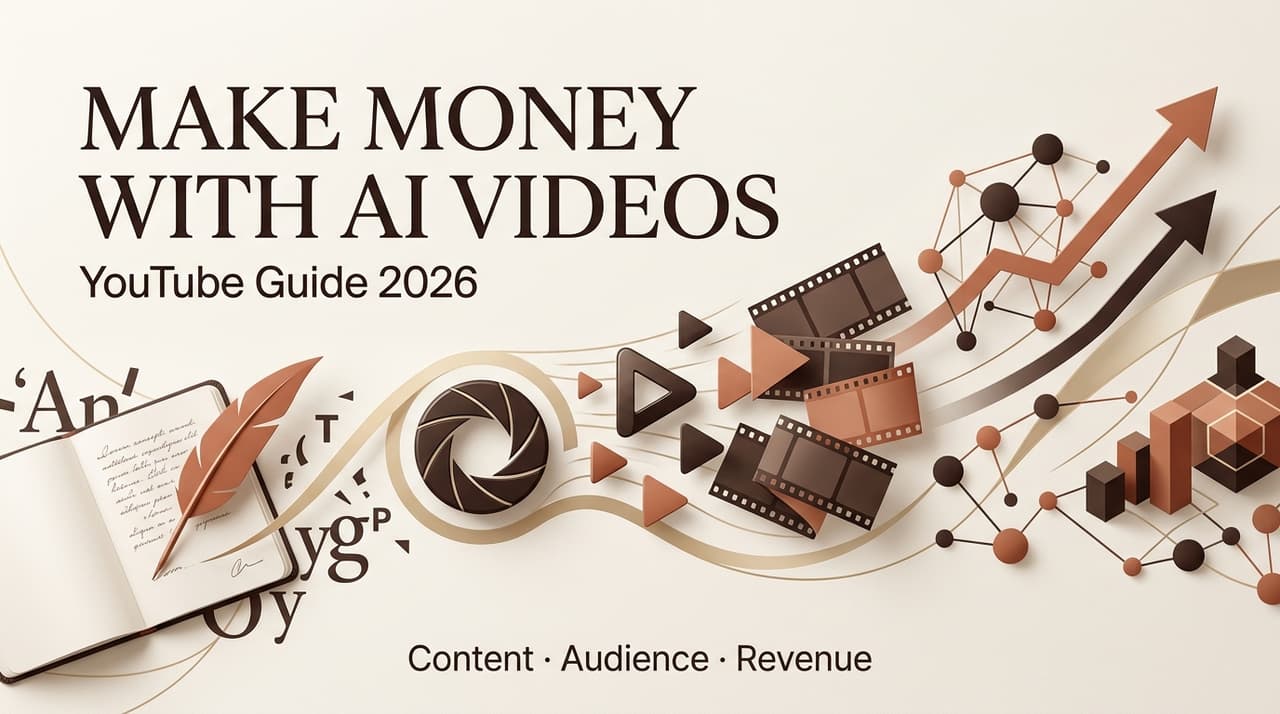
Hi, I’m Leo. A buddy DM’d me last month with a screenshot of his YouTube dashboard: monetization denied. He’d pushed out forty AI-generated “fact” videos in three weeks, same template every time, and YouTube quietly shut the door. His question was the one I get constantly now: how to make money with ai videos without getting your channel torched. I’ve run enough real client projects through these tools to have an answer — and it’s not the one the “AI cash machine” crowd is selling.
Here’s the 30-second version before we dig in: yes, you can earn from AI-assisted video. No, you can’t earn from AI spam. The whole game is which side of that line you land on, and the line is more specific than most people think.
Can You Monetize AI Videos on YouTube?
Short answer: yes. YouTube has never banned AI as a production tool. What it bans is content that looks mass-produced, templated, or scraped — regardless of whether a human or a model made it.
So when people ask me can i make money with ai videos on youtube, I flip the question. It’s not “is AI allowed?” It’s “does each video show a human actually deciding something?” That’s the test reviewers apply, and it’s the test that decides whether you ever see a payout.
What usually matters: originality, value, and policy compliance
To even apply, you need to clear the YouTube Partner Program eligibility thresholds. The early-access tier opens at 500 subscribers plus 3 public uploads and 3,000 watch hours in 12 months (or 3 million Shorts views in 90 days) — that gets you fan funding and some Shopping. Full ad revenue still needs 1,000 subscribers and 4,000 watch hours, or 10 million Shorts views in 90 days.
But hitting the numbers is the easy part. The actual gate is YouTube’s channel monetization policies, which reward content that’s “original and authentic.” Translation, in plain creator-speak: if a stranger can tell your videos differ from one another in substance — not just the thumbnail — you’re probably fine. If they all read like the same machine output with the noun swapped, you’re not.
Monetization Paths Without Income Promises
I won’t tell you what you’ll make. Anyone who hands you a number is guessing or lying. What I can tell you is where the money actually comes from, because ads are usually the smallest slice.
Ads, affiliate content, sponsorships, and product funnels
Here’s how I’d rank the paths for an AI-assisted creator, roughly by how much control you keep over the outcome:
| Path | What it pays on | Who it suits |
| Affiliate / product funnels | Clicks and conversions you drive | Reviewers, tutorial channels |
| Sponsorships | Flat deals once you have an audience | Niche channels with trust |
| Ad revenue (YPP) | Views, after the thresholds | Everyone, eventually |
| Fan funding | Memberships, Super Thanks | Channels with a community |
The pattern I keep seeing: ad revenue is the byproduct, not the plan. When I figure out how to make money using ai videos for a client channel, the affiliate and sponsorship layer is usually where the real margin lives — because that income doesn’t depend on YouTube’s RPM lottery. Ads following YouTube’s advertiser-friendly content guidelines just sit underneath as a floor.
YouTube AI Content Policy Basics
This is the part my buddy skipped, and it cost him his channel. There are two separate policies people constantly confuse, plus a disclosure rule. Get all three straight.
Disclosure, reused content, and synthetic media considerations
Inauthentic content. In July 2025, YouTube renamed its old “repetitious content” rule to “inauthentic content” and sharpened it to explicitly target mass-produced, templated uploads. This applies to your whole channel — a batch of cookie-cutter videos can pull monetization off everything. This is the rule that nuked my buddy.
Reused content. Separate policy. It’s about repackaging stuff that’s already online — clips, slideshows, text-to-speech reads of articles — without adding real commentary or transformation. You can still monetize reused material if you genuinely transform it: a reaction with your take, a critical review, footage you’ve re-cut with your own narrative.
AI disclosure. If your video contains realistic synthetic media — a real person’s voice cloned, a real event altered, a fake-but-believable scene — you have to flag it. YouTube’s altered or synthetic content disclosure tool lives in the upload flow under the “AI use” attribute. Here’s the part people miss, straight from YouTube’s GenAI disclosure help page: you do not need to disclose AI used for production assistance — scripts, ideas, captions, or content that’s obviously unrealistic. Disclosure is about deceptive realism, not about whether AI touched the file.
I’ll be honest: this one confused me at first too. The mental shortcut that finally stuck — would a viewer be fooled? If no, you’re clear.
Faceless + AI Video Workflows
Faceless channels are where most people try AI first, and where most people get it wrong. The mistake is treating “faceless” as permission to remove the human entirely. It isn’t.
Where AI helps and where human editing still matters
I run a lot of my faceless work through CrePal because the agent handles the grind — scripting passes, scene generation, rough cuts — while I keep the editorial decisions. That’s the whole point: AI does the production, I do the directing. The tools that survive 2026 are the ones used that way, not the ones used to mass-produce and walk away.
Where AI genuinely saves me hours: first-draft scripts, voiceover scratch tracks, b-roll generation, thumbnail variations. Where I still grab the wheel: the angle, the pacing, the one opinion in the video that an algorithm would never have. Last week I let an agent generate a six-scene explainer and the third scene was flat-out boring — accurate, well-rendered, and dead. I rewrote it by hand. That rewrite is the difference between “authentic” and “inauthentic” in YouTube’s eyes, and honestly, in the viewer’s too.
The grey zone, spelled out: pure automation — scrape, generate, publish, repeat — is dead for monetization. AI as a layer under human judgment is not just allowed, it’s the only version that scales without a strike landing.
Realistic Expectations for New Creators
Let me kill the fantasy gently. The “post 30 AI videos a day and retire” pitch was never real, and in 2026 it’s a fast track to a denied application.
Why quality, niche, and consistency matter more than automation
Volume used to be a cheat code. Now it’s a flag. YouTube’s own reviewers check your most-viewed and newest videos for variation, so a channel that scales sameness is scaling its own risk. The creators making money are the ones who picked a niche, brought a real point of view, and stayed consistent for months — boring advice, but it’s the advice that’s actually true.
Automation doesn’t replace any of that. It just lets one person do the work that used to need three. That’s the honest value, and it’s plenty. I take on more projects now without more overtime — that’s the win. Not magic money. More output, same human.
Safer Content Ideas to Start With
If you’re figuring out how to make ai videos for money without tripping a policy, start where transformation is built into the format. These are the lanes where “human added value” is obvious by default.
Tutorials, explainers, reviews, and visual storytelling
- Tutorials — you’re demonstrating a real process, so the value is inherent. AI handles visuals, you handle the teaching.
- Explainers — your framing and analogies are the product. The model can’t fake a genuinely good explanation.
- Reviews — your opinion is the originality. This is the safest lane, and it doubles as affiliate fuel.
- Visual storytelling — original narrative over AI-generated scenes. Disclose if it looks real; otherwise create freely.
Notice the through-line: every one of these has a human judgment that AI can’t counterfeit. That’s not a coincidence. It’s the exact thing both YouTube and your audience are paying for.
FAQ
Can I make money with AI videos on YouTube in 2026?
Yes, but only if you add clear human creative input. Pure automated, templated AI content is increasingly flagged under YouTube’s inauthentic content policy. Successful creators use AI for drafting and production, then apply their own scripting, editing, opinions, or unique angles before publishing. Channels that treat AI as a full replacement often get limited reach or demonetized.
How much do ai videos make on youtube?
This is where I refuse to promise and instead give the actual ranges. Long-form ad revenue typically runs around $2–$10 RPM (revenue per 1,000 views), swinging hard by niche and audience country — finance and tech sit high, entertainment sits low. Creators keep 55% of long-form ad revenue and 45% on Shorts. So reaching $1,000 from ads alone can take anywhere from roughly 100,000 to 500,000 views. That’s exactly why I push affiliate and sponsorship income — it doesn’t ride the RPM rollercoaster.
How to make money using AI videos without getting demonetized?
Focus on transformation. Use AI for scripting, visuals, or voiceover, but add your own commentary, unique insights, custom editing, or original storytelling. Pick a specific niche, vary formats, and disclose realistic synthetic content when required. Channels that succeed treat AI as a production assistant, not the entire creator.
How to make AI videos for money on YouTube as a beginner?
Start small: choose one niche you understand, create 10–15 videos with clear human input (your voice, opinions, or edits), and focus on consistency rather than volume. Use AI tools for first drafts, then refine hooks, thumbnails, and pacing yourself. Apply to the Partner Program once you hit the thresholds, and prioritize affiliate or sponsorship opportunities early — ad revenue grows slowly.
So, the bottom line on how to make money with ai videos: it works, but not the way the hype merchants frame it. AI is the intern that drafts; you’re the one who signs off. Pick a niche, keep the human in the loop, disclose what’s realistic, and treat ad revenue as the floor instead of the ceiling. My buddy? He’s rebuilding — one real video at a time now. Run a small test, watch your first month of RPM, and adjust from there. If you’ve already been demonetized for AI content, drop what happened in the comments — I want to see where the line actually fell for you.
Previous posts: