Compliance & Legal Disclaimer: This tutorial is an operational guide designed for digital studios and creators evaluating third-party software vendors. It does not constitute legal advice. We cannot declare any specific third-party AI tool as universally “safe” or “unsafe.” Software encryption capabilities, data retention limits, and training usages change frequently; you must verify a tool’s specific terms at the time of your project. Under no circumstances should you upload real-person intimate materials or non-consensual intimate imagery (NCII) into any AI system, even for “testing” purposes, as this violates platform policies and global laws. Always consult qualified legal counsel to review vendor contracts before uploading sensitive commercial assets.
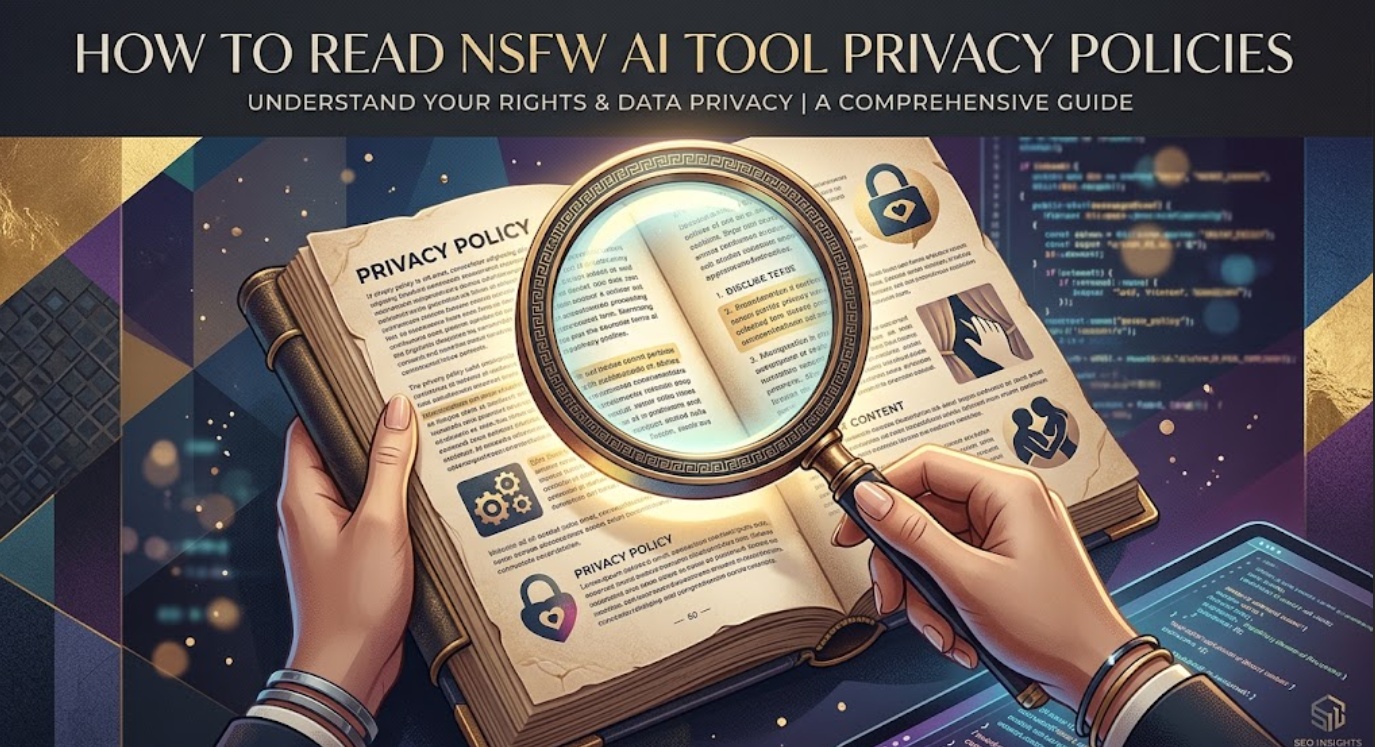
When a commercial studio or independent creator prepares to generate mature, adult-themed, or highly sensitive conceptual art, evaluating the software vendor is just as critical as writing the creative brief. You cannot rely on a tool’s marketing claims of “absolute privacy.” Before any proprietary client data or sensitive character design touches a third-party server, your team must formally audit NSFW AI privacy policy documentation.
Reading a privacy policy is an exercise in threat modeling. You are looking for exactly what data is taken, how long it lives on their servers, who else gets to see it, and how you can destroy it. This guide provides a clause-by-clause framework for evaluating vendor documentation so you can determine if a platform meets your studio’s operational security standards.
Start With the Data the Tool Collects
The first section of any legitimate privacy policy outlines data collection. You must map out both the data you actively hand over and the data the tool passively scrapes.
Uploaded Images, Prompts, Outputs, and Account Data
Look for the “Data You Provide” section. This defines your NSFW AI upload privacy. Does the policy explicitly distinguish between account data (your email, billing address) and generation data (your text prompts, uploaded reference images, and final outputs)? If you are using an Image-to-Image workflow, the policy must clearly state how uploaded reference materials are classified. If this distinction is missing or blurred into a general “User Content” definition, the policy lacks the necessary granularity for enterprise risk assessment.
Metadata, Logs, and Device Information
Next, review the “Data Collected Automatically” section. Almost all web-based AI tools collect telemetry. Look for clauses detailing the collection of IP addresses, browser types, device IDs, and usage logs. In the context of mature content creation, metadata can be highly sensitive. Ensure the policy specifies whether your prompt history is linked directly to your identifiable device information or if it is anonymized.
Find Every Permitted Use of Your Content
Knowing what data they collect is only the first step. You must now locate the “How We Use Your Data” section to uncover exactly what they are legally permitted to do with your sensitive uploads.
Service Delivery, Moderation, and Product Improvement
Vendors need the right to process your data simply to deliver the service (e.g., rendering the image). However, watch for phrases like “improving our services” or “developing new features.” You must verify if “product improvement” is explicitly separated from AI model training. Furthermore, check the moderation clauses. Do they use automated hash-matching (like StopNCII) to block illegal content, or does “moderation” imply a human will manually review your adult-themed prompts?
Model Training, Human Review, and Marketing
This is the most critical check for any commercial artist. Does the tool use your uploads and generated outputs to train their foundational models? You must locate the AI training opt out clause.
- Is the opt-out enabled by default, or must you manually toggle a setting?
- Does the policy allow human engineers to review your prompts for Quality Assurance (QA)?
- Does the tool claim a perpetual license to use your generated NSFW content in their public marketing materials? If the policy is vague on these points, you must assume your data will be trained on and potentially viewed by human reviewers.
Trace Storage and Sharing
Data breaches rarely happen at the front door; they often occur in the backend storage facilities or through third-party partners.
Retention Periods and Deletion Exceptions
Locate the adult AI data retention timeline. A robust policy will state exactly how long they keep your data (e.g., “Prompt logs are purged after 30 days”).
- Does the policy state what happens to your data after you delete an image from your gallery?
- Is there an active image deletion policy indicating whether deletion is immediate (hard delete) or if the asset lingers on backup servers for months (soft delete)? If the timeframe is listed as “as long as necessary for business purposes,” the retention period is effectively unknown. You must contact the vendor for a hard timeline.
Subprocessors, International Transfers, and Legal Requests
AI companies rarely own their own server farms. They use AI tool subprocessors (like AWS, Google Cloud, or specialized GPU clusters like RunPod).
- Look for a linked “List of Subprocessors.” If it is missing, the data chain is unknown.
- Check the “Data Transfers” section. If you are based in the EU but the servers are in the US, the policy must outline compliance with frameworks like the Data Privacy Framework (DPF) or Standard Contractual Clauses (SCCs).
- Review the “Legal Disclosures” clause to understand how the company responds to government subpoenas regarding user data.
Check the Controls Available to Users
A policy is only useful if it grants you the tools to enforce your data rights.
Download, Delete, Object, and Opt Out
Audit the “Your Rights” section. Under frameworks like the GDPR or CCPA, you should have the right to request a full export of your data and mandate its deletion.
- Where is the actual mechanism for AI training opt out? Is it a button in the UI, or do you have to email a specific Privacy Officer?
- Can you selectively delete single generations, or is it an all-or-nothing account wipe?
Account Closure and Support Escalation
Verify the account closure process. When you delete your account, does the policy guarantee that all associated generation histories and uploaded references are simultaneously destroyed? Look for a dedicated privacy contact email (e.g., [email protected]). If a tool only offers a generic Discord server for support, escalating a serious data privacy request will be nearly impossible.
Decide Whether the Policy Fits the Project
After you audit NSFW AI privacy policy documentation, you must map the vendor’s legal reality against your project’s risk profile.
Synthetic Tests Versus Sensitive Client Assets
If you are generating purely fictional adult characters for a personal project, a tool with standard data retention and a manual opt-out might be acceptable. However, if you are uploading proprietary client assets or highly sensitive storyboard concepts, standard policies are rarely sufficient. For example, when moving approved static assets into a collaborative video orchestration platform like CrePal, enterprise teams must verify that the platform’s specific Privacy Policy supports isolated workspaces, zero data retention on deleted assets, and strict subprocessor agreements before handing off the project.
Document the Policy Version and Approval Decision
Policies change. You must document the exact legal parameters under which you approved the tool. Create an internal log for your studio:
- Vendor Name: [Tool Name]
- Document Reviewed: Privacy Policy / Terms of Service / Subprocessor List
- Date of Policy Version: [e.g., Last Updated: May 1, 2026]
- Date Accessed: [Current Date]
- Deletion Timeframe: [e.g., 30 Days / Unknown – Awaiting Support Reply]
- Decision: [Approved for Fictional Use Only / Rejected]
Red Flags That Need Clarification
During your audit, watch for evasive legal drafting. If you encounter these red flags, the policy requires clarification from the vendor’s legal team before use:
- “Trusted Partners”: Sharing data with “trusted partners” without providing a link to a formal subprocessor list is a massive security blind spot.
- “May Use”: Phrases like “we may use your images to improve our services” mean they will use them. If there is no clear opt-out linked to this phrase, treat it as a mandatory data surrender.
- Silent on Security: If the policy does not explicitly mention encryption standards (e.g., “encrypted at rest using AES-256”), you cannot assume your data is cryptographically secured.
Limits and Trade-Offs
It is vital to understand that an audit only reveals what the company claims to do.
- Policy vs. Practice: A pristine privacy policy does not mathematically prevent a database hack or a rogue employee leak.
- The Trade-Off: The most private workflow is entirely local and offline. The moment you utilize a cloud-based AI tool for its superior speed, specialized adult-models, or collaboration features, you are trading absolute security for convenience. The audit simply ensures that this trade-off is calculated rather than blind.
FAQ
Can clients require independent security audits before tool approval? Yes. Enterprise clients frequently demand a SOC 2 Type II compliance report or an ISO 27001 certification from any third-party SaaS vendor used in their production pipeline. If the NSFW AI tool cannot provide these independent audit reports, the client may explicitly forbid its use on their project.
Who owns breach notifications after a project has ended? If a vendor suffers a data breach exposing your generated assets or prompts, the vendor must notify you (the account holder). However, if those assets contained confidential client IP, your studio is legally obligated to notify your client, even if the project concluded months ago. This is why immediate asset deletion post-project is critical.
Should separate clients use separate accounts and workspaces? Absolutely. Do not mix proprietary concepts from Client A and Client B in the same web tool account. Utilizing separate, isolated workspaces (or distinct paid accounts) ensures that if one account is compromised, banned, or audited, the other client’s data remains entirely quarantined.
What happens when a subprocessors list changes mid-project? Under GDPR and standard DPAs, vendors must notify enterprise users before adding a new subprocessor, giving you time to object. If a consumer-grade AI tool silently adds a new backend server provider in a different jurisdiction, you must immediately re-audit the tool to ensure the new data flow does not violate your client NDAs.
How often should an approved vendor receive another review? Studio compliance officers should re-audit the privacy policies, terms, and subprocessor pages of all approved AI tools quarterly. Furthermore, any time a vendor issues a “We are updating our Privacy Policy” email, production must pause until the new terms are reviewed and re-documented in the studio’s approval log.
Conclusion
To effectively audit NSFW AI privacy policy documentation is to take ownership of your studio’s digital footprint. In the fast-moving world of generative media, assuming a vendor prioritizes your privacy is a dangerous gamble. By systematically breaking down data collection, demanding clarity on model training opt-outs, verifying exact deletion timelines, and documenting the policy version dates, creators can safely navigate the landscape of hosted generation tools. Whether you are prepping assets for local finishing or cloud orchestration, rigorous vendor vetting is the ultimate firewall protecting your creative and commercial integrity.