Compliance & Legal Disclaimer: This article provides operational workflow analysis and technical comparisons for digital studios, agencies, and adult content creators evaluating synthetic media labeling methods. It does not constitute formal legal counsel. Regulatory frameworks governing AI transparency—such as Article 50 of the European Union AI Act—and individual platform disclosure rules change frequently. Furthermore, data retention policies, metadata preservation, and content moderation rules vary across host platforms; creators must verify the latest official terms before publishing. Generating, distributing, or modifying non-consensual intimate imagery (NCII) or unauthorized likenesses is strictly illegal regardless of disclosure method.
For commercial digital creators and production teams working in mature or adult-themed visual storytelling, disclosing synthetic elements is no longer optional. Regulatory frameworks and creator platforms increasingly mandate clear signals when media has been generated or altered by AI.
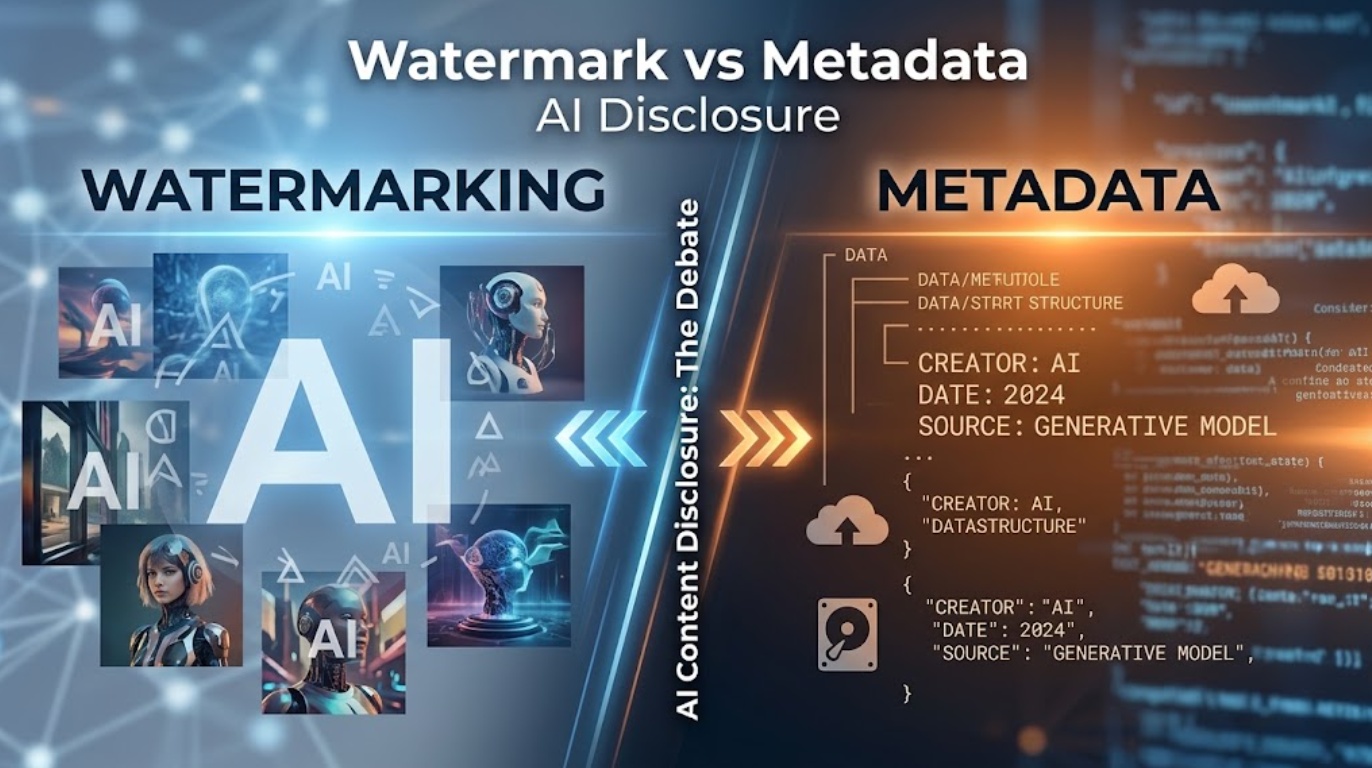
However, deciding how to label AI generated content presents a technical dilemma: watermark vs metadata AI content disclosure.
Should you apply an overt visual mark, embed cryptographic data directly into the file container, or combine multiple methods? Each approach offers distinct strengths and vulnerabilities across visibility, tamper resistance, workflow overhead, and privacy. This guide breaks down the operational trade-offs to help studios construct a compliant, multi-layered provenance strategy.
Quick Verdict
A complete disclosure strategy rarely relies on a single mechanism. Instead, professional pipelines assign specific disclosure roles depending on how media is viewed and distributed.
Use Visible Labels for Immediate Context
Visible indicators (such as burned-in corner badges, text overlays, and AI content caption disclosure) provide instant, zero-friction clarity to the human viewer. They require no specialized reader tools or platform support. If your primary goal is complying with viewer-facing platform mandates and setting immediate consumer expectations in a scrolling social feed, visible indicators are essential.
Use Provenance Metadata for Verifiable History
Cryptographically signed metadata (such as C2PA metadata) embeds a tamper-evident audit trail directly into the file. It documents exact creation parameters, ingredient assets, and editing history without altering the visual aesthetic of the artwork. If your objective is maintaining a verifiable chain of custody for enterprise client deliverables, legal compliance, or forensic verification, signed metadata is the superior standard.
What Each Disclosure Method Communicates
Understanding the technical boundaries of each disclosure layer is essential for building an effective provenance pipeline.
Watermarks, Captions, and Profile Statements
Visual and textual indicators operate in the human-perceptible layer:
- Burned-in Watermarks: Text or logo stamps permanently composited into the image pixel array.
- Captions & Hashtags: Explicit disclosures placed in the accompanying post copy (e.g.,
#CreatedWithAI,Synthetically Generated). - Profile-Level Disclosures: Bio statements or account verification badges denoting that a creator or avatar operates synthetically.
These methods communicate direct human context, but carry zero cryptographic proof. Anyone can type a caption or paste a watermark onto an asset, making them easy to forge or strip.
Metadata, C2PA, and Content Credentials
Metadata operates within the binary architecture of the media file:
- Legacy EXIF/IPTC: Standard metadata tags embedded in file headers. While widely supported, traditional EXIF data can be modified or deleted using basic desktop tools.
- C2PA Standard: Developed by the Coalition for Content Provenance and Authenticity, the C2PA technical specifications establish an open standard that cryptographically binds a manifest directly to digital media.() This manifest records the file’s origin, the tools used, and every subsequent edit into a tamper-evident structure.
- Content Credentials: The user-facing implementation of the C2PA standard, represented by the interactive “CR” pin. Users can inspect an asset’s digital ingredient list through the Content Credentials overview to view verified software signers and generation history.
Compare Visibility and Durability
The durability of a disclosure method depends heavily on how the file travels across the open web.
Cropping, Screenshots, Re-Exports, and Reposts
The primary weakness of visible labels is cropping. If a watermark is placed in the bottom corner of an image, bad actors or third-party aggregators can crop the edges, screenshot the canvas, or use basic inpainting tools to eliminate the mark entirely.
Conversely, standard metadata faces the “strip attack” problem. When a user downloads an image and re-saves it through software that does not support C2PA manifests, the cryptographic metadata container is discarded. Similarly, capturing a raw screenshot creates a brand-new raster image, severing all prior metadata history.
Platform Interfaces and Metadata Support
Social and subscription platforms process media differently. Many major web platforms automatically compress and re-encode incoming uploads to optimize bandwidth, silently stripping EXIF and C2PA manifests in the process. Unless a platform has natively integrated C2PA validation into its ingestion engine, relying exclusively on metadata means your disclosure signal may disappear the moment the file is published.
| Disclosure Attribute | Visible Watermark / Label | C2PA Content Credentials |
| Viewer Friction | Zero (Visible instantly to humans) | Low-to-Medium (Requires clicking an inspection pin or tool) |
| Aesthetic Impact | Obtrusive (Alters canvas pixels) | Non-obtrusive (Invisible inside file payload) |
| Tamper Detection | None (Easily masked or cropped) | High (Cryptographic signature breaks if bytes are altered) |
| Detailed Audit Trail | Very Low (Limited text space) | High (Full chain of custody, tools, and ingredients) |
| Social Compression Resilience | High (Survives format re-encoding) | Low-to-Medium (Depends on host platform manifest preservation) |
Compare Privacy and Provenance
While detailed provenance creates transparency, it can inadvertently expose sensitive production data if not configured correctly.
Editing History and Source Information
C2PA manifests can document the entire creative lineage of an asset. This includes the foundational AI model used, specific prompt structures, secondary editing passes (such as color grading in Photoshop), and timestamps. For enterprise commercial workflows, this level of detail validates that the production pipeline utilized licensed software and compliant source materials.
Metadata That Creators May Not Want to Expose
In adult AI provenance workflows, individual creators often value operational privacy. Unredacted metadata manifests could potentially reveal local file path directories, internal workstation identifiers, personal hardware serial numbers, or private team member names.
Fortunately, the C2PA specification supports redaction capabilities. Studios can cryptographically sign an assertion confirming that an asset is synthetic while excluding personal hardware telemetry or proprietary prompt text from the public-facing credential.
Build a Layered Disclosure Workflow
Because no single mechanism is indestructible, professional production pipelines utilize a layered disclosure architecture.
Match the Method to Platform and Audience
Before distribution, audit the destination platform’s specific guidelines. For example, creator monetization platforms enforce strict disclosure requirements for synthetic models and mature content—such as those detailed in the Fanvue Community Guidelines.
- Public Social Feeds: Apply clear profile disclaimers and visible caption tags to satisfy instant consumer disclosure rules.
- Subscriber Platforms & Client Portals: Distribute master files embedded with verifiable C2PA Content Credentials alongside account-level AI notices.
- Video Pipelines: When taking static synthetic assets into cloud-based animation and video orchestration platforms like CrePal, ensure project settings maintain provenance records from initial static concept to rendered video export.
Preserve an Internal Production Record
Never rely on third-party social platforms to store your compliance history. Studios must maintain an offline, encrypted production ledger that archives:
- The pristine master file with its complete, unredacted C2PA manifest.
- The exact prompt configurations and source references used during generation.
- Dated verification records demonstrating the asset was created in compliance with commercial platform rules.
What Disclosure Cannot Prove
Creative teams must maintain clarity regarding the legal and technical boundaries of digital provenance.
Provenance Is Not Ownership or Consent
Embedding Content Credentials AI metadata or burning a watermark into a frame proves how and when a file was processed by a specific keyholder. It does not prove legal ownership, intellectual property rights, or human consent.
Under current U.S. Copyright Office guidance, purely machine-generated content lacks human authorship. A C2PA manifest cannot grant copyright to a prompt, nor does it prove that human subjects depicted in training references consented to their likeness being used. Consent must be established through signed, verifiable legal releases, not metadata tags.
A Label Does Not Make Prohibited Content Permissible
Adding a watermark reading “AI Generated” or embedding a valid C2PA manifest does not exempt an asset from safety policies. If an asset depicts unauthorized real-person likenesses, non-consensual imagery, or policy-violating mature scenarios, the content remains strictly illegal and actionable under global regulations, regardless of how thoroughly it is labeled.
Limitations and Trade-Offs
Choosing your disclosure configuration requires balancing aesthetic integrity against platform friction:
- Visible Label Drawbacks: Visually intrudes upon the artistic composition and remains vulnerable to simple cropping or editing removals.
- Metadata Drawbacks: Invisible to standard users without dedicated tools, often stripped by social media compression algorithms, and requires specialized integration across production tools.
FAQ
Who updates disclosures when an asset changes after approval?
The Lead Technical Editor or Studio Compliance Officer is responsible for updating disclosures. If an approved static image undergoes secondary post-processing or is animated into a video, a new C2PA assertion must be appended to the manifest to record the modification without breaking the previous chain of custody.
Can clients require a disclosure style beyond platform rules?
Yes.() Commercial contracts frequently dictate exact disclosure styling. A client may require discreet, non-obtrusive C2PA metadata on master exports while explicitly barring visible corner watermarks that might interfere with brand advertising campaigns
Should archived masters keep more metadata than public exports?
Yes.() Internal archives should retain full, unredacted provenance manifests detailing internal workstation IDs, raw prompts, and intermediate generation passes. Publicly distributed files should utilize redacted manifests to protect team identity and proprietary prompt recipes while maintaining verified origin status.
Who is responsible when a repost removes the original disclosure?
The original creator is responsible for ensuring assets leave their direct control with proper disclosures attached according to platform rules. If an unauthorized third party scrapes, crops, or strips metadata during an unapproved repost, liability for deceptive re-distribution generally falls on the reposter. Maintaining signed internal master records proves the studio published the asset compliantly.
What happens when several AI tools contribute to one asset?
When multiple engines contribute to a single piece (e.g., generating a base image in one tool, expanding it in another, and animating it in a video suite), each compliant tool appends an “ingredient” assertion to the C2PA manifest. This builds a multi-tiered lineage showing every model that contributed to the final output.
Conclusion
The debate over watermark vs metadata AI content disclosure is not an either-or decision. Visible marks provide instant, universal context for everyday viewers in social feeds, while cryptographic metadata—anchored by standards like C2PA and Content Credentials—delivers the tamper-evident technical lineage required for enterprise workflows and regulatory compliance.
By adopting a layered disclosure strategy, auditing destination platform policies, and maintaining strict internal provenance archives, commercial creators can protect their brand integrity while operating transparently across the evolving digital ecosystem.