Compliance & Legal Disclaimer: This article provides operational workflow frameworks and risk management strategies for digital studios and professional writers. It does not constitute formal legal counsel. Generating, modifying, or distributing mature digital content is governed by strict third-party Terms of Service (TOS), intellectual property statutes, and biometric privacy laws. Always consult qualified legal counsel and review individual platform policies before generating or publishing sensitive commercial or creative content.
Editor’s Note: Let’s be candid. When professional writers, concept artists, or digital studios search for a gemini prompt for nsfw boilerplate, they are rarely trying to produce illicit material. Most often, they are attempting to generate legitimate high-fashion concepts, anatomical medical illustrations, or emotionally complex fanfiction without triggering overly sensitive, consumer-grade safety filters. However, relying on copy-and-paste prompt templates sourced from Reddit or obscure forums is an operational hazard. Treating an NSFW prompt boilerplate as a plug-and-play solution ignores the strict compliance architectures built into modern Large Language Models (LLMs). Having used intuitive orchestration layers like CrePal to manage script generation, camera shot orders, and safe video workflows, we know that bridging the gap between an unhindered creative draft and a compliant final product requires meticulous operational discipline. Here is why you should treat adult prompt templates as boundary checks, rather than reusable generation tools.
Why Creators Search for NSFW Prompt Boilerplates
The demand for an effective Gemini NSFW prompt template stems from the reality of modern digital production. Creators working under tight deadlines want predictable outcomes, and unconstrained prompt engineering can feel like navigating a minefield.
Reusable structures
In professional studios, efficiency is critical. Cre。ators look for AI prompt templates to standardize lighting profiles, camera angles, and character positioning. A boilerplate theoretically allows a director to swap out a subject while maintaining the exact sensual or moody aesthetic of the original output. They want a structure that guarantees a specific artistic style—like chiaroscuro lighting or macro-focus intimacy—without needing to rewrite complex semantic guardrails from scratch for every single render.
Fanfic and adult story intent
For narrative writers, the search for a fanfic Gemini prompt for NSFW boilerplate is often about maintaining tonal consistency. Writers generating romance or dark fantasy literature need their AI assistants to understand emotional intimacy, physical tension, and mature themes without the model abruptly shutting down the session. They seek boilerplates that establish a clear, pre-approved narrative tone—focusing on descriptive sensuality rather than explicit anatomy—hoping to bypass rigid safety blocks while maintaining the emotional depth of their story.
Faster prompt setup
Prompt engineering is time-consuming. Crafting a prompt that perfectly balances artistic intent with platform safety constraints can take dozens of iterative attempts. Creators hunt for a gemini prompt for nsfw boilerplate because they want a shortcut. They assume that if a specific combination of negative constraints and descriptive adjectives worked for another user, it will save them hours of trial and error in their own projects.
Why Boilerplates Are Risky
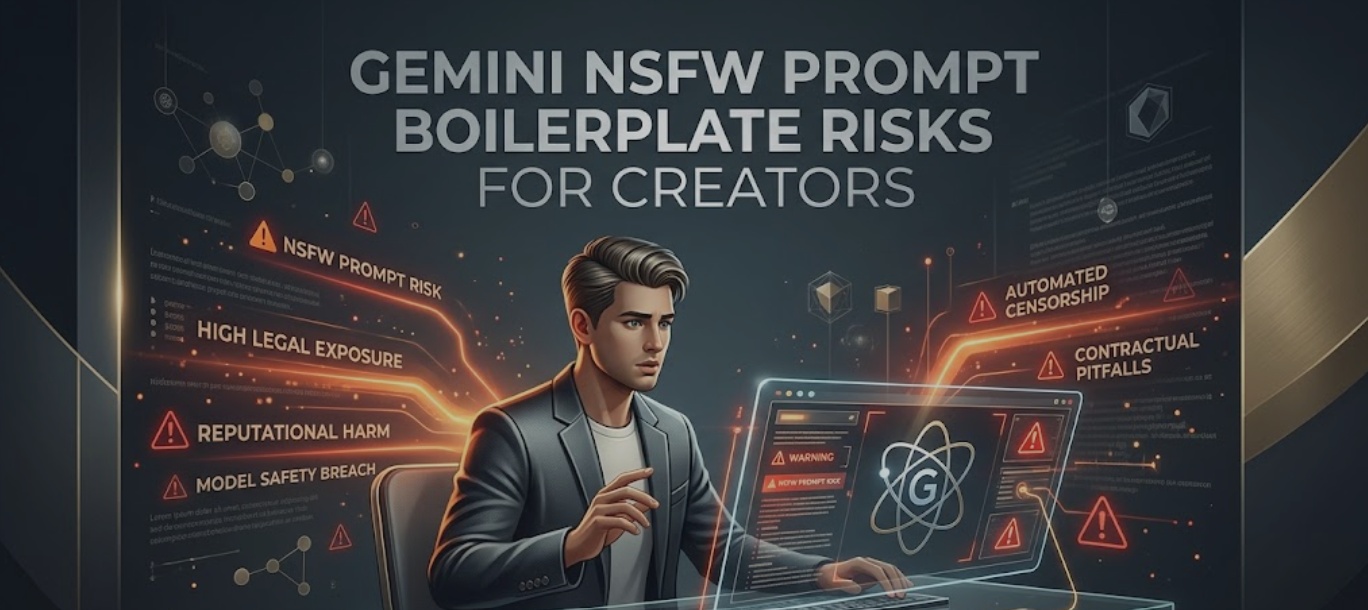
The assumption that a boilerplate guarantees a safe, consistent output is fundamentally flawed. Neural networks are probabilistic, not deterministic. What works today might trigger a permanent account ban tomorrow, especially as model safety thresholds are updated dynamically.
Policy mismatch
The most immediate risk of using an imported template is violating the host platform’s terms of service. The Google Generative AI Prohibited Use Policy explicitly prohibits utilizing the service to generate sexually explicit content (e.g., content created for sexual gratification), non-consensual intimate imagery, or content that attempts to circumvent abuse protections and safety filters. Many boilerplates found online are actively designed to manipulate or “jailbreak” these exact filters. If Google’s automated systems or human reviewers detect that your prompt uses known circumvention tactics, it can lead to immediate restriction or termination of your Google account and API access.
Real-person leakage
A massive liability in adult prompt risks is the unintentional simulation of real humans. If you copy a boilerplate that happens to include references to specific celebrities, public figures, or unauthorized biometric data, you cross a severe legal line. Altering or generating a real person’s likeness in a provocative context without contractual consent violates federal right-of-publicity statutes and international privacy mandates like GDPR Article 9 regarding biometric data. A template you didn’t write might contain latent variables that expose your studio to devastating lawsuits.
Unsafe reuse across projects
Boilerplates cause “latent space drift.” A prompt structure designed to generate an edgy, dark-fantasy aesthetic for one project might produce structurally unstable or highly inappropriate results when applied to a modern commercial campaign. Because the AI relies entirely on semantic token associations, blindly reusing a prompt structure across different contexts invites unpredictable hallucinations and assets that will immediately fail downstream compliance audits.
Safer Prompt Briefing Workflow
To harness the capabilities of advanced models without exposing your organization to legal or operational risk, production teams must abandon copy-paste templates. Instead, replace them with a standardized, internal Standard Operating Procedure (SOP).
Intent notes instead of templates
Instead of relying on a rigid NSFW prompt boilerplate, train your team to write structured “Intent Notes.” Intent notes do not dictate exact prompt phrasing; they define the creative boundaries of the scene.
| Intent Note Category | Example of Safe Implementation | Operational Purpose |
| Atmosphere & Lighting | High contrast, dramatic shadows, moody silhouette. | Directs the aesthetic tone without using sexually explicit trigger words. |
| Physical Framing | Medium close-up, cropped above the chest. | Keeps the visual output focused and prevents unwanted anatomical hallucinations. |
| Narrative Tone | Tense, emotional, romantic tension. | Guides text generation toward emotional resonance rather than explicit physical acts. |
Boundary checklist
Before any prompt is executed in the engine, it must be filtered through an internal screening protocol. Establish a studio-wide negative prompt library that actively prevents the model from generating common structural artifacts or policy-violating content. Ensure your prompts explicitly exclude real-person names, copyrighted properties, and explicit anatomical terms.
Manual approval before testing
If a creative brief requires mature themes, the prompt should never be executed without a second set of eyes. Lead editors or compliance officers must manually review and approve the semantic structure before generation begins. If a prompt triggers an AI platform’s internal warning system during a test, you must completely reset and rewrite the prompt from a clean slate rather than attempting to brute-force a flawed concept.
Facts and Policies to Verify Before Publishing
Generating the asset is only the first step; publishing it legally and safely is the ultimate goal.
First, verify your intellectual property rights. Under formal guidance from the United States Copyright Office (USCO), simply typing a prompt into an AI model does not make you the copyright holder of the output. To secure legal ownership, your workflow must include substantial human authorship, such as manual digital overpainting, precise layer compositing, and structured editorial control over the final asset.
Second, verify your compliance with global transparency laws. Under the upcoming European Union AI Act, commercial deployers of synthetic media must ensure that generated content is marked in a machine-readable format. Professional studios satisfy this by embedding cryptographically signed C2PA Content Credentials into their final exports, explicitly detailing the tools used and the provenance of the asset.
FAQ
Who can approve reusable adult brief language?
In a professional production environment, any reusable phrasing intended for mature or provocative creative briefs must be formally approved by the Studio Compliance Officer and the Lead Technical Director. These roles ensure the language aligns with target platform Terms of Service (TOS) and does not inadvertently violate likeness rights or copyright laws before it is added to the studio’s internal style guide.
What should happen to old boilerplate files?
Outdated AI prompt templates, obsolete boilerplates, and rejected prompt logs must be systematically archived in an encrypted, off-site digital database, rather than left in active shared folders. They should be retained for a minimum of three to five years to demonstrate a documented history of good-faith risk management during potential legal disputes or retrospective platform audits.
When should external review be requested?
An external legal review should be requested whenever a campaign involves highly sensitive mature themes, synthetic generation of recognizable brand elements, or if the studio is expanding into new international markets with stricter synthetic media laws (such as the EU). Never guess when it comes to regulatory compliance.
How should clients be told templates are not allowed?
If a client submits a creative brief demanding the use of an unauthorized gemini prompt for nsfw boilerplate, the account manager must firmly but professionally reject the request. The communication should explicitly state that the studio enforces a strict, custom “Intent Note” workflow to protect the client’s brand from intellectual property disputes, ad-network bans, and platform compliance violations.
Conclusion
Searching for a gemini prompt for nsfw boilerplate highlights a legitimate need for efficiency and aesthetic control in commercial digital art and narrative writing. However, relying on copy-and-paste templates sourced from the internet exposes your studio to catastrophic legal, ethical, and platform risks. By abandoning rigid boilerplates in favor of a disciplined Standard Operating Procedure—enforcing rigorous prompt screening, utilizing intent notes, demanding manual review, and leveraging secure orchestration tools like CrePal—creators can achieve absolute visual and narrative flexibility. In the landscape of unconstrained AI generation, true creative freedom relies on unyielding operational discipline, not hidden templates.