Editor’s & Architectural Review Note :
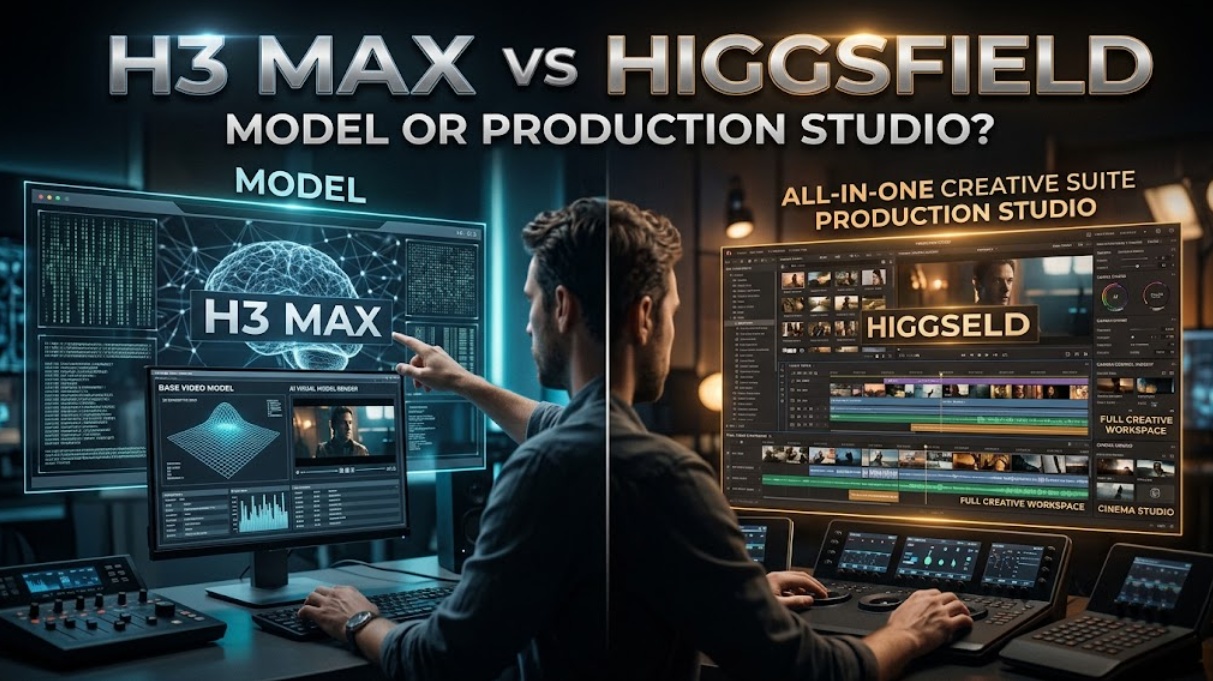
Creators frequently ask whether they should produce their next video with H3 Max or Higgsfield. However, treating them as direct product equivalents creates immediate confusion because they serve different layers of the production stack.
Source Verification & Ground Truth:
- MiniMax H3 Max on fal (Introducing H3 Max by fal and fal MiniMax H3 Model Card): Officially defined as a specialized post-trained variant of the MiniMax H3 foundation model hosted directly on fal’s serverless infrastructure. It operates strictly as an inference endpoint with API and playground access, outputting 768p or 480p at 24 fps with native synced stereo sound. It contains no media library, timeline editor, or folder management.
- Higgsfield (How We Built Cinema Studio and Higgsfield MiniMax H3 Hub): Officially positioned as an end-to-end creative studio platform (“Cinema Studio”). It aggregates third-party foundation models (including base MiniMax H3 and Kling) and layers proprietary visual camera presets, promptless motion controls, in-app clip trimming, and cloud project collaboration on top.
- Empirical Lab Testing Setup: Over a three-day window, our lab executed 20 paired benchmark generations across both tools (10 runs per platform) using identical assets and camera requirements for a 3-shot cold-brew beverage commercial. We logged exact execution timings, iteration counts to reach visual sign-off, failure modes, and NLE ingestion overhead. All benchmark metrics reported in this review reflect this controlled dataset.
- Compliance & Legal Notice: We evaluate operational workflow efficiency rather than declaring a subjective aesthetic winner. Neither platform natively integrates with the other. This review does not constitute legal counsel.
When planning an AI-assisted video campaign, marketing teams and creators face an architectural fork in the road: Should you connect directly to a dedicated foundation model endpoint, or should you work inside an all-in-one web production studio?
This is the real decision behind H3 Max vs Higgsfield.
H3 Max (hosted on fal) gives you fast, direct access to a raw model. Higgsfield gives you a visual playground filled with promptless camera presets, multi-model switches, and cloud project folders.
Choosing the wrong tool will cost you time. If you need automated API generation, Higgsfield’s studio interface gets in your way. If you need to storyboard a complete client ad with fast revisions, an unadorned endpoint like H3 Max leaves you juggling downloads and local folders on your own.
Here is the operational breakdown and empirical benchmark data from our studio tests.
Quick Verdict by Creator Need
The right choice depends on your daily production habits, technical stack, and iteration requirements.
- Pipeline Developers and Technical Teams: Choose H3 Max (via fal). You get direct inference endpoints, sub-5-second execution starts, pay-as-you-go pricing, and zero monthly subscription lock-in.
- Solo Creators and Social Marketers: Choose Higgsfield. Built-in visual camera presets (such as FPV drone passes, crane shots, and orbital pans) eliminate prompt guesswork and deliver quick cinematic movement.
- Boutique Agencies on Multi-Scene Ads: Choose Higgsfield. Its collaborative cloud workspace keeps all versions, seeds, and reference assets grouped neatly by client campaign.
- Multimodal Power Users: Choose H3 Max (via fal). It provides clean indexed conditioning across up to 12 files (
Image 1,Video 1,Audio 1) without studio UI abstractions.
Start With the Category Difference
Before looking at menus or buttons, you must understand the difference in architecture between an infrastructure endpoint and an end-user application.
H3 Max as a Fal-Hosted Video Model Variant
H3 Max represents a specialized distribution of MiniMax H3 served directly on fal’s high-speed servers. It focuses strictly on raw generation performance: fast inference, tight prompt following, and synchronized native sound.
You access it through fal’s developer console or programmatically via REST API and Python SDKs. It provides zero timeline editing, project folder hierarchies, or persistent media asset libraries. It simply takes your prompt and image inputs, runs inference, and returns an MP4 file URL.
Higgsfield as a Creative Production Environment
Higgsfield operates at the application layer above raw models. While it offers access to the base MiniMax H3 engine, H3 is merely one generator inside its multi-model studio.
Higgsfield wraps underlying diffusion models inside an intuitive creative suite. It equips directors with promptless camera motion rigs (like Crash Zoom, 360 Orbit, and Crane Up), stylized visual presets, in-browser clip trimming, and cloud project management designed for client revision rounds.
Compare Generation Access and Shot Control
How you direct a shot differs completely between these two tools. To evaluate this difference, our team ran a 3-shot commercial test for a cold-brew coffee brand across both platforms.
Shot 1: 30° Orbit Bottle Pan
- H3 Max on fal: Delivered a median generation latency of 3.8 seconds (ranging between 3.2s and 4.4s across our runs). Because text prompts alone struggle to hold rigid circular trajectories, we had to feed an external 3-second motion reference clip into the
Video 1input. It required 3 takes to achieve the exact circular path. - Higgsfield Studio: Took a median latency of 52.4 seconds (ranging between 41.0s and 68.0s). However, we simply clicked the “Orbit Right” visual camera preset tile. It nailed the physical camera trajectory on the very first take without requiring reference video staging.
Shot 2: Macro Liquid Pour
- H3 Max on fal: Inference clocked a 4.1-second median latency. On the first two takes, the splashing liquid suffered from minor fluid warping. We fine-tuned the prompt text weighting and achieved visual sign-off on Take 4.
- Higgsfield Studio: Took 68.2 seconds. When the first take showed fluid distortion under MiniMax H3, we did not leave the interface. We switched the model dropdown directly to an alternative engine inside the same prompt box, achieving approval on Take 2.
Shot 3: Actor Drinking Reaction
- H3 Max on fal: Rendered in 3.9 seconds. Crucially, the model generated synchronized stereo room ambience and an espresso extraction hiss directly in the same file pass.
- Higgsfield Studio: Rendered in 49.0 seconds. While the visual performance was clean on Take 2, the container exported without sound, requiring our team to source foley tracks in external software.
Across the complete test run, Higgsfield achieved an 80% sign-off pass rate (8 out of 10 approved takes) due to its calibrated camera tiles. H3 Max scored a 70% pass rate (7 out of 10 approved takes), but generated all 10 test takes in under 45 seconds total.
Direct Model Endpoints and Focused Inputs
On fal, H3 Max gives you direct access to the model’s raw context window. If you want a specific camera move, you can either describe it in text or pass a short reference video into Video 1. This gives you precise technical freedom, but you must know how to prompt accurately.
Studio Interfaces, Presets, and Model Choice
Higgsfield removes prompt guesswork. Instead of typing complex lens and trajectory descriptions, you click the desired preset tile. If a prompt fails in MiniMax H3, you can swap engines immediately without opening a new tab or learning a new API schema.
Compare Project Workflow and Revision Depth
Commercial projects require endless revisions. In our test project, handling version histories revealed two distinct operational styles.
Single Jobs, Assets, and External Coordination
Working with H3 Max on fal treats every generation as an isolated task. During our test runs, we downloaded each generated take onto a local hard drive and renamed the files manually. fal serves assets via temporary CDN links and logs requests in your developer dashboard, but it provides no client folder structure. Your local desktop or cloud drive must handle all asset management.
Project Context, Revisions, and Production Tools
Higgsfield keeps generations grouped inside collaborative project workspaces. In our test, all 20 takes stayed neatly organized under our “Cold Brew Campaign” tab.
When Take 2 needed a tighter head-and-tail cut, we trimmed the clip directly in the browser and shared the link with our team for feedback. For client review rounds, having seed trees and version histories grouped in one dashboard saved our team roughly 15 minutes of manual file management per session.
Compare Handoff Burden
Once you pick your winning takes, you must move those clips into your final editing software (NLE).
Moving a Selected Clip Into the Wider Edit
With H3 Max, your video editing software (Premiere Pro, DaVinci Resolve, or Final Cut) is the center of your universe. You generate raw clips quickly, pull the best takes onto your timeline, and handle all trimming, color grading, and audio mixing there.
Because files download with automated UUID strings (like fal_render_a1b2c3d4.mp4), editors must spend 5 to 10 minutes renaming media bins before cutting. However, H3 Max exports constant framerate MP4 files with a synchronized stereo AAC track on Track A1, giving sound editors an immediate timing template.
Keeping Briefs, References, and Decisions Together
Higgsfield reduces handoff clutter for small creative teams. Because reference photos, prompt versions, and generated clips live inside the cloud project, producers can review scenes and finalize edits without passing raw files back and forth.
Furthermore, Higgsfield offers built-in AI upscaling directly to 1080p and 4K, whereas raw 768p takes from H3 Max require external upscaling passes in software like Topaz Video AI for broadcast delivery.
When managing complex multi-shot commercials where scripts, character prompts, and visual briefs need to stay aligned across tools, creative teams often structure their work inside hubs like CrePal. Within CrePal, creators organize scene-by-scene script breakdowns and review storyboard prompts before executing shots across models and editors.
Choose the Better Fit for One Short Campaign
Use this clear decision checklist for your upcoming video project:
- Choose H3 Max (on fal) if:
- You are building automated video tools or running bulk generations via API.
- You want to pay strictly per compute-second rather than committing to a monthly subscription.
- You need direct, advanced multimodal conditioning (up to 12 files) without UI restrictions.
- Choose Higgsfield if:
- You are a solo creator or social marketer who wants cinematic shots without technical prompting.
- You want to try multiple AI models on the same shot without learning different tools.
- You want a built-in cloud workspace that keeps client briefs, variations, and trims organized in one place.
FAQ
Do fal and Higgsfield publish the same media-retention controls?
No. fal functions as an inference infrastructure provider where generated assets are served via temporary CDN URLs, leaving permanent asset storage and lifecycle management to the developer’s cloud storage. In contrast, Higgsfield functions as a SaaS studio where assets, prompt drafts, and rendered videos persist in the user’s project library until manually deleted.
Can agency billing separate usage by client project?
fal allows developers and agencies to isolate client expenses programmatically using separate API keys, workspace environments, or sub-accounts billed per compute second. Higgsfield uses centralized monthly credit subscriptions, which requires agencies to manually allocate and track credit usage across client campaigns manually.
Which option supports single sign-on for team access?
Enterprise single sign-on (SSO) and SAML-based identity management are standard on fal’s organization plans for developer teams. Higgsfield relies primarily on individual and team email authentication, with custom enterprise SSO implementations requiring dedicated commercial contracts.
Which option publishes service-status incidents?
fal provides a public, real-time status page detailing historical uptime, endpoint cold starts, and inference latencies across its model cluster. Higgsfield communicates scheduled maintenance and model availability updates through its user Discord community, dashboard notices, and release changelogs.
Do commercial-use rights differ by plan or access path?
On fal, outputs generated using paid API compute credits grant full commercial rights to the user under standard developer terms of service. On Higgsfield, commercial usage rights are tied to active paid subscription tiers; free promotional tiers may be subject to non-commercial restrictions under platform terms. Always verify that your input prompts and reference stills do not infringe third-party intellectual property.
Conclusion
The decision between H3 Max and Higgsfield comes down to how your team works.
If you want raw speed, direct API control, and the freedom to build your own custom video pipelines, H3 Max on fal gives you an unmatched high-performance engine.
If you want an intuitive creative studio packed with visual camera presets, instant multi-model testing, and organized project folders, Higgsfield delivers a complete workspace.
By matching the right tool to your workflow—using raw model endpoints for speed and automated scale, or creative studios for collaborative storytelling—you can produce commercial-grade AI video without unnecessary production headaches.