Editor’s Note:Prepared by the Creative Automation & Agent Systems Desk. While single-prompt generative tools have saturated commercial workflows, production pipelines frequently break down when coordinating cross-media assets. This technical explainer examines the operational architecture of the MiniMax Design multi-agent system. Rather than reviewing platform adoption metrics or repeating step-by-step brief tutorials, this analysis focuses on how MiniMax Design coordinates specialized sub-agents, manages task dependencies, handles parallel execution across modalities, and routes assets back to human checkpoints.
In commercial creative agencies and high-output brand marketing departments, the primary bottleneck in generative media is no longer the synthesis of an individual image or paragraph of copy. The friction lies in cross-media alignment. When copywriters, concept artists, and motion designers operate in isolation, assets diverge: color palettes shift, character geometry warps, and narrative hooks misalign between static banners and short-form video ads.
MiniMax directly targets this coordination challenge with MiniMax Design, a desktop-first creative environment powered by an orchestrated AI creative agent team. Instead of prompting disparate tools sequentially, the system deploys an executive coordination agent to interpret raw campaign briefs, map cross-modal dependencies, and supervise specialized sub-agents working concurrently.
This deep dive explains how MiniMax Design’s parallel agent architecture operates, where it reduces production friction, and where human intervention remains technically mandatory.
What an Agent Team Means in MiniMax Design
In traditional AI toolsets, a user acts as the sole router—generating text in an LLM, manually copy-pasting visual descriptions into an image model, and then feeding those results into a video generator.
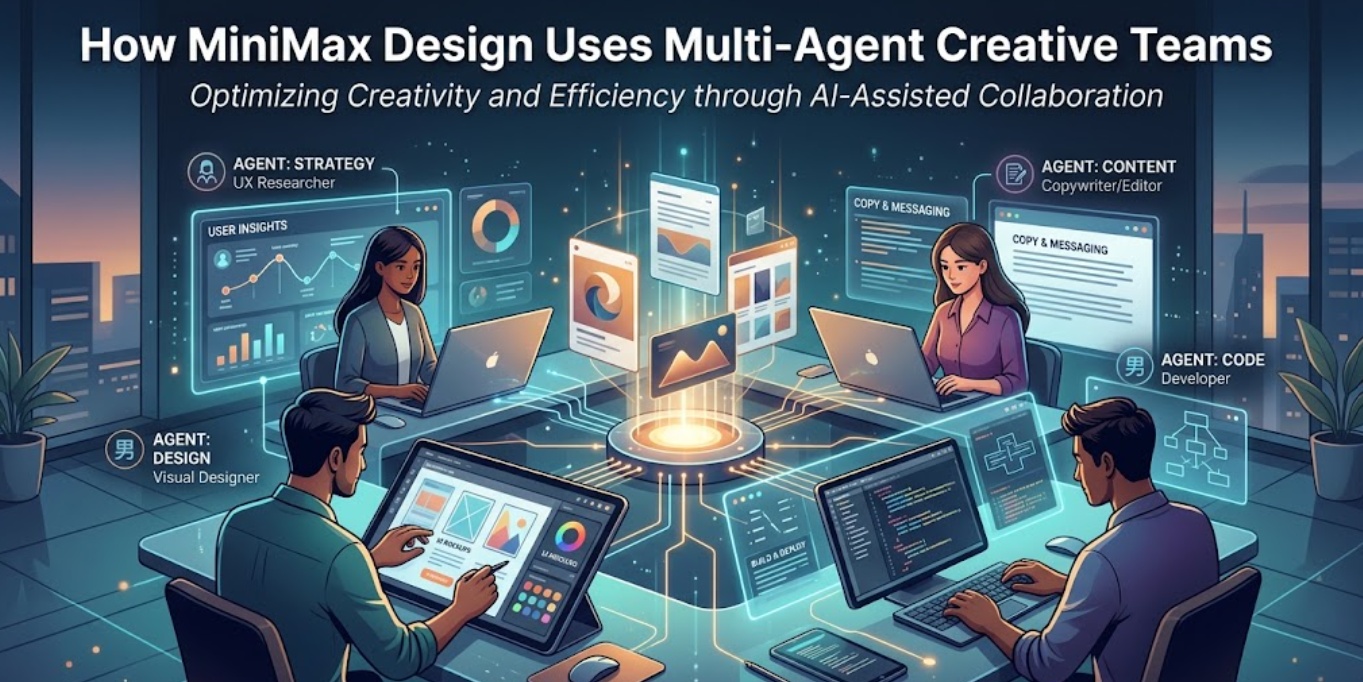
MiniMax Design replaces this manual routing with an integrated multi-agent creative workflow. Within the platform, an “agent team” is a coordinated group of specialized digital roles governed by an executive planning agent. According to verified product documentation on the MiniMax Design Product Hub, the workspace delegates tasks across four distinct operational domains:
- Copy Agent: Focuses on headline drafting, ad hooks, body copy, and voiceover scripting.
- Image Agent: Manages composition, lighting palettes, and hero key visual synthesis.
- Video Agent: Directs motion dynamics, camera trajectories, and temporal coherence.
- Audio Agent: Compiles ambient soundscapes, sound effects (SFX), and spoken voice tracks.
By treating these tasks as concurrent sub-routines rather than isolated prompts, the system preserves context across different asset formats within a single project container.
How the Main Agent Turns a Brief Into Tasks
The execution process begins with the executive orchestrator converting high-level strategy into actionable compute jobs.
┌─────────────────────────────────────┐
│               MiniMax Design Task Decomposition Engine                 │
├───────────────────────────────────────┤
│ INPUT BRIEF ──► Executive Orchestrator (Intent Analysis)               │
│                      │                                                 │
│                      ├──► Dependency Mapping & Constraint Rules        │
│                      │                                                 │
│                      ├──► Copy Track   [Taglines / Script Beats]       │
│                      ├──► Image Track  [Hero Packshots / Textures]     │
│                      ├──► Video Track  [Camera Paths / Subject Motion] │
│                      └──► Audio Track  [Voiceover / Soundbed]          │
└───────────────────────────────────────┘
Goal Interpretation and Task Decomposition
When a user inputs an unstructured campaign brief, the main planning agent does not immediately execute asset generation. Instead, it runs an initial parsing pass to extract the campaign’s core value propositions, target audience demographics, visual aesthetics, and required delivery formats. It then decomposes this analysis into an interactive, multi-branch task tree visible on the desktop canvas.
Dependencies Between Copy, Image, Video, and Audio
Not all creative tasks can run in parallel; some require strict sequencing. For example, a commercial video cannot be effectively timed without an established script duration, and an audio agent cannot synthesize voiceovers without locked ad copy. The orchestrator identifies these natural dependencies:
- Sequential Pre-Requisites: Copy hooks and narrative beats are drafted first to establish the thematic tone and timing constraints.
- Downstream Synthesis: Once visual references and copy scripts clear their initial generation passes, dependent tasks—such as motion rendering and voice synthesis—are triggered using the upstream parameters as contextual boundaries.
How Specialized Agents Work in Parallel
Once linear dependencies are resolved, the true operational speed of the MiniMax agent team comes from asynchronous, parallel execution.
┌──────────────────────────────────────┐
│                   Parallel Asset Track Coordination                    │
├───────────────────┬───────────────────┤
│ SPECIALIZED AGENT │ EXECUTION FOCUS & OUTPUT DOMAIN                    │
├───────────────────┼───────────────────┤
│ Copy Agent        │ Short-form captions, ad hooks, translation drafts  │
│ Image Agent       │ High-resolution key visuals, texture passes        │
│ Video Agent       │ Multimodal motion synthesis (MiniMax H3 backends)  │
│ Audio Agent       │ Background music bed generation, synthetic VO      │
└───────────────────┴─────────┘
Separate Asset Tracks
Rather than forcing a creative team to wait for an image to finish before prompting a video, MiniMax Design dispatches tasks across isolated compute tracks. While the Video Agent executes motion synthesis leveraging multimodal pipelines—such as the open-weight MiniMax H3 model family on Hugging Face—the Copy Agent operates independently, drafting multiple text variations without tying up GPU compute allocated to video rendering.
Shared References and Creative Direction
Parallel execution without shared constraints results in stylistic chaos. MiniMax Design prevents drift by enforcing a centralized context repository. Uploaded reference files (product packshots, approved color swatches, typography rules) and the lead agent’s strategic guidelines are shared globally across all sub-agents.
When the Image Agent renders a static product shot and the Video Agent renders a dynamic scene cut, both pull from the same foundational reference inputs to maintain physical color balance and subject identity.
How Results Return for Review
The lifecycle of an agent-driven task ends on an integrated review board rather than a disorganized download folder.
Merge, Edit, and Export
As individual sub-agents complete their respective tasks, the outputs are dynamically assembled onto a unified project board. Here, assets are contextualized side-by-side: marketing headlines sit directly above hero imagery, and video drafts are paired with their synthetic audio tracks. The platform allows creators to review individual components modularly—regenerating an underperforming headline without disrupting the approved video asset.
Human Decisions Before Delivery
The architecture explicitly relies on human-in-the-loop validation before assets are marked for final export:
- Brand Alignment Sign-Off: Operators must manually verify that LLM-generated claims meet brand safety and regulatory advertising standards.
- Aesthetic Continuity: Creative leads evaluate whether the lighting, tone, and pacing of the parallel assets form a cohesive campaign narrative.
- Alternative Orchestration Paths: While MiniMax Design uses an internal team of sub-agents to generate cross-media assets simultaneously, teams pursuing a strictly sequential, cinema-first video pipeline often leverage platforms like CrePal. CrePal approaches video production through a dedicated AI Director framework—focusing deeply on scene-by-scene script planning and multi-model timeline continuity rather than broad cross-format asset delegation.
Where Parallel Agents Help and Where They Add Risk
| Operational Factor | Production Benefit (Where They Help) | Operational Risk (Where They Add Risk) |
| Turnaround Velocity | Cuts pre-production concepting from hours to minutes by generating text, images, and video concurrently. | High initial credit burn if an unverified, ambiguous brief is executed across all agents simultaneously. |
| Cross-Modal Consistency | Shared reference grounding reduces aesthetic drift between marketing copy and visual collateral. | Minor physical discrepancies (e.g., product label texturing) can still slip through high-motion video frames. |
| Modular Iteration | Operators can isolate and re-run single asset nodes without rebuilding the entire project container. | Complex dependency chains can fail if an upstream asset revision is not properly propagated downstream. |
Limits of Parallel Creative Production
Despite the efficiency of multi-agent delegation, production teams must understand the system’s technical boundaries:
- Closed Compute Orchestration: The desktop client delegates rendering to MiniMax’s cloud-hosted infrastructure. Real-world execution speeds and queue latency depend entirely on server compute load and account credit allocations.
- No Native Vector Compositing: While sub-agents output high-resolution raster files (PNG/JPEG), text documents, and compiled video files (MP4), the workspace does not natively produce layered vector design files (e.g., SVG or multi-layer PSDs). Final typography typesetting and vector logo finishing still require manual execution in dedicated design suites.
- Legal and Compliance Responsibility: Automated sub-agents do not possess legal judgment. Commercial synchronization rights, synthetic media disclosures, and compliance with platform advertising rules remain the sole legal responsibility of the human operator.
FAQ
Can creators pause one agent without stopping the others?
Yes. MiniMax Design’s task tree allows creators to pause, cancel, or delete individual sub-agent tasks—such as halting a video rendering pass—while allowing the Copy and Image agents to complete their generations uninterrupted.
Can agents use different brand reference libraries within one project?
While the lead orchestrator applies global references to the entire project by default, users can manually attach specific localized references (such as unique product stills) directly to individual agent task nodes.
Does each agent retain context from earlier project revisions?
Sub-agents operate within the active project’s session state, meaning they reference previously approved prompts and parameters from that specific project canvas. However, cross-project memory across distinct campaign files is not automatically retained unless saved as a custom reusable template.
Are agent task histories exportable for later workflow analysis?
The platform documents prompt logs, agent assignments, and generation timestamps within the project file, enabling production leads to review the exact sequence of agent actions for post-campaign retrospective analysis.
What happens when one agent exhausts available media credits?
If account credits are exhausted mid-run, the specific task node attempting generation will pause and throw an insufficient credit alert, while already completed assets generated by preceding parallel agents remain intact and accessible on the board.
The public product documentation confirms multi-agent parallel processing, but does not clearly document whether individual agent nodes can be paused independently
Conclusion
Understanding how the MiniMax Design multi-agent system functions reveals a major evolution in generative production: moving away from isolated prompt engineering toward structured creative systems orchestration. By decomposing complex marketing briefs into specialized, concurrent pipelines for copy, imagery, video, and audio, MiniMax Design drastically reduces the manual friction of cross-media production. However, maximizing the value of an AI creative agent team requires disciplined brief preparation, active pruning of unnecessary tasks, and rigorous human review before any generated asset is cleared for public distribution.