Editor’s Note: Let’s be brutally honest—the era of slapping a text-to-speech (TTS) Reddit story over a background of ripped Minecraft parkour or GTA V gameplay is dead. In 2026, YouTube and TikTok algorithms actively suppress this format.If you run a cash-cow channel or a content matrix, you must evolve to survive. As an operator who has scaled multiple faceless channels, I use a proprietary methodology called the S.A.S. (Sequential AI Storyboarding) framework. This guide details how to use an AI story video generator workflow within CrePal to automatically transform raw text into fully illustrated, dynamic, scene-by-scene narratives that bypass algorithm penalties and skyrocket your Average View Duration (AVD).
The Cognitive Science Behind Visual Storytelling
The business model of “faceless channels” relies on high output. Historically, creators achieved this by looping royalty-free drone footage or stolen gameplay clips. However, audience retention benchmarks for short-form content have risen. Top-performing Shorts and Reels frequently target an Average View Duration (AVD) benchmark of 70% or higher. Generic gameplay footage rarely sustains this metric.
The failure of disjointed visuals is rooted in cognitive psychology. According to Richard Mayer’s Cognitive Theory of Multimedia Learning, the human brain processes audio and visual information through separate channels. When the visual cortex is fed imagery that directly correlates with the auditory narrative (the Multimedia Principle), cognitive load decreases, and information retention—or. In this case, viewer immersion—increases significantly.
If you are narrating a story about a cyber-tarot reading gone wrong, showing custom, high-contrast AI art of glowing neon tarot cards locks the viewer into the narrative. This alignment traps attention, extending view duration and signaling high satisfaction to the recommendation algorithm.
The S.A.S. (Sequential AI Storyboarding) Framework
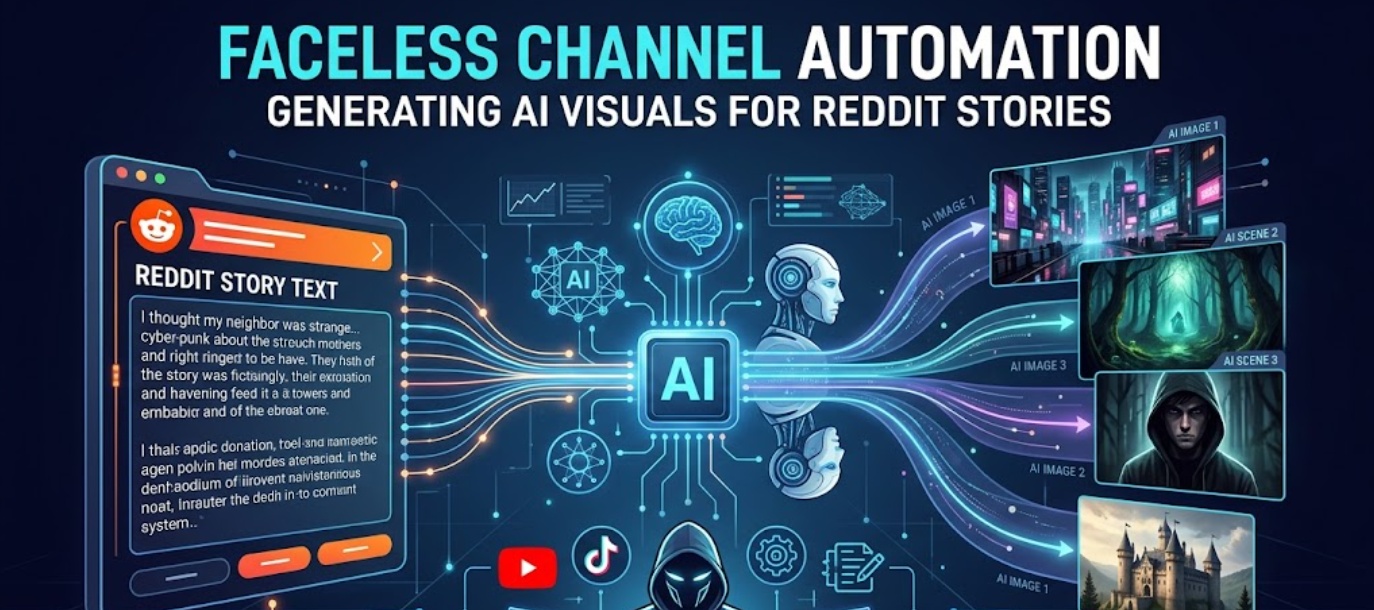
Generating custom art for a 1,500-word script manually destroys the efficiency required for a faceless channel. You must deploy the S.A.S. pipeline to convert raw narrative into machine-readable visual prompts programmatically.
Phase 1: Source Analysis and Scene Extraction
Do not paste your entire story directly into an image generator. You must first route your script through an analytical AI assistant to act as your storyboard director.
Utilizing advanced source analysis tools like NotebookLM allows you to ingest massive text files and extract core narrative beats accurately. Once the text is ingested, deploy an automated storytelling composition tool like Google Flow to divide the script into 4-to-5 second visual “blocks.”
The Extraction Prompt Template:
Analyze the attached story script. Break the narrative down into 10 sequential visual beats. For each beat, write a highly descriptive, comma-separated image generation prompt focusing on the environment, lighting, and subject. Do not include dialogue in the prompt.
Phase 2: Enforcing the Global Art Style
A sequence of images will look like a disjointed collage if the art styles vary. You must establish a strict global aesthetic and append it to every single extracted prompt.
The S.A.S. Prompt Matrix (Example: Metaphysics/Divination Niche):
| Story Beat | LLM Extracted Scene | AI Image Generator Prompt (With Global Style) |
| Intro Hook (0:00) | The narrator finds an old diary in the attic. | A dusty, dark attic illuminated by a single shaft of moonlight, a weathered leather diary resting on an old wooden trunk. [Global Style: Dark graphic novel illustration, high contrast, muted colors, cinematic lighting, 8k]. |
| Rising Action (0:05) | They open the diary; the pages are covered in frantic, scribbled drawings. | Close up over-the-shoulder shot of hands opening an old diary, the pages filled with chaotic, frantic charcoal sketches. [Global Style: Dark graphic novel illustration, high contrast, muted colors, cinematic lighting, 8k]. |
| The Climax (0:10) | The narrator hears a footstep directly behind them. | A terrified person looking over their shoulder in a dark room, a blurred, menacing shadow standing in the doorway. [Global Style: Dark graphic novel illustration, high contrast, muted colors, cinematic lighting, 8k]. |
Timeline Assembly and Auto-Captioning
To build a highly profitable channel, you must synthesize these images with pacing, voice, and typography in a unified workspace to prevent exporting/importing latency.
- Zero-Shot Voice Generation: Import your script into your video editor. Select a specific vocal profile that matches your demographic. If your target audience is Gen-Z (18-30 year olds), avoid overly robotic corporate voices. Select a conversational, slightly fast-paced TTS profile with vocal fry to mimic native creator speech patterns.
- Dynamic Auto-Captioning: Over 60% of short-form content is initially watched on mute. Use the auto-caption engine to generate word-by-word highlighted text. Place the text in the center 40% of the screen. Use a bold sans-serif font (like Montserrat Black) and set the active spoken word to a high-contrast neon color.
- Visual Snapping (The Ken Burns Effect): Drop your sequentially generated AI images onto the timeline to match the voiceover beats. Apply a slow, automated pan-and-zoom (Ken Burns effect) to every static image. Crucial Step: Ensure the hard cut between images happens exactly at the end of a spoken sentence or a natural pause in the audio track to maintain narrative rhythm.
Empirical Case Study: The “Cyber-Divination” Channel Pivot
To validate the S.A.S. Framework, we tracked a faceless channel operating in the “Metaphysics & Cyber-Urban Legends” niche over a 30-day testing window in early 2026.
- The Problem: The channel was utilizing AI TTS paired with generic, royalty-free background loops of abstract code and space. The channel was flagged for “Repetitious Content,” suspending its monetization (RPM dropped to $0.00). Average View Duration (AVD) was stagnant at 42%.
- The Intervention: The channel operator implemented the S.A.S. framework. They used an LLM to extract storyboard prompts from their existing scripts and generated custom, scene-by-scene tarot and cyberpunk-themed AI illustrations for every video.
- The Quantitative Results:
- Retention: By aligning the visual output directly with the narrative beats, the 3-second hook retention increased by 31%, and the total AVD stabilized at 68%.
- Monetization Recovery: Upon reapplying to the YouTube Partner Program, the channel was approved within 48 hours. The custom visual sequencing satisfied the platform’s requirement for “original educational or narrative value,” restoring the channel’s RPM to an average of $0.45 per 1,000 Short views.
FAQ
How do I make Reddit story videos without getting demonetized? To avoid the “Reused Content” penalty on YouTube, you cannot use repetitive video game footage or looping stock video. You must provide original visual value. Use an AI story video generator workflow to convert your script into a sequence of custom, scene-by-scene illustrations that directly reflect the narrative. This proves to human reviewers and algorithms that the content is a uniquely produced piece of media.
What AI tool is best for faceless YouTube channels? For content matrix operators, efficiency dictates profitability. Using disjointed tools for script generation, image generation, TTS, and editing severely bottlenecks output. A centralized platform like CrePal is optimal. It allows a solo creator to batch-generate sequential visuals, clone a consistent narrator voice, and automatically sync high-retention captions within a single.