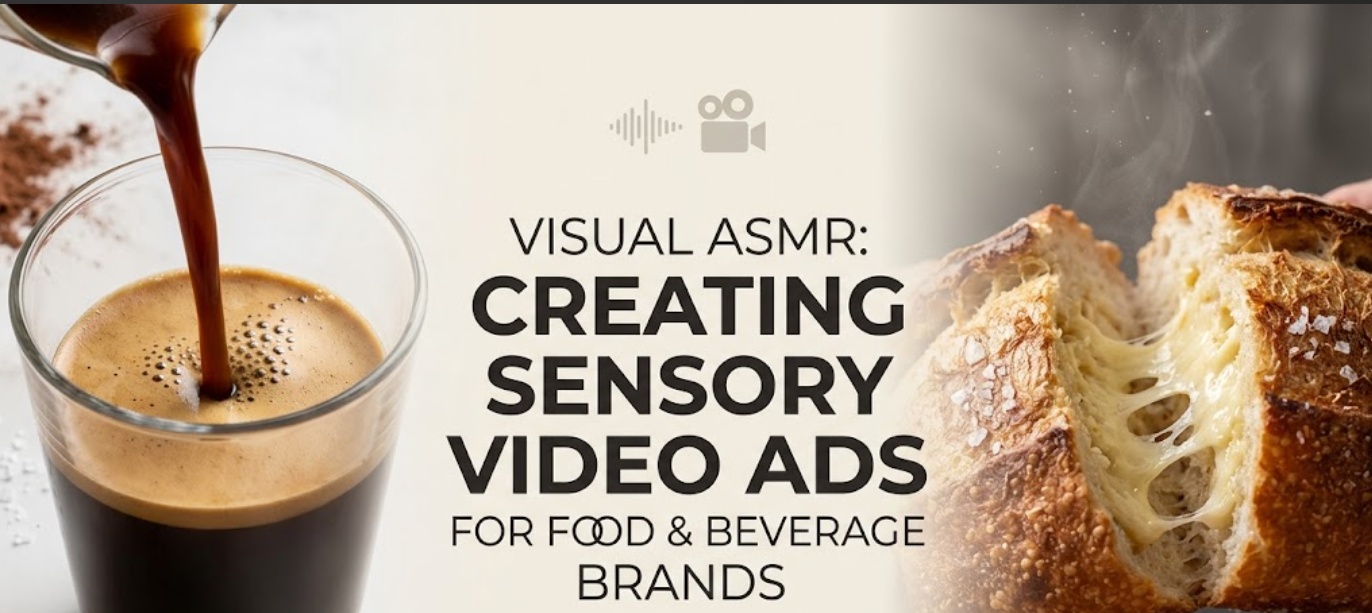
Editor’s Note:The era of static, brightly lit menu photography is over. When marketing premium culinary experiences in 2026, consumers do not just want to see a product; they want to feel the temperature, hear the carbonation, and practically taste the extraction. According to foundational research on the science of sensory marketing published by Harvard Business Review, campaigns that engage multiple senses significantly amplify brand recall and perceived value.
The Rise of Sensory Marketing in Food & Beverage
The digital food and beverage market has reached saturation. Whether you are promoting a Michelin-starred tasting menu or a boutique roasted bean, a standard top-down flat-lay photo no longer disrupts the algorithmic feed. To capture market share, top-tier brands are transitioning entirely to sensory marketing.
Why visual ASMR triggers higher engagement than traditional plating shots
Sensory marketing targets the autonomic nervous system. Autonomous Sensory Meridian Response (ASMR) leverages specific audio-visual triggers—like, like the slow, viscous pour of caramel, the sharp crack of a roasted coffee bean, or the deep, resonant sizzle of a sear—to induce a mild, pleasurable tingling sensation, a phenomenon extensively documented in peer-reviewed psychological studies published in PLOS One.
For modern oriental tea brands or boutique coffee labels, the marketing funnel frequently drives users toward highly immersive offline activations. Selling tickets to a “sound of blank space” meditation tea ceremony or an immersive coffee sensory workshop requires bridging the digital-to-physical gap. If the initial video creative allows the viewer’s brain to “hear” the crackling ice and “feel” the warmth of the rising steam, the psychological barrier to RSVP is drastically lowered.
Prompting for Macro Culinary Physics
When acting as a visual asmr creator, your generative AI tools are only as good as the physical parameters you define. Generative video models naturally struggle with fluid dynamics (liquids often look like gelatin if prompted incorrectly). You must explicitly command the physics engine.
Simulating rising steam, slow-motion pours, and macro extraction shots
To bypass the “AI plasticity” effect, you must construct prompts that dictate the lens focal length, the lighting angle, and the exact physical behavior of the liquid or gas.
The F&B Motion Prompt Matrix:
| Visual Element | Lens & Camera Prompt | Fluid Dynamics & Lighting Parameters | Motion Scale (1-10) |
| Espresso Extraction | 100mm macro lens, extreme close-up, fixed camera | Thick, golden crema dripping slowly from a chrome portafilter, viscous liquid dynamics, dark moody background, warm rim lighting. | 3 (Keep structural integrity) |
| Iced Beverage Pour | 50mm lens, slow tilt down, shallow depth of field | Slow-motion splash as amber liquid hits perfectly clear ice cubes, heavy condensation on the glass, bright natural backlighting. | 5 (Allow for splash variation) |
| Rising Steam/Smoke | 85mm lens, slight tracking right | Thick, volumetric steam rising slowly from a dark ceramic teacup, catching cinematic shafts of morning sunlight, dust motes. | 2 (Let the environment move, not the cup) |
xpert Workflow Tip: Never attempt to generate the environment, the human consumer, and the macro food detail in a single prompt. Isolate the product. A hyper-focused shot of melting butter on a sear will always render with higher fidelity than a wide shot of a chef cooking in a busy kitchen.
The Audio-Visual Synchronization Workflow
A beautifully generated slow-motion pour is completely ineffective if the sound design feels hollow. In sensory marketing, the audio track is arguably more important than the visual. You are not just adding a background music track; you are engineering acoustic triggers.
Matching crisp foley sounds (ice clinking, liquid pouring) to AI visuals
To finalize your cinematic B-roll, import your generated clips into an advanced sensory video editor timeline.
- The Foley Layering Process: Do not rely on a single sound effect. To create hyper-realistic ASMR, you must layer your Foley (custom sound effects). For a shot of iced coffee, layer three distinct tracks: a low-frequency ambient room tone, a high-frequency “crack” of ice settling, and the wet, viscous sound of the liquid pour.
- Micro-Transient Snapping: Zoom in on your audio waveform until you can see the individual milliseconds. The exact frame where the AI-generated liquid hits the ice in the video must align perfectly with the sharpest peak (the transient) of the ice-clink audio file. A delay of even 3 frames will break the ASMR illusion and alert the viewer’s brain that the video is synthetic.
- Binaural Panning: If your AI camera slowly pans from left to right across a steaming cup of tea, use your editor’s audio pan controls to slowly shift the sound of the sizzling steam from the viewer’s left headphone to their right headphone. This creates a deep, three-dimensional spatial awareness that anchors the sensory meditation experience.
FAQ
How do I create an ASMR food video? Creating an ASMR food video requires prioritizing extreme macro visuals and layered sound design. First, use an AI video generator to create hyper-detailed, slow-motion clips of specific culinary actions (e.g., steam rising, liquid pouring) by using precise focal length and fluid dynamic prompts. Second, import those clips into an editor and layer high-fidelity Foley sound effects (like sizzling, crackling, or pouring), ensuring the audio peaks align down to the millisecond with the visual impacts on screen.
Can AI generate cinematic coffee B-roll? Yes. By using advanced image-to-video diffusion models, you can generate Hollywood-tier coffee B-roll without a physical camera. The key is isolating the subject in your prompt (e.g., focusing solely on an espresso portafilter rather than a whole cafe scene) and maintaining a low motion-scale parameter. You can then assemble these high-resolution, slow-motion clips in a unified platform like CrePal, layering in ambient cafe audio to create a complete, sensory-rich advertisement.