Editor’s Note: All service frameworks, dynamic cost models, and technological production benchmarks outlined in this operational evaluation have been updated for the Q2 2026 corporate benchmarking cycle.
The operational mathematics governing digital creative production have fundamentally transformed. Growth-stage direct-to-consumer (DTC) brands, digital-first enterprises, and performance marketing organizations no longer view mobile-native vertical video as an organic social experiment. Today, short-form creative assets (ranging from 15 to 60 seconds) stand as the primary engine driving paid performance customer acquisition loops across Meta, TikTok, and YouTube Shorts.
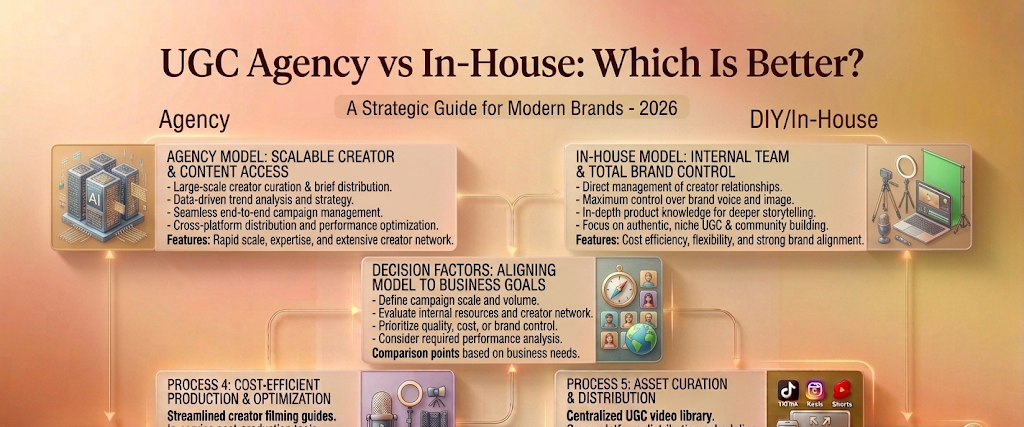
However, as platform algorithms increasingly reward creative diversity and penalize repetition, marketing leaders face a structural infrastructure challenge. The core question is no longer whether to execute short-form creative—it is deciding how to build the underlying production pipeline. Should an enterprise delegate its entire creative development lifecycle to a specialized external ugc agency, or commit capital to construct an internal creative studio entirely in-house?
                    [Creative Production Infrastructure Dilemma]
                                         |
                +------------------------+------------------------+
                |                                                 |
                v                                                 v
    [Outsourced Variable Model]                       [In-House Fixed Infrastructure]
    - Low asset brand intimacy                        - High initial capital expenditure
    - High demographic agility                        - Severe capacity bottlenecks
    - Fixed external agency premiums                  - Absolute brand compliance control
Many growth teams miscalculate this decision by evaluating it through a simple hiring framework. In reality, this choice dictates an organization’s financial risk profile, asset velocity, and data-feedback integration.
This operational guide provides a definitive comparative analysis. Drawing on 2026 performance benchmarks across asset unit costs, processing velocity, and creative degradation mechanics, we analyze both models to establish an objective decision matrix for digital strategy directors and chief marketing officers ($$CMO$$).
What a UGC Agency Does
A specialized performance agency operates as a decentralized, mobile-native asset factory. Unlike traditional advertising firms tied to slow, multi-month production lifecycles, contemporary ugc agencies function as agile direct-response hubs.
When an internal growth team issues a ugc content creation request, the agency manages the full lifecycle of native vertical video production:
- Creator Sourcing: Matching your brand with a precise ugc influencer or micro-creator based on audience demographic alignment and historical conversion data.
- Script Optimization: Writing psychologically optimized direct-response scripts designed to hook viewers within the first 3 seconds.
- Post-Production Editing: Infusing raw footage with native captioning, pacing cuts, and kinetic text to maximize feed retention.
UGC Agency vs In-House Team: The 4 Core Vectors
Choosing between an external partner and an internal team requires analyzing clear operational trade-offs across four key structural pillars.
- Cost
The choice between an agency and an in-house build comes down to variable-cost flexibility versus fixed-overhead commitments.
| Operational Cost Component | UGC Agency Model | In-House Studio Build |
| Monthly Overhead Cost | $5,000 – $15,000 (Flat retainer) | $20,000 – $35,000 (Salaries + Benefits) |
| Equipment & Tech Stack | Included in retainer fees | $8,000+ upfront + ongoing licenses |
| Financial Risk Profile | Low (Variable, simple cancellation) | High (Fixed long-term payroll overhead) |
- Speed
Velocity is the metric where structural design creates the largest friction gap.
Agencies inherently introduce communication and approval layers. A standard agency production loop—from brief alignment and creator selection to shipping, shooting, revisions, and approval—typically spans 14 to 21 business days.
Conversely, an in-house team excels at real-time iteration. Because the content coordinators and editors sit within your immediate workspace or shared Slack channels, an in-house team can concept, shoot, edit, and launch a reactive piece of social creativity in under 24 hours.
- Quality Control
Quality control is an evaluation of brand consistency versus performance-optimized variety.
- In-House Teams offer unmatched brand intimacy. Internal creators live inside your product ecosystem daily, resulting in absolute alignment regarding core visual identity, strict compliance guardrails, and subtle tonal nuances.
- Agencies maintain an objective distance. They design content specifically for algorithmic engagement and direct-response metrics. While an agency-managed asset might occasionally push the outer boundaries of your brand guidelines, it is deliberately engineered to look raw, disruptive, and authentic within a crowded discovery feed.
- Creative Volume
Sustaining scale inside modern ad accounts requires a constant influx of net-new visual concepts to fight creative fatigue. This volume requirement exposes the capacity bottleneck of an in-house team. A single internal video editor can realistically produce 10 to 15 high-quality, fully realized vertical video cuts per month before hitting an output wall.
An agency scales volume via decentralized execution. By leveraging a distributed network of dozens of external creators simultaneously, an agency can source hundreds of unique visual hooks, geographic backdrops, and consumer demographics over a single campaign cycle.
Where AI Changes the Decision
The binary choice between an agency retainer and an expensive internal headcount has been completely rewritten by automated video technology. Brands are no longer restricted to selecting one pure model; instead, they can use hybrid frameworks driven by cloud automation engines.
According to a case study on producing creative assets in 48 hours via BusinessABC, cloud software has drastically lowered the barriers to high-volume asset creation, turning multi-week timelines into minor operational sprints. A lean, single-person internal content manager can now match the output scale of a mid-sized external agency.
This is where CrePal completely redefines the workflow. Instead of losing days to manual post-production, internal growth teams use CrePal’s automated cloud architecture to ingest raw assets and instantly output dozens of direct-response variations. The engine’s peak-detection technology automatically maps visual cuts to audio transients with sub-33ms precision, while generating native captions and hook variants instantly. This architecture shifts the economic breakeven point, allowing lean internal teams to execute high-volume testing loops without the top-heavy cost of a full traditional studio or agency.
The Ultimate Decision Matrix
To choose the correct operational path, evaluate your brand against these industry standard criteria:
                  [Evaluate Your Operational Profile]
                                   |
         +-------------------------+-------------------------+
         |                                                   |
         v                                                   v
 [Choose: UGC Agency]                               [Choose: In-House + AI]
  - Ad Spend: $15k - $50k/mo                         - Ad Spend: >$100k/mo
  - Need diverse demographics                        - Strict legal compliance
  - Core focus is non-creative                       - Need <24hr trend turnaround
When to Hire a UGC Agency
- Ad Spend Constraints: Your monthly paid media budget sits between $15,000 and $50,000, making the fixed overhead of a $25,000/month internal team mathematically unviable.
- Operational Team Focus: Your core company specializes in product engineering or logistics, meaning that building and managing an internal creative studio distracts from your core focus.
- Demographic Demands: Your product serves highly diverse customer personas across multiple age brackets, requiring an expansive, distributed network of diverse creators.
When to Build an In-House (Empowered by AI)
- Substantial Campaign Scale: Your monthly ad spend exceeds $100,000, and your performance loops require more than 40 unique video assets per month to combat creative fatigue.
- High Sensitivity to Brand Compliance: You operate within a heavily regulated vertical (such as fintech, healthcare, or legal services) where every word of script copy requires rigorous legal sign-off.
- High Real-Time Trend Dependency: Your core marketing strategy relies heavily on capturing real-time cultural moments, demanding an agile content team that can concept, execute, and publish assets within hours.
FAQ
Is a UGC agency worth it?
Yes, for brands that need specialized testing frameworks without building internal infrastructure. An agency provides immediate access to pre-vetted creators, performance data analytics, and professional post-production editing, converting what would be a complex operational project into a predictable monthly variable cost.
Is in-house UGC cheaper than an agency?
Only at high volumes. While an individual in-house video asset may seem inexpensive on paper, when you factor in employee salaries, benefits, software licenses, equipment, and recruiting overhead, the total cost is significant. In-house teams typically become cost-competitive only when your production volume demands cross 25 to 30 unique videos per month. For a deeper breakdown of the personnel economics behind creative sourcing, review the Influee Global Creator Ecosystem Report.
Can AI replace a UGC agency?
AI cannot replace the human connection of a real creator on camera, but it completely automates the production, editing, and variation generation phases. By using tools like CrePal to handle cutting, sync, and aspect formatting, a single brand manager can effectively run an asset pipeline that previously required a dedicated agency production team. For insights on how teams are balancing software with creative control, check the MHI Media In-House vs Agency Operational Analysis.
What should a UGC content request include?
A professional ugc content creation request brief must include clear target audience descriptions, specific visual dos and don’ts, native aspect ratio goals (9:16 vertical), explicit usage rights timelines, and structured script concepts containing multiple hook options (the first 3 seconds) and a direct call-to-action (CTA). To analyze typical retainer deliverables and structural briefs, explore the Darkroom Performance Creative Economics Report.
Conclusion
The choice between a UGC agency and an in-house team is not a question of creative capability—it is a reflection of your company’s operational scale, compliance constraints, and technology strategy. Agencies provide unmatched creator volume and low initial overhead, while in-house teams offer tight brand control and rapid deployment.
For many modern growth brands, the optimal path is a hybrid approach: maintaining a lean, agile internal strategy lead, and empowering them with automated cloud video tools like CrePal a platform that can quickly and easily generate videos, to simplify the production process.. This framework delivers the speed and brand intimacy of an in-house model with the scalable production capacity of an enterprise agency.
Ready to transform your creative workflow and scale your video testing without expanding your headcount overhead? Explore the official CrePal Platform Workspace and unlock high-velocity performance creative production today.