Legal & Compliance Disclaimer: This article is strictly for educational, administrative, and technological workflow optimization purposes. It does not constitute legal counsel, regulatory auditing, or platform compliance advisory services. The generation, modification, management, and distribution of digital assets are governed by complex federal, international, and regional intellectual property statutes alongside strict third-party platform terms of service. Creators and production studios must consult qualified legal counsel and review individual hosting platform policies to ensure strict compliance within their specific jurisdictions.
Editor’s Note: Let’s be honest about why creative professionals search for an ai image editor no restrictions workspace. It is rarely about bypassing safety rules to cause harm; it is about escaping overzealous, automated content filters that freeze a production pipeline. When an art director is retouching a classical Renaissance sculpture, designing cinematic horror makeup, or color-grading high-fashion editorial swimwear, standard cloud editors frequently trigger false-positive blocks. Having incorporated CrePal, an intuitive, beginner-friendly video creator, into our studio workflows to handle the final dynamic rendering stages, we have learned that bridging the gap between an unhindered static editing environment and a polished video handoff requires a delicate balance: maximizing artistic sovereignty while maintaining ironclad ethical and legal control. Here is how professional studios navigate that divide.
What “No Restrictions” Usually Means
When digital artists, VFX teams, and commercial studios evaluate an ai photo editor no restrictions platform, they are looking for professional tool sovereignty, not lawlessness. In a production environment, “no restrictions” translates to three specific technical capabilities that standard consumer-grade applications fail to deliver.
Fewer prompt blocks
Consumer AI platforms rely on broad, keyword-matching guardrails that lack semantic nuance. If a medical illustrator attempts to render an anatomical diagram, or a concept artist prompts for a “battle-damaged warrior with superficial lacerations,” basic filters immediately reject the request. In a professional studio context, an uncensored image editor refers to a system with refined contextual awareness. It evaluates the creative intent behind a prompt rather than relying on arbitrary blocklists, allowing creators to execute complex, dark, or biologically detailed themes without triggering false-positive lockouts.
Adult-style editing support
Mature digital art, high-fashion swimwear retouching, and synthetic character design require precision tools that do not artificially smooth or obscure anatomy. Creators utilizing an ai uncensored image editor need absolute control over skin textures, lighting gradients, and structural geometry. Where consumer tools might automatically blur a high-opacity mesh garment or refuse to process a life-drawing figure, a professional unrestricted editor allows artists to manipulate fine visual details with the same freedom as traditional desktop photo editing software.
Flexible exports
True creative freedom extends beyond the rendering canvas to data ownership. Standard consumer tools often lock exports behind proprietary cloud wrappers, compress color channels to save server bandwidth, or force visible watermarks onto the image. A professional ai photo editor uncensored workflow guarantees complete file autonomy. Studios must be able to export uncompressed 16-bit PNGs, multi-layer EXR depth maps, and lossless TIFF files without forced resizing, color degradation, or vendor lock-in.
Why Some Restrictions Still Matter
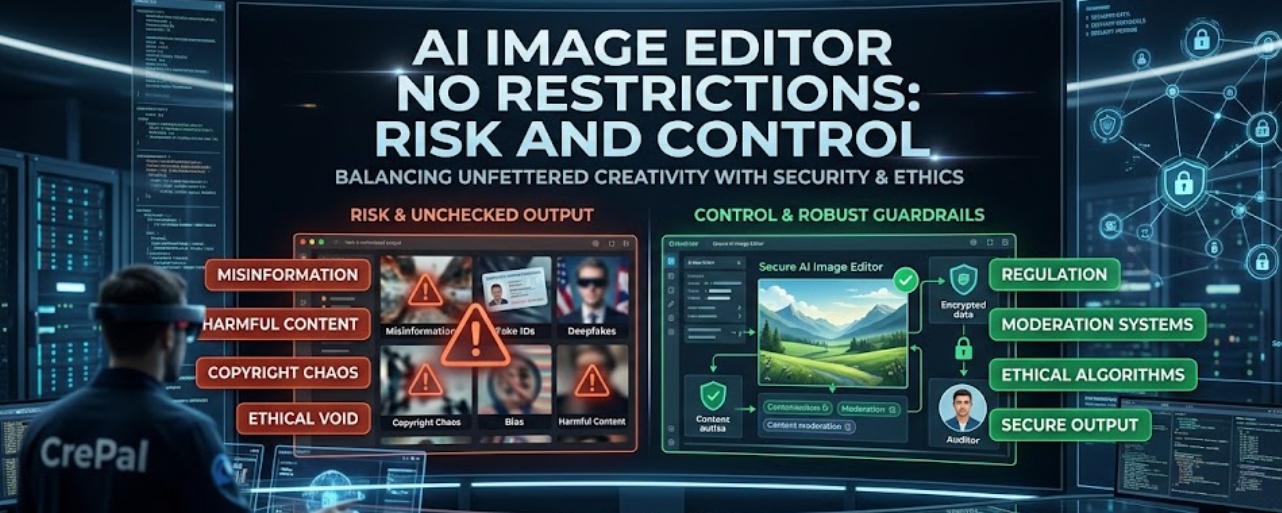
While removing arbitrary software roadblocks is essential for productivity, operating an ai photo editor with no restrictions without internal guardrails is a severe commercial hazard. Professional studios enforce strict administrative boundaries because failing to do so invites catastrophic legal liability and permanent distribution bans.
Consent and likeness limits
The absolute red line in digital production is the unauthorized manipulation of real human likenesses. Whether operating under United States common law governing the Right of Publicity, California’s AB 2602 statutory restrictions on synthetic performers, or the European Union’s GDPR Article 9 mandates regarding biometric data processing, non-consensual likeness alterations are strictly illegal. Legitimate production pipelines mandate that any real person depicted in an asset must have an active, signed commercial release agreement on file before their image is ingested into an editing suite.
Platform policy limits
You may possess the technical capability to edit an image locally without restrictions, but commercial distribution channels act as the ultimate gatekeepers. Hosting networks, social media platforms, and merchant payment processors enforce strict, zero-tolerance terms of service regarding mature, violent, or synthetic media.
Furthermore, under the EU AI Act Article 50 transparency obligations, deployers of synthetic content entering European markets must apply machine-readable provenance markings (such as C2PA metadata or imperceptible watermarks) and clear user-facing disclosures. Failing to comply carries severe regulatory penalties, including fines up to 3% of global annual turnover.
Commercial-use limits
From an intellectual property standpoint, total reliance on automated generation is a liability. According to formal policy guidance issued by the United States Copyright Office (USCO), visual works generated purely by artificial intelligence without substantial human creative intervention do not qualify for copyright protection. To secure legal ownership over an asset, a studio must prove significant human authorship. This requires documenting an extensive editorial trail—such as manual masking, custom overpainting, and precise multi-layer compositing—proving that the tool was used as an instrument of human expression rather than an autonomous creator.
Safer Workflow for Flexible Image Editing
To harness the power of unrestricted editing tools without exposing the studio to legal or operational risk, production teams must replace software-level blocking with a standardized Standard Operating Procedure (SOP).
Source review
Never ingest unverified files into a production pipeline. Before editing begins, the project manager must audit the provenance of the source image:
- Synthetic vs. Real Verification: Determine whether the source is a purely algorithmic generation or a real-world photograph.
- Contractual Matching: If the image contains a recognizable human likeness, cross-reference the file against an immutable database of signed talent release forms and government-issued age verification records.
- Training Data Audit: For fictional synthetic characters, ensure the underlying base model was trained on commercially licensed or public domain datasets, verifying that the asset does not infringe upon registered third-party trademarks.
Edit notes
When working in an unrestricted environment, maintaining an audit trail of technical modifications is vital for both legal defense and downstream technical consistency. Editors must log all structural alterations within the project’s metadata wrapper.
This step becomes critical during the video handoff phase. When still assets are transferred into an intuitive video creation suite like CrePal to generate dynamic video motion, accompanying the files with structured edit notes—detailing exact depth map coordinates, alpha channel boundaries, and lighting profiles—ensures that the video animation engine maintains visual continuity. If a character features a specific texture patch or scar in the static asset, documentation guarantees the video team will not allow the AI camera engine to blur or mutate it during movement.
Publish readiness
Before an edited asset leaves the studio storage server for client delivery or public broadcast, it must pass a rigorous pre-flight compliance check:
| Checklist Item | Technical Verification Requirement | Operational Purpose |
| Metadata Integrity | Embed digitally-signed C2PA provenance credentials. | Satisfies regional transparency laws (such as the EU AI Act) and establishes proof of creation. |
| EXIF Scrubbing | Strip internal hardware IDs and local server routing data. | Protects studio infrastructure privacy and prevents leaking proprietary workflow paths. |
| Platform Compliance | Match output specs against target host content guidelines. | Prevents automated shadowbanning, account suspension, or payment processing freezes. |
Red Flags Before Using Any Editor
Not all unrestricted editing tools are built for legitimate commercial use. Many unregulated web applications pose severe data privacy and cybersecurity risks. Mark any software vendor as a critical operational hazard if you observe these red flags:
- Opaque Corporate Jurisdiction: The vendor provides no physical corporate address, hides its ownership structure, or operates outside established international intellectual property frameworks like those enforced by the World Intellectual Property Organization (WIPO).
- Predatory Terms of Service (TOS): The platform agreement includes buried clauses granting the vendor a “perpetual, irrevocable, global royalty-free license to utilize, modify, and distribute all uploaded user content for public model training.” Using such tools violates standard client Non-Disclosure Agreements (NDAs).
- Forced Cloud Telemetry: The software lacks offline execution or client-side processing options, forcing all sensitive, unencrypted visual assets through external cloud servers without a verifiable data deletion policy.
- Absence of Audit Logging: The platform offers no administrative controls to export session logs, cryptographic file hashes (such as SHA-256), or user access histories, making it impossible to pass an enterprise compliance audit.
FAQ
Who decides whether a restriction is necessary?
In a professional production environment, the necessity of a restriction is determined collaboratively by the Studio Compliance Officer and the Lead Technical Director. The Compliance Officer evaluates legal mandates, local statutory frameworks (such as FTC synthetic advertising disclosure guidelines), and hosting platform rules. The Technical Director evaluates whether a software restriction interferes with legitimate creative execution, establishing internal technical guardrails that protect the studio without hampering artist productivity.
How should teams document rejected edit requests?
When an artist or client requests an edit that violates internal safety guardrails or likeness policies, the rejection must be recorded in the studio’s centralized administrative log. The documentation must include the time-stamped request, the specific policy or statutory violation identified, and the formal written refusal sent to the requester. This log should be retained in an encrypted archive for a minimum of five years to demonstrate good-faith compliance during legal or regulatory audits.
When should flexible editing stay internal only?
Flexible, unrestricted editing should remain strictly internal during concept exploration, look-development (lookdev), and pre-visualization phases involving unverified experimental models or sensitive client intellectual property. Assets produced during these internal stages must never be uploaded to public staging servers, shared via external communication channels, or ingested into cloud-based video generators until they have cleared a formal pre-flight rights and compliance review.
What changes if assets are for paid campaigns?
When edited assets are deployed in paid commercial advertising, regulatory scrutiny increases exponentially. Under](https://www.ftc.gov/news-events/topics/consumer-protection/synthetic-media), paid campaigns featuring AI-generated or heavily modified human likenesses must include clear, prominent, and unavoidable consumer-facing disclosures. Furthermore, paid campaigns require full chain-of-title documentation, proving that every layer, texture, and character model utilized in the image possesses commercial licensing rights cleared for global ad spend.
Conclusion
Searching for an ai image editor no restrictions solution is a legitimate quest for professional creative sovereignty. High-performing production studios require tools that respect artistic intent, support fine detail manipulation, and provide lossless data exports without automated interference. However, removing software-level restrictions shifts the burden of responsibility entirely onto the studio. By replacing arbitrary algorithm blocks with a disciplined Standard Operating Procedure—enforcing rigorous source provenance reviews, maintaining detailed edit logs, and ensuring clean, standardized transitions into downstream video tools like CrePal—creators can achieve the exact visual results they envision without exposing their business to catastrophic legal or platform risks. In modern digital production, true creative freedom is built on a foundation of operational discipline.