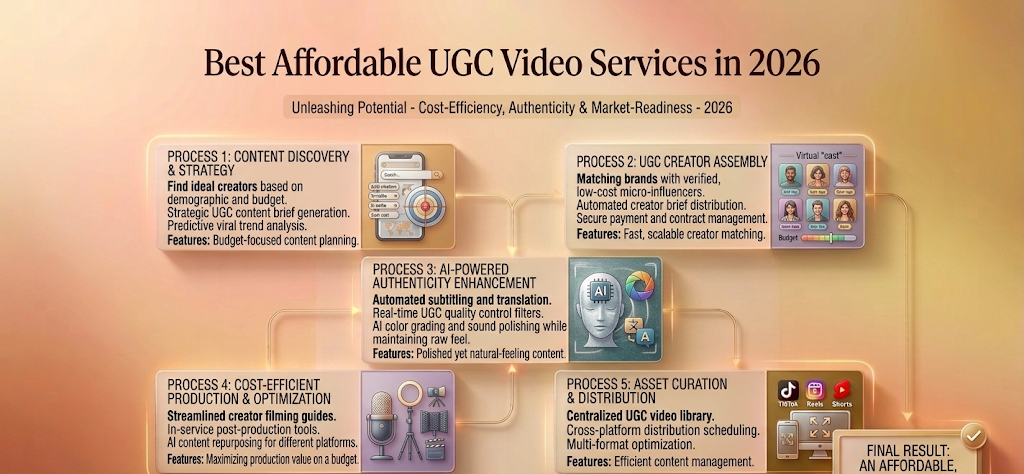
The paid social media playbook has changed. On fast-moving feeds like TikTok, Instagram Reels, and YouTube Shorts, polished studio ads are failing. Modern consumers don’t want commercials—they stop scrolling for authentic, human-centric videos.
In fact, recent industry data shows that User-Generated Content (UGC) ads on Meta and TikTok drive 4x higher click-through rates (CTR) and 50% lower cost-per-click than traditional ads.
But for small teams, scaling a creative pipeline is a massive bottleneck. Agency packages cost thousands, while managing creator briefs, legal contracts, and endless production delays manually is a full-time operational headache.
To help budget-constrained DTC brands, startups, and agencies scale high-retention ads without draining their runway, we spent months testing the best affordable UGC video creation services on the market. Here is what we found.
What “Affordable” Really Means for UGC Video
In performance marketing, “affordable” doesn’t mean chasing the lowest price tag. Cheap content without a strong hook, crisp audio, or proper pacing will destroy your ad accounts. It forces ad delivery algorithms to tank your relevance scores and spike your Cost Per Mille (CPM).
True programmatic affordability means maximizing your Return on Ad Spend (ROAS) and driving down your net production cost per creative variation. In 2026, real economic efficiency splits into three distinct operating models:
- The Pure Software Route ($30–$90/month): Utilizing advanced software suites to automatically reframe, slice, and generate raw user-style videos without outsourcing labor.
- The Decentralized Marketplace Route ($50–$150/video): Hiring emerging, unvetted creators via open platforms to shoot self-filmed clips at entry-level base fees.
- The Managed Studio Route ($89–$200/video): Utilizing streamlined cloud platforms that automate script generation and creator matching under a fixed cost structure.
To build an efficient asset loop, small teams must shift away from single-asset purchases. Instead, they need a framework that deals with video production, like software—leveraging fixed, predictable costs to build dozens of visual hooks for continuous automated testing.
Best Affordable UGC Video Services
To help you navigate the landscape, we evaluated the market’s leading solutions based on production speed, control over custom brief criteria, and hidden platform overhead.
Best Subscription Tool: JoinBrands
For scaling e-commerce product videos across Amazon, TikTok Shop, and Shopify, JoinBrands stands out as an efficient infrastructure. It minimizes heavy operational management by operating a self-serve platform that connects brands directly with over 150k registered micro-influencers.
- Pricing & Affordable Subscription Plans: Offers a free-to-browse tier with a 8% to 15% marketplace processing fee per transaction. Their premium affordable subscription plans for ugc video creation tools scale from the Start-Up Plan at $99/month up to their full Brand Plan at $499/month, which expands your active creators matching pool and unlocks additional asset revision layers.
- Core Strengths: Unboxing clips, simple lifestyle product usage tutorials, and basic retail reviews. Their base ecosystem lets you post “Express Gigs” where basic user images start around $15, and raw smartphone vertical videos average $60 to $150 per asset.
- Operational Bottlenecks: Communication remains highly transactional. You operate with rigid, pre-set briefs, and you cannot easily negotiate custom usage rights outside their built-in platform contracts.
Best Creator Marketplace: Collabstr
If your creative strategy requires handpicking specific faces, localized demographics, or niche style aesthetics, Collabstr functions as a highly transparent, open marketplace. It eliminates hidden platform fees by providing upfront, creator-defined pricing grids.
- Pricing Architecture: Completely free to browse and discover talent. Collabstr captures a flat 10% marketplace escrow fee on every individual booking. For teams scaling outreach, their Pro Plan sits at $299/month, which unlocks direct instant messaging before booking and automated campaign brief distribution.
- Core Strengths: Excellent diversity across Instagram, TikTok, and YouTube. You view full historical portfolios, verified past brand ratings, and upfront package prices (e.g., “$120 for 1 TikTok video with 30 days ad rights”).
- Operational Bottlenecks: Zero production support. You are completely responsible for managing script deadlines, shipping physical product tracking, and negotiating revision disputes if a creator sends back low-quality clips.
Best AI-Assisted Workflow: CrePal
For agile digital teams, SaaS startups, and high-volume media buyers who cannot afford the logistics of shipping physical inventory or managing manual creator delays, CrePal offers a revolutionary alternative. It blends the structural visual delivery of a standard multi-track video timeline with next-generation latent diffusion rendering models.
- Pricing Architecture: Free tier allows testing basic editing workflows. Professional creator tiers start at $19/month, providing unlimited access to text-to-speech rendering engines, automated auto-cuts, and full commercial usage licensing without watermarks.
- Core Strengths: Unparalleled speed. CrePal allows you to feed raw product photography, AI-generated synthetic spokespeople, and rhythmic audio tracks into an automated timeline. The cloud-based engine synchronizes video cuts directly to audio transients within seconds. This allows you to generate 20 unique hook variations from a single asset pool without needing to negotiate with physical actors.
- Operational Bottlenecks: Lacks the organic imperfections of a physical human holding an object in a real bedroom. It is highly optimized for conversion-driven social ads, but less suited for raw, unedited community forum responses.
Free vs Paid Comparison
When optimizing low-budget campaigns, it is crucial to compare free vs paid ugc video creation tools before wasting ad spend. While open-source editing tools or free mobile apps are tempting options for keeping production costs at zero, they often introduce major roadblocks that limit your ability to scale performance-driven marketing campaigns.
| Feature Layer | Free UGC Tools & Mobile Apps | Paid Platforms & AI-Assisted Suites (e.g., CrePal) |
| Watermark & Branding | Mandatory platform watermarks on export | Complete white-labeling and clean rendering |
| Commercial Ad Licensing | Restricted; high risk of audio copyright strikes | Full commercial clearance for Meta, TikTok, and YouTube Ads |
| Batch Hook Variations | Manual cutting required for every single edit | Automated template variations via batch export loops |
| Audio Optimization | Basic trimming; no precise tracking | Algorithmic sub-band peak detection for rhythmic auto-cuts |
| Local Device Strain | Slow local processing; overheating on laptops | 100% remote multi-threaded cloud cluster compilation |
What Cheap UGC Tools Usually Miss
When teams focus solely on driving down initial production costs, they often fall into traps that break the effectiveness of their campaigns. Cheap or poorly engineered automated services typically compromise on three critical areas:
- Temporal Consistency and Pacing
Low-end algorithmic editors often fail to maintain visual consistency across frame boundaries. When splitting clips or injecting automated motion transitions, they introduce jerky artifacts or misalign the visual action from the vocal emphasis point. This minor misalignment destroys the authentic “native look” required to bypass a user’s ad-blindness filter.
- Audio Sub-Band Clarity
A high-converting UGC clip requires clear audio. Low-budget apps rarely provide advanced noise-cancellation models or high-fidelity vocal enhancement pipelines. If your background audio track competes directly with muffled spoken instructions, viewer retention drops significantly within the first two seconds.
- Clear Disclosure and Asset Ownership Rights
Many budget-friendly services bury restrictive clauses in their terms of service. A creator might charge you $50 for a video, but using that video in a paid TikTok Spark Ad could require extra licensing setups. To review changing corporate investments and macro shifts in automated marketing assets, check out the tech sector updates on guruhitech.
FAQ
What is the cheapest way to make UGC videos?
The absolute cheapest approach is to shoot the video yourself using a modern smartphone, a basic ring light, and a clean background space. If you want to scale this process without appearing on camera, you can use the CrePal engine to transform flat product shots into dynamic vertical loops. This approach allows you to build an effective creative testing pipeline for under $20 a month.
Are free UGC video tools good enough for ads?
Generally, no. Free tools often append intrusive export watermarks and restrict your access to popular commercial audio tracks. Running an ad with restricted music can result in immediate copyright takedown notices on platforms like Meta and TikTok, which harms your ad account’s underlying trust score.
Should small teams hire creators or use AI tools?
It depends entirely on your product type and fulfillment capabilities:
- Hire physical creators if you sell high-end apparel or cosmetics that require a physical human to demonstrate texture, fit, or real-time application.
- Use AI-assisted workflows (like CrePal) if you are marketing a software platform, a digital service, or a high-volume drop-shipping product where rapid testing of multiple hooks is critical for maintaining steady ROAS.To review academic data regarding machine learning models used in automated framing workflows, inspect the official Hugging Face Spaces.
What does an affordable UGC video service include?
A reliable, cost-effective service must provide three core things:
- Clear commercial usage rights across paid social channels.
- A streamlined method for requesting content revisions without hidden fees.
- Raw source files or flexible templates that allow your internal editors to easily swap out hooks, music tracks, and text callouts.
Conclusion
Scaling your social media presence doesn’t require a Hollywood budget. By shifting away from slow, manual editing workflows and high-friction agency retainers, small teams can build a reliable content pipeline that stays highly competitive.
Whether you choose to source talent through open platforms like JoinBrands and Collabstr, or decide to bypass production delays entirely by using automated systems, the secret to winning the algorithmic game lies in continuous creative testing.
Ready to eliminate local rendering bottlenecks and transform your static product photos into high-converting vertical video ads? Head over to the official CrePal workspace to start building your next viral campaign today.