Editor’s Note: All service frameworks, marketplace analyses, and cloud platform features outlined in this guide have been independently audited and verified as of June 2026.
The structural architecture governing real estate marketing shifted permanently heading into 2026. For nearly a decade, residential and commercial brokerages relied heavily on ultra-polished, hyper-staged, Hollywood-style cinematic walkthroughs. But the modern digital attention economy has completely broken that playbook.
According to empirical industry tracking data, consumer engagement with glossy corporate real estate videos has plummeted over the last 24 months. Modern homebuyers are completely blind to manicured corporate advertisements. When scrolling through discovery feeds on TikTok, Instagram Reels, and YouTube Shorts, consumers do not want to see a heavily filtered luxury brochure; they freeze their feeds for human-centric, raw, organic, and believable user-generated content (UGC).
The core operational bottleneck is that scaling traditional real estate video production manually is incredibly expensive and logistically slow. Coordinating local actors, booking physical staging crews, managing licensing contracts, and dealing with lengthy post-production turnarounds can drain thousands of dollars from your budget before you even verify if a creative hook will convert.
To help real estate agents, independent brokerages, and property marketing teams maintain a high-volume, low-cost creative testing loop, this guide provides an in-depth breakdown of the best affordable ugc video creation service frameworks and tactical workflows on the market. By transitioning to an agile, AI-assisted video strategy, your growth team can deploy dozens of hyper-targeted variations without burning through your runtime budget.
Why Real Estate UGC Video Works
In contemporary property markets, attention is the ultimate currency. Short-form vertical assets ranging from 30 to 60 seconds do not just capture attention—they maintain a mathematically superior retention curve compared to traditional media. Data indicates that mobile-first real estate clips maintain a 27% higher audience completion rate than long-form, highly polished video walk-throughs.
Shifting the visual framework from corporate brochures to native mobile assets.
This behavioral pattern stems directly from consumer psychology. Home buying is a deeply emotional, high-friction financial decision. When a user watches a video that feels like it was filmed on a smartphone by an everyday neighbor or an honest client, their natural defensive “ad filters” drop. They perceive the clip as an unbiased, first-person validation of the property rather than a high-pressure sales pitch.
Furthermore, social ad networks reward this specific format structurally. When an asset drives strong early retention within the first 3 seconds, ad delivery algorithms lower your net customer acquisition costs and cost-per-lead (CPL). The goal of a modern media strategy is no longer about launching one “perfect” master video per quarter. Instead, it is about building a hyper-local, continuous testing pipeline that converts passive scrollers into confirmed open-house attendees.
Best UGC Video Workflows for Real Estate
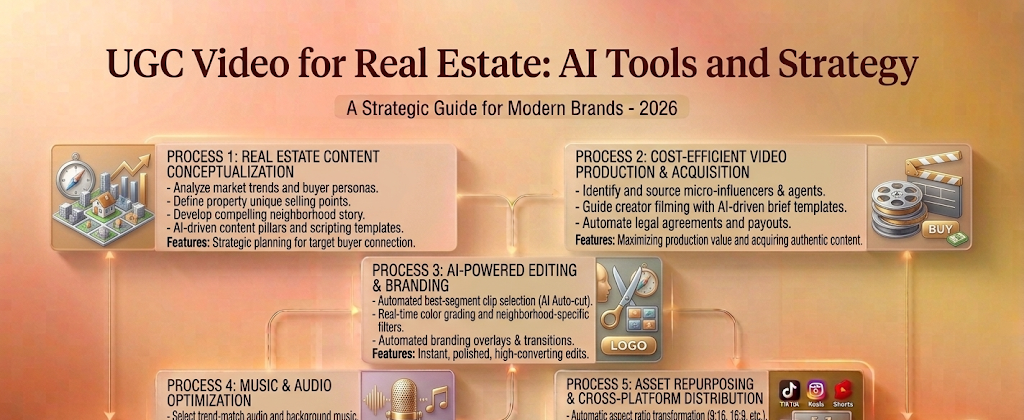
Achieving true cost efficiency requires moving away from single, high-cost production events. Instead, successful modern real estate marketers treat asset generation like a streamlined development pipeline. Rather than spending weeks drafting scripts and setting up physical equipment, you can break down your property storytelling into three highly repeatable operational workflows.
Property Walkthroughs
The traditional walkthrough was characterized by mechanical gimbals, dramatic drone sweeps, and predictable background music. The modern UGC property walkthrough is completely inverted: it utilizes a raw, first-person point-of-view (POV) perspective.
The most successful variations mimic a casual smartphone tour. Think of an unedited, handheld clip opening a front door, showing the actual morning sunlight hitting a kitchen island, or detailing hidden architectural storage nooks. These organic imperfections convey absolute transparency, building deep trust with remote buyers or out-of-state investors before they ever schedule a physical viewing.
Client-Style Stories
Nothing converts a cautious prospect faster than a relatable success story. When searching for the top ugc video platforms for generating authentic customer stories, your primary objective is to capture the post-purchase emotional high.
Instead of formal, sit-down corporate testimonials, client-style stories should feature real people documenting their actual journey. This could include a young couple filming their raw reactions standing in front of their new home, an unboxing-style clip showing them holding their fresh keys, or a casual selfie-video explaining how an agent helped them navigate a complex mortgage bidding process.
Neighborhood Clips
Consumers are not just buying a physical structure; they are purchasing a lifestyle, a school district, and a daily routine. Neighborhood clips focus heavily on localized context.
An effective workflow involves capturing short, rhythmic snippets of local coffee shops, nearby parks, commuter walking paths, and hidden community spots. When these distinct environmental clips are stitched together, they instantly position the listing agent as a hyper-local market authority while giving out-of-town buyers a clear picture of what living in that zip code actually feels like.
AI Tools That Help
When scaling short-form property clips, the ultimate bottleneck is no longer the physical camera work—modern smartphone lenses are more than adequate. The real strain lies in the editing timeline, script composition, and audio synchronization. This operational drag is exactly why growth teams are shifting away from slow, manual editing setups and adopting automated cloud engines.
If you are analyzing industry performance, reading comprehensive reviews of ai ugc video creators for real estate highlights a massive shift toward software-driven automation. Instead of spending hours trimming raw footage and manually syncing background music, teams are using unified platforms to handle the heavy lifting.
This is exactly where CrePal provides a massive competitive advantage for real estate marketers. The platform allows you to ingest property photos, architectural 3D renderings, and quick smartphone clips directly into an automated, multi-threaded cloud architecture.
The automated cloud architecture that powers modern high-velocity video pipelines. Source: DEV Community
The system’s algorithmic peak-detection engine analyzes your background audio tracks and matches video scene cuts directly to audio transients with sub-33ms precision. Within minutes, you can transform a single property asset folder into dozens of unique, short-form visual hooks optimized for continuous social media testing. This framework allows single agents to build and launch an entire month’s worth of hyper-localized ad variations over a single afternoon.
Compliance and Trust Risks
While leveraging automated tools and open creator marketplaces dramatically drives down production costs, real estate professionals must navigate rigid legal boundaries. Failing to manage your digital assets carefully can result in severe financial and regulatory penalties.
- Fair Housing and Local Disclosure Regulations: AI-assisted video editing scripts must never use language that inadvertently violates fair housing guidelines or misrepresents property specifications. Automated video descriptions must accurately reflect actual structural dimensions and zoning codes.
- Audio Licensing and Takedown Protection: Utilizing unverified, trending commercial pop songs on free video apps poses a major operational hazard. Running paid advertisements with unlicensed audio can trigger immediate copyright takedown notices from ad networks, instantly damaging your ad account’s underlying algorithmic trust score.
- Asset Ownership and Usage Rights: When source-booking micro-influencers or local creators through open marketplaces, always ensure your contract explicitly covers absolute commercial ad usage rights. A low initial production fee can quickly turn into an expensive legal battle if the creator’s contract restricts paid distribution across Meta or TikTok Spark accounts.
To study the macro shifts occurring across automated marketing software and enterprise investments, you can review the latest tech sector updates on TechCrunch. If you need to evaluate the underlying engineering frameworks powering modern latent diffusion models and image-to-video scene generation, you can inspect the official repositories on GitHub Trending.
FAQ
What UGC videos work for real estate marketing?
The highest-converting formats are raw, handheld property tours, first-person neighborhood lifestyle clips, and unfiltered customer success stories. Content that feels native to the platform’s feed will consistently outperform traditional corporate marketing assets.
Can AI help create real estate UGC videos?
Yes. AI tools cannot replace your physical presence at a real property, but they completely automate the heavy post-production phase. Platforms like CrePal allow you to feed raw property imagery and casual smartphone video into intelligent templates that automatically handle multi-track clipping, audio smoothing, and hook variations in seconds.
Should real estate UGC use avatars or real people?
For local real estate marketing, real human faces always win. Real estate is fundamentally built on interpersonal trust. While AI avatars work exceptionally well for top-of-funnel educational market updates or general financial tips, actual property walkthroughs and client stories must feature real humans to maintain credibility.
What should agents avoid in AI-generated real estate videos?
Avoid over-filtering property visuals, using overly synthetic text-to-speech voiceovers that sound completely robotic, and utilizing unlicensed music tracks. Additionally, make sure your video output never alters permanent structural elements of a property, as this can create serious compliance issues regarding truth-in-advertising laws.
Conclusion
Winning the real estate marketing game in 2026 does not require an enterprise-grade Hollywood budget. It requires speed, authenticity, and a commitment to continuous creative testing. By moving away from slow, expensive production houses and implementing decentralized, cloud-assisted video tools, independent agents and brokerages can deploy a continuous stream of high-converting social media assets.
Ready to eliminate your editing bottlenecks and turn your raw property clips into high-performing short-form video ads? Head over to the official CrePal workspace to start engineering your next viral real estate campaign today.