Compliance & Legal Disclaimer: This operational guide is intended for digital creators, studios, and agencies preparing to publish synthetic media. It is based strictly on currently available official Fanvue documentation as of August 2026. This article does not constitute legal counsel, nor does it guarantee account approval, monetization, or immunity from moderation. Meeting a basic checklist does not ensure your content will be permitted. You must independently review Fanvue’s official legal pages before publishing. Generating or distributing non-consensual intimate imagery (NCII), unauthorized likenesses, or content depicting minors is strictly prohibited on Fanvue and illegal globally. CrePal is referenced solely as a generalized content orchestration tool and has no official partnership or affiliation with Fanvue.
As the creator economy continues to integrate generative media into mainstream monetization pipelines, subscription platforms are drawing precise lines between permitted artistic creation and prohibited digital exploitation. For commercial creators, talent agencies, and independent artists developing digital avatars, understanding the Fanvue AI content rules is a mandatory prerequisite before setting up a creator account.
Unlike legacy platforms that implemented reactionary, blanket bans on synthetic media, Fanvue has established a structured framework that accommodates AI creators. However, this flexibility comes with rigorous compliance obligations. To monetize adult AI media safely, creators must navigate mandatory disclosure standards, ironclad age-cue boundaries, and verifiable consent protocols. This comprehensive review analyzes Fanvue’s current operational rules, audit mechanisms, and risk mitigation strategies.
Quick Answer: Fanvue Allows Compliant AI Media
Yes, Fanvue allows creators to publish and monetize AI-generated content, including adult and mature media. However, monetization is contingent upon strict operational compliance:
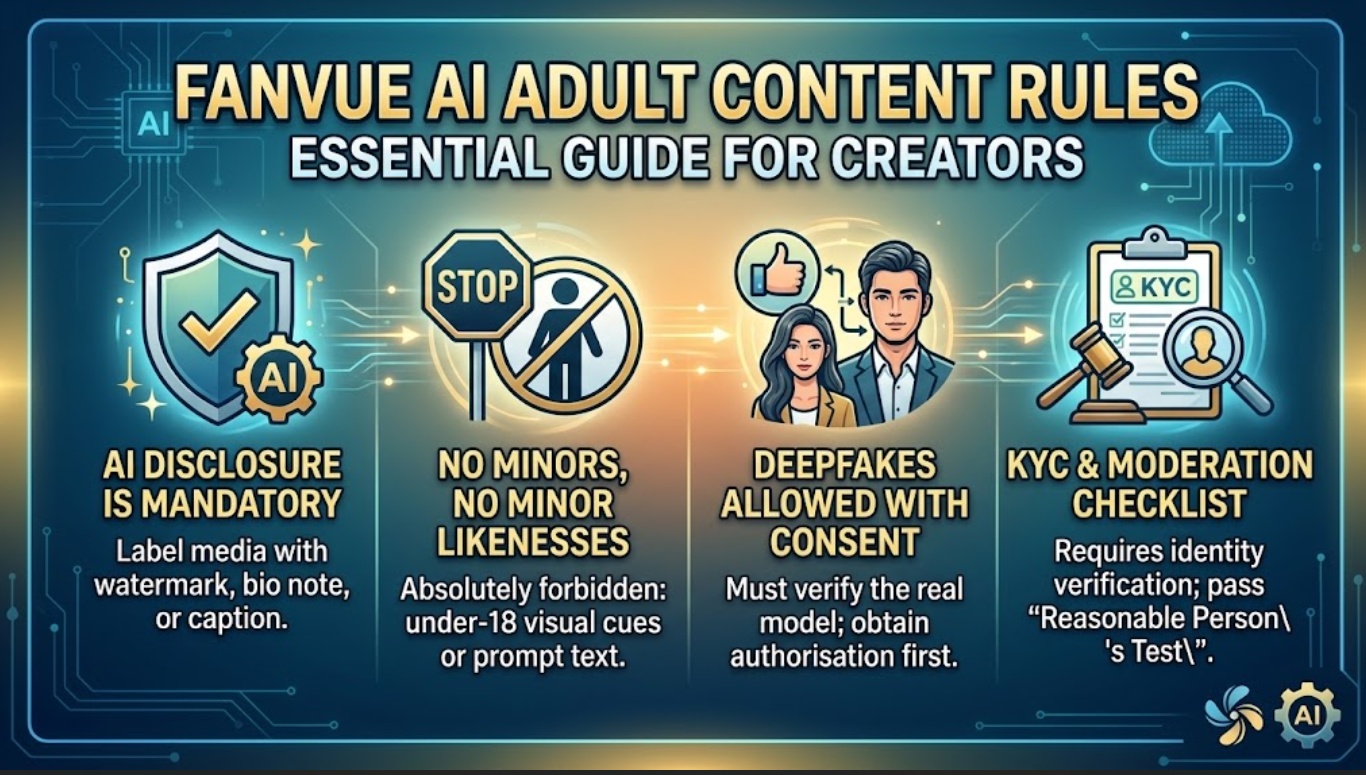
- Mandatory Disclosure: All synthetic personas and AI-assisted posts must be explicitly marked so subscribers know the content is not human-created.
- Adult Verification: Fictional synthetic characters must be designed with unambiguous adult traits (18+), completely avoiding minor-like aesthetics.
- Consensual Replicas: Any digital twin or replica derived from a real human requires verified identity credentials and written consent.
- Clean Storefront: All public discovery zones (profile photos, cover banners, and free preview posts) must remain strictly Safe For Work (SFW).
Which Fanvue Rules Apply to AI Content
When operating an AI creator profile, your primary operational baseline is the Fanvue Community Guidelines. This document defines how synthetic personas must interact with the community and presents transparency standards for subscriber trust.
Clear and Prominent AI Disclosure
A foundational pillar of the Fanvue AI creator policy is transparency. Creators are prohibited from deceiving subscribers into believing a synthetic character is a real, living person. Under current guidelines, AI disclosure Fanvue mandates clear and conspicuous signaling:
- Profile-Level Notice: The creator bio must state unambiguously that the persona is AI-generated, virtual, or synthetic.
- Feed & Post Context: Automated posts, promotional clips, and direct message interactions should not claim real-world physical availability or fabricate offline encounters.
- Placement Standards: Disclosures cannot be hidden at the bottom of lengthy legal copy, buried in unrelated hashtags, or rendered in low-contrast text.
No Harm, Deception, or Unauthorized Impersonation
Fanvue enforces strict anti-impersonation rules. Using AI to mimic real individuals without explicit legal clearance violates both platform rules and global privacy statutes. Creating an AI clone of a celebrity, influencer, or private acquaintance to solicit subscriptions is classified as fraudulent impersonation and triggers immediate, permanent account termination alongside payment freezes.
Consent and Adult-Age Requirements
Identity and age verification form the core of platform compliance. Creators must align their generation workflows with the Fanvue Age Verification Policy.
Real-Person Replicas Need Documented Consent
If your production pipeline utilizes Fanvue deepfake consent workflows—such as using an Image-to-Image pipeline based on a living model or training a custom LoRA adapter on a real person’s photos—the real person must be fully verified by Fanvue.
- The real model must complete Fanvue’s third-party identity and age verification process.
- The account holder must maintain a signed, legally binding consent agreement explicitly authorizing the creation, distribution, and commercial monetization of their synthetic likeness in adult contexts.
- Unilateral uploads of real-person reference images without an accompanying release violate non-consensual intimate imagery regulations monitored by organizations such as StopNCII.
AI Characters Must Not Resemble Minors
For 100% synthetic, purely fictional AI characters, platform filters actively scan for age cues. Fanvue maintains a zero-tolerance policy regarding child sexual abuse material (CSAM) and child exploitation.
- Fictional characters must be rendered with adult facial structures, mature body proportions, and clear adult contextual environments.
- Prompts incorporating juvenile themes, school uniforms, youth-centric styling, or descriptions that imply underage status are strictly prohibited.
- If a model’s visual age is ambiguous, Trust & Safety teams default to account suspension. Studios must design character sheets that clearly establish an adult demographic (e.g., 25+ aesthetic).
Adult Content and Public Discovery Areas
While Fanvue provides monetization infrastructure for adult content creators, it maintains a strict firewall between public discovery areas and paywalled feeds, as outlined in the Fanvue Acceptable Use Policy.
Mark Permitted Intimate Content as 18+
When publishing adult media behind the paywall, creators must ensure the profile is properly registered as an 18+ account. Under Fanvue adult content rules, explicit sexual depictions and nudity are allowed only within age-gated, subscriber-only tiers or pay-per-view (PPV) messages. Correct categorization prevents explicit media from being served to general audiences or unregistered visitors.
Keep Profile, Banner, and Intro Media SFW
The Fanvue public media rules require all un-paywalled spaces to remain strictly Safe For Work (SFW):
- Avatar & Cover Header: Must not contain explicit nudity, exposed genitalia, or overt sexual acts.
- Public Feed Previews: Free teasers and promotional text visible to non-subscribers must remain within SFW boundaries.
- Bio & Welcome Text: Should describe the subscription value proposition without explicit anatomical descriptions.
| Platform Surface Area | Permitted Content Type | Required Disclosure |
| Profile Photo / Avatar | SFW Only (No nudity) | Recommended in Bio |
| Cover Header Banner | SFW Only (Stylized / Cinematic) | Profile-level AI indicator |
| Public / Free Feed Posts | SFW Teasers / Mood Previews | Visible AI hashtag or caption note |
| Paywalled Subscriber Feed | 18+ Mature AI Media Permitted | Account-level disclosure active |
| Direct Message / PPV | 18+ Explicit Media Permitted | Consistent persona disclosure |
Content Fanvue Does Not Permit
Even within private, paywalled subscriber tiers, certain categories of synthetic adult media are completely banned under the Fanvue Community Guidelines.
Non-Consensual Intimate Media and Exploitation
Fanvue actively monitors and removes synthetic media that violates personal consent. This includes:
- “Nudifying” photographs of unconsenting real individuals.
- Face-swapping public figures or acquaintances into explicit scenes.
- Generating revenge porn or voyeuristic synthetic scenarios.
Prohibited Adult Themes and Misleading Profiles
The platform strictly forbids extreme, harmful, or non-consensual themes, including:
- Content depicting extreme violence, incest, bestiality, or non-consensual sexual aggression.
- Deceptive financial schemes, such as promising real-world physical dates in exchange for high-tier tips or PPV purchases.
- Impersonating another existing creator or re-uploading scraped media from other platforms.
Prepare a Fanvue Publishing Record
To survive periodic account audits and compliance checks, digital agencies and production studios must build an auditable internal record for every AI asset before it goes live.
Save Consent, Identity, Source, and Disclosure Evidence
Maintain an internal, encrypted compliance ledger containing:
- Model Consent Releases: Government IDs and signed release forms for any real human reference models.
- Synthetic Provenance Logs: Prompt structures, negative prompts (confirming age safeguards), and tool metadata.
- Disclosure Captions: Dated records proving that published posts contained explicit AI notices at the time of broadcast.
For studios managing multi-shot campaigns, character consistency, and post-production editing, utilizing an internal cloud orchestration suite like CrePal helps centralize this pipeline. While CrePal does not manage external platform moderation, it provides an organized workspace where teams can link approved scripts, audio licenses, and image-to-video parameters into a unified timeline, ensuring that every asset is fully vetted internally before deployment to Fanvue.
Recheck the Policy Before Every Campaign
Platform rules in the generative AI sector evolve rapidly due to shifting payment processor regulations (e.g., Mastercard and Visa compliance mandates). Audit Fanvue’s legal terms quarterly and before launching major subscription tiers to confirm that your content formats remain compliant with the latest standards.
Limits and Policy Changes
Relying on static assumptions in generative media is a major operational risk. The parameters outlined in this guide reflect Fanvue’s official documentation as of August 2026.
However, payment processors and international regulators continually refine synthetic media policies. Creators must routinely check the “Last Updated” timestamps on Fanvue’s legal portals. What is classified as “prominent disclosure” today may shift toward standardized cryptographic watermarks (such as C2PA Content Credentials) tomorrow.
FAQ
Can a team member manage an approved AI creator account?
Yes. Talent agencies and studio teams often manage the day-to-day operations of an AI creator profile (including scheduling, messaging, and subscriber engagement). However, the primary account owner must be a verified individual who passes Fanvue’s Know-Your-Customer (KYC) identity and bank payout verification checks.
Who responds when Fanvue requests supporting documentation?
The registered account owner is legally responsible for responding to Fanvue Trust & Safety inquiries. If the platform flags an asset for potential likeness infringement or ambiguous age cues, the owner must provide signed consent forms, model IDs, or prompt provenance records within the requested timeframe to prevent account suspension.
Should old profile previews remain in an internal archive?
Yes. Studios should maintain a timestamped internal archive of all historical bio text, profile pictures, and cover banners. If an account is mistakenly flagged for missing AI disclosures during an automated sweep, this archive serves as empirical proof of compliance during the appeals process.
Can creators reuse a disclosure statement across several campaigns?
Yes, standard disclosure formulas (e.g., “This profile features 100% synthetic, AI-generated content.”) can be reused across bio descriptions and automated welcome messages. However, post-level captions should integrate the disclosure naturally to maintain subscriber engagement without looking like automated spam.
Can agencies manage separate accounts for several fictional creators?
Yes. Agencies frequently manage multiple synthetic personas across distinct niches. Each profile must be treated as an independent compliance entity, with its own dedicated bio disclosure, strict SFW public discovery assets, and properly paywalled adult tiers.
Conclusion
The Fanvue AI content rules provide a viable commercial pathway for digital artists and studios monetizing mature synthetic media. However, commercial viability depends on rigorous discipline: maintaining prominent AI disclosures, ensuring fictional characters unambiguously reflect adult ages, securing verifiable releases for real-person replicas, and strictly isolating adult content behind subscription paywalls.
By implementing thorough pre-flight checklists and maintaining an auditable internal production ledger with platforms like CrePal, creators and agencies can build sustainable, compliant digital brands that thrive within platform regulations.