Compliance & Legal Disclaimer: This operational guide is intended for professional digital studios creating mature, adult-themed concepts. It does not constitute legal counsel. The workflows discussed mandate strict adherence to purely fictional character designs or explicitly authorized, consensual reference materials. Simulating real-person likenesses in explicit contexts without documented consent violates global privacy laws and Right of Publicity statutes. Furthermore, data retention policies and commercial usage rights vary drastically between software platforms; always verify platform Terms of Service (TOS) before deploying any assets.
When building a reliable adult AI art workflow, commercial studios face a critical decision before rendering a single pixel: how should the generation engine be prompted?
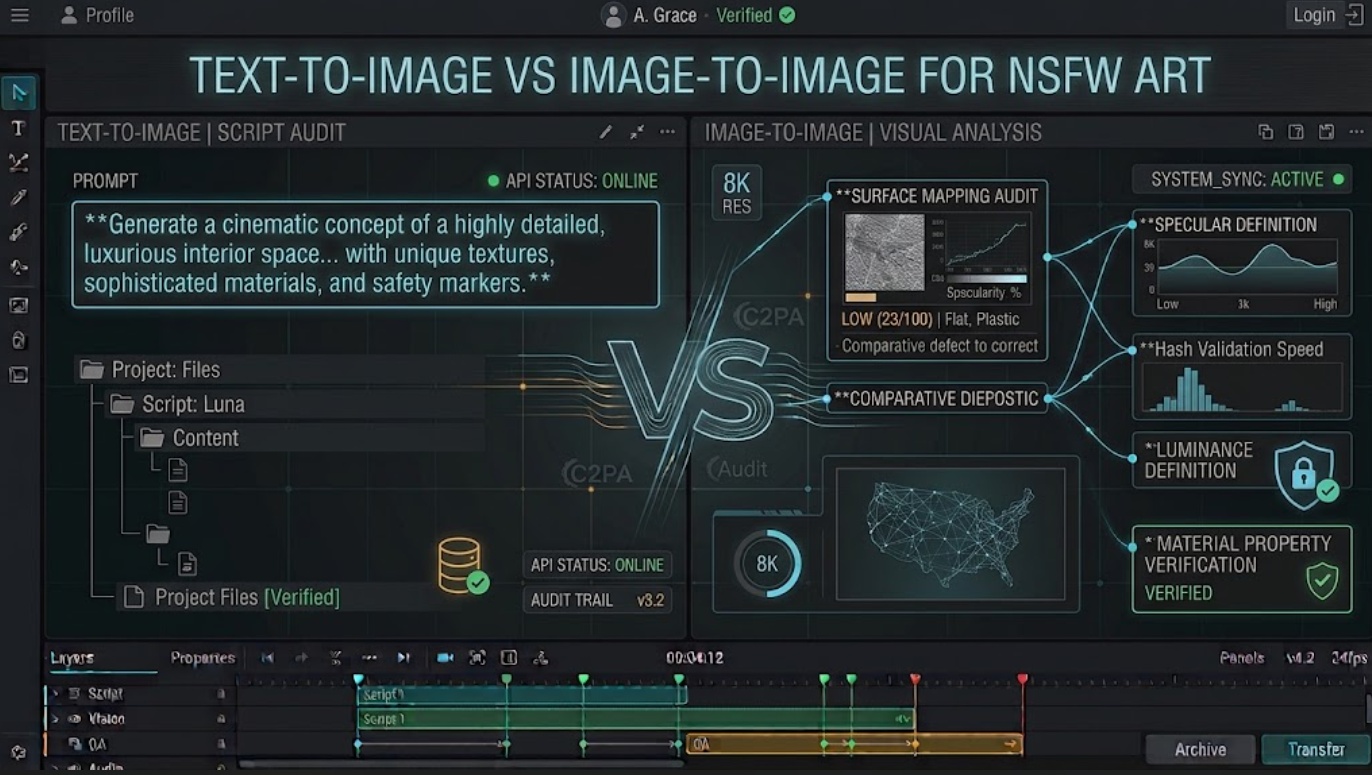
While establishing security protocols for third-party tools is essential, the foundational step of your pipeline dictates the success of the entire campaign. Deciding between text-to-image vs image-to-image NSFW generation is not about which tool produces a subjectively better picture. It is a calculated trade-off between conceptual freedom and structural control.
Whether you are designing a high-fashion lingerie storyboard or developing stylized fictional adult character art, your input method determines how efficiently that asset can be handed off to downstream video orchestration platforms like CrePal. This guide provides a practical, side-by-side analysis of both input models, equipping creative teams with the workflow logic and legal boundaries needed to make the right production choice.
Quick Verdict
For studios managing tight deadlines, the choice between input modes depends entirely on your current production milestone.
| Workflow Stage | Recommended Method | Primary Strength | Primary Weakness |
| Concept & Ideation | NSFW text to image | Infinite conceptual variety, rapid mood exploration. | Poor structural consistency, difficult to precisely replicate. |
| Execution & Revision | NSFW image to image | Locks anatomical structure, allows precise texture editing. | Inherits all structural flaws of the source reference. |
How the Two Workflows Start
The fundamental mechanical difference between these two pipelines is their starting anchor. Understanding this difference is key to managing client expectations and resource allocation.
Prompt-First Concept Development
Text-to-Image (T2I) starts from absolute zero. The AI model relies entirely on the semantic weight of your text tokens. In an adult AI art workflow, your text prompt carries the immense burden of describing complex anatomy, clothing physics, lighting direction, and camera focal length all at once. Because the latent space has no physical constraints, a T2I prompt will yield wildly different compositions across a batch of generations. It is an engine of discovery designed to brainstorm variations.
Approved Source Images and Visual Anchors
Image-to-Image (I2I) starts with a validated baseline. You supply a source image—a 3D wireframe, a rough sketch, or a previously approved T2I generation—alongside your text prompt. The model uses the pixel data of that source image as a rigid structural map. If the source image features a character leaning against a doorframe, the resulting generations will strictly adhere to that spatial arrangement, focusing only on rendering the aesthetic or lighting changes requested in your text prompt.
Compare Creative Control
Commercial clients require predictability. When rendering synthetic assets, losing the character’s recognizable identity between revisions is a critical workflow failure.
Identity, Composition, and Style Consistency
Winner: Image-to-Image T2I struggles heavily with identity consistency. Generating the exact same fictional character in different outfits or provocative poses using only text is notoriously difficult, as the model frequently alters facial geometry. I2I workflows solve this. By using a baseline image and applying advanced adapters (like ControlNet depth-mapping or Canny edges), I2I forces the model to respect the underlying skeletal structure, ensuring the character’s identity remains rock-solid across multiple scenes.
Revision Scope and Repeatability
Winner: Image-to-Image If a T2I generation is 90% perfect but features a warped hand, running the exact same prompt again will likely ruin the 90% you liked. I2I allows for targeted repeatability. Through inpainting (a sub-category of I2I), an artist can mask the flawed area and force the AI to regenerate only that specific section—such as fixing the drape of a sheer fabric—while completely ignoring the rest of the canvas.
Compare Privacy, Consent, and Rights
The operational risks diverge significantly when evaluating how these two methods handle proprietary data and intellectual property.
Upload Exposure and Source-Image Records
T2I limits your data exposure to text strings. I2I, however, requires uploading actual pixel data to a rendering engine. If you are using a cloud-based API, you are transmitting visual assets to external servers. Platform policies regarding data retention and model training vary wildly. For highly sensitive commercial briefs, I2I workflows often necessitate localized, offline generation nodes to prevent corporate data leaks and protect client NDAs.
Fictional Characters Versus Real-Person Likenesses
The boundary for AI reference image consent is absolute. If your I2I workflow utilizes a photograph of a real human being as a structural reference, you must possess a signed, commercial model release explicitly authorizing AI manipulation. Simulating a real person in a mature context without verifiable consent is illegal and actively combated by global organizations like StopNCII. To mitigate this risk, commercial studios ensure all I2I source files are 100% synthetic, utilizing 3D anatomical dummies or entirely fictional T2I outputs as their base references.
Compare Production Cost and Handoff
Efficiency in a commercial studio is measured by the “waste ratio”—how many generations must be discarded to achieve one usable asset ready for final delivery.
Failed Attempts, Review Time, and Reusable Assets
T2I carries a high waste ratio. Because of its open-ended nature, a technical artist might generate 50 images just to find one that adheres perfectly to the client’s spatial requirements. I2I drastically reduces compute waste. By locking the composition early, the artist spends rendering time only on polishing textures. The resulting approved I2I generation then becomes a reusable anchor asset for the rest of the campaign.
Preparing Images for Animation and Editing
When static character art is destined for downstream animation (Image-to-Video workflows), structural integrity is non-negotiable.
T2I often generates anatomical shortcuts—hidden limbs, merging fabrics, or illogical lighting—that look acceptable in a quick still image but completely break a video physics engine. I2I allows technical directors to enforce rigid anatomical boundaries. When this precise, I2I-refined image is imported into CrePal’s video orchestration suite, the platform can seamlessly map motion, align camera tracking, and generate fluid video scripts because the underlying geometry of the static asset is flawless. Without the strict control of I2I, video orchestration often fails due to structural warping.
Limitations and Trade-Offs
Both systems have unavoidable drawbacks that must be managed operationally:
- T2I Limitations: Lacks fine-tuned spatial control. It is nearly impossible to dictate exact finger placements, precise gaze directions, or specific prop interactions using text alone.
- I2I Limitations: Inherits the flaws of the source. If the source image has poor lighting logic or stiff, unnatural posing, the I2I output will carry those exact flaws into the final render. Furthermore, I2I can easily become overprocessed or hyper-smoothed if the rendering parameters are pushed too high.
FAQ
Can teams mix both methods within one character project? Yes, this is the industry standard. A studio will typically use NSFW text to image to brainstorm the fictional character’s face, style, and mood. Once the client approves a specific T2I output, that image is fed into an NSFW image to image pipeline to standardize the character. Finally, the optimized I2I assets are pushed to an orchestration platform like CrePal for video delivery.
Can approved reference libraries transfer after a company acquisition? This depends entirely on the commercial usage rights granted by the specific AI platform used to generate the original references. Some platforms claim joint ownership or restrict transferability. Legal counsel must verify the specific End User License Agreement (EULA) before transferring AI asset libraries.
Who owns a derivative brief created from licensed artwork? If you use a licensed, copyrighted image as an I2I reference to generate a mature derivative, the copyright status is highly complex. The U.S. Copyright Office currently maintains that purely AI-generated works lack human authorship. Furthermore, generating a derivative does not erase the original copyright holder’s underlying rights to the composition.
How should source consent changes affect later campaign assets? If a human model revokes consent for their likeness to be used as an AI reference, all future I2I generations utilizing that specific source must halt immediately. Existing assets may also need to be pulled from public distribution depending on the termination clauses within the original model release contract.
Can approved outputs become references for unrelated characters? Yes, provided the approved output is a purely fictional synthetic asset. Studios often strip the color and texture from an approved image, utilizing only its depth-map or structural wireframe as an I2I base for an entirely different, unrelated fictional character in future projects.
Conclusion
Deciding between text-to-image vs image-to-image NSFW workflows is a matter of matching the right tool to the correct production milestone. Text-to-image is your engine for boundless ideation, allowing teams to quickly generate dynamic, provocative concepts from a blank slate. Image-to-image is your tool for precise execution, providing the strict compositional control required to refine details and maintain character consistency. By understanding these operational strengths and enforcing strict copyright and consent boundaries, studios can produce structurally sound assets that are perfectly optimized for final video orchestration through platforms like CrePal. Master the input, and you secure the quality of the final campaign.