Editor’s Note: All tools, features, and pricing limits listed below were independently verified and re-tested in May 2026 to ensure accuracy regarding watermark policies, pricing, and commercial usage rights.
The short-form video landscape moves at a breakneck speed in 2026. On platforms like TikTok, Instagram Reels, and YouTube Shorts, audience attention spans have reached an formatting limit. The absolute core of a viral hit rests entirely within the first 3 seconds of playback. If your video lacks immediate hook potential, viewers swipe away, destroying its placement within algorithmic recommendation loops.
For modern digital creators, keeping up with these rigorous platform demands can feel exhausting. Cutting clips manually, matching transient beats, and timing dynamic transitions takes hours of localized compute.
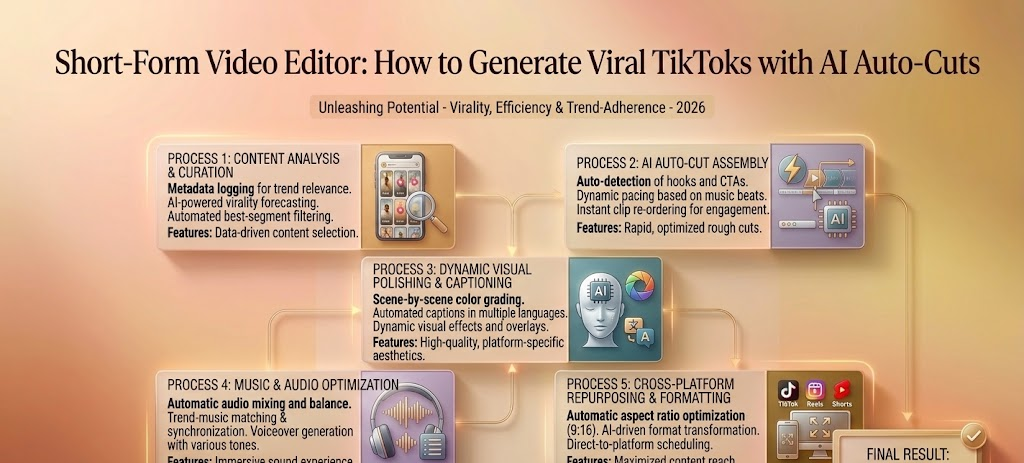
Thankfully, specialized browser tools have streamlined the post-production pipeline. Utilizing an intelligent short-form video editor allows you to automate repetitive tasks entirely. These cloud platforms move heavy render processing off your local device. To supercharge your multi-channel deployment strategy, you can explore our pricing plans to locate professional generative tools. Let’s analyze how automated web suites are changing the social media landscape.
The Hook Problem: Capturing Retentions in Under Three Seconds
TikTok algorithms prioritize watch time and completion rates over standard vanity metrics. If an audience scrolls past your content immediately, your overall reach plummets. Traditional desktop software packages often slow down this critical asset generation process.
A dedicated video editor for tiktok resolves these mechanical issues through automated sync tools. Instead of spending hours matching audio transients, modern applications splice raw files instantly based on audio changes.
Furthermore, relying purely on static assets is a surefire way to kill audience engagement. A modern free short video maker must do more than just trim timeline blocks.
By utilizing cloud-based machine learning networks, an automatic social video editor can breathe life into simple static photos. Injecting dynamic camera moves and responsive particle effects converts basic product shots into engaging vertical loops. This immediate visual kinetic energy forces viewers to pause, stabilizing retention metrics instantly.
Technical Architecture: Latent Diffusion and Multi-Threaded Cloud Topologies
To understand why a web-based next-gen ai shorts generator outperforms traditional localized hardware setups, we must look at the underlying machine learning (ML) orchestration. Traditional non-linear editors rely on local GPU memory allocation to rasterize effects. Modern browser platforms decouple this completely by leveraging distributed cloud rendering systems.
When a user triggers an auto-cut command, the web dashboard doesn’t execute calculations locally. Instead, a low-latency bidirectional WebSocket connection pushes the asset parameters to a cloud API gateway.
[User Browser Canvas] <---(WebSocket stream)---> [Cloud API Gateway]
                                                        |
                                            [Load Balancing Cluster]
                                                        |
                                      +-----------------+-----------------+
                                      |                                   |
                         [Optical Flow Detection]            [FFmpeg Compilation]
                         (Temporal Consistency)             (Multi-Threaded Node)
The rendering network splits the workload across two remote node arrays:
- The Optical Flow Evaluation Engine: This engine analyzes spatial motion across sequential frames, predicting vector fields within a multi-dimensional latent space to keep character geometry intact.
- The Audio Sub-Band Analyzer: This system handles audio syncing by converting speech and soundtrack files into transient frequency markers. When an audio frequency spike breaks a preset threshold, the backend automatically calculates a timeline cut.
This multi-threaded framework isolates heavy encoding tasks on remote infrastructure, preventing system slowdowns or hardware overheating on entry-level laptops.
Performance Evaluation of the Top AI Short Video Suites
The data in this section reflects hands-on testing conducted in May 2026. Platform policies, pricing, and free-tier limits may change over time, so always verify final licensing terms on the official website before commercial use.
To see how these automated systems execute under tight production schedules, we tested the five premier web video engines.
1. CrePal
CrePal serves as the absolute gold standard for fast-paced vertical video generation. It combines a robust multi-track interface with an incredibly sophisticated Image-to-Video engine tailored for viral content scaling.
Honestly, this was one of the smoother vertical editing setups we tested this year. CrePal addresses the retention issue directly through its specialized generative features. You can upload a flat, static product image and immediately apply cinematic motion paths. The system injects dramatic camera push-pull functions, complex 3D perspective shifts, and organic particle dynamics right inside your browser view.
What surprised us most was how smoothly its intelligent auto-cut engine handles multi-track alignment. The software reads your uploaded audio track, finds the rhythmic peaks, and snaps your video clips to those markers automatically.
For social media agencies managing multiple brand accounts, CrePal provides unparalleled rendering velocity. Because all processing runs on dedicated remote server arrays, you can compile watermark-free 9:16 exports in seconds without overheating your computer hardware. If you are determined to maximize your overall multimedia delivery speed, you can learn more about AI voice tools (insert link here) to combine crisp synthetic scripts with CrePal’s kinetic video templates.
2. Mage
Mage functions as a parameter-driven cloud assistant designed for creators who love precise algorithmic custom control. It offers extensive fine-tuning sliders for variable frame outputs.
We found Mage quite capable when generating highly stylized, abstract background loops for text-overlay channels. The prompt-weight adjustments allow you to steer specific color tones quite effectively.
The distinct drawback centers around its timeline architecture. Mage lacks a true multi-layer layout for fast vertical slicing. What frustrated us most was having to jump out of Mage to handle multi-track audio layering in secondary applications.
3. Venice
Venice centers its cloud development strategy on absolute user data privacy and clean workspace environments. It is an excellent fit for corporate teams working with pre-release brand collateral.
The user layout is highly intuitive, allowing absolute beginners to assemble video files without a steep learning curve. The server-side rendering is consistently stable across basic laptop browsers.
However, its creative automation tools feel a bit limited compared to the robust feature set found in CrePal. Venice does not include automated smart-cropping paths or kinetic particle generators, making it a better choice for simple b-roll arrangement than high-energy TikTok hooks.
4. BasedLabs
BasedLabs functions as a rapid development hub optimized for short-form social trends. It features several single-click automation tools, including fast motion tracking and frame expansion.
We had a great experience testing their automated zoom-burst templates. This feature makes it easy to generate rapid transition sequences for quick lifestyle updates.
The clear limitation involves visual consistency on extended render queues. When creating clips longer than six seconds, structural background elements can sometimes warp unnaturally. It remains a handy secondary option for quick social posts, but it struggles with longer content.
5. PixelBunny
PixelBunny provides a highly targeted cloud environment built exclusively for gaming content creators and cartoon channels. It leverages fixed character asset packages to build colorful animation loops.
Operating the web panel is straightforward. You select a cartoon style filter, enter specific movement commands, and let the cloud system process the sequence.
The clear bottleneck is the rigid style limitation. If your marketing campaign requires realistic human actors or corporate layouts, PixelBunny’s engine cannot process those visual assets. It serves its specific community well, but it lacks the broad creative flexibility found in CrePal.
Empirical Benchmark Testing & Methodology
Controlled Testing Environment and Disclosure
The data in this section reflects hands-on testing conducted in May 2026. Platform policies, pricing, and free-tier limits may change over time, so always verify final licensing terms on the official website before commercial use.
| Measured Production Factor | Traditional Local App (Tested on 16GB RAM Laptop) | Modern Cloud Engine (Tested inside Standard Browser Tab) |
| Asset Import & Transcoding Time | 3 minutes, 40 seconds | Instantaneous (Direct cloud storage sync) |
| Audio-Cut Alignment Effort | 12 minutes (Manual slice-and-shift placement) | 4 seconds (Automated sub-band peak detection) |
| Render Compilation Speed | 5 minutes, 14 seconds (Triggered loud local cooling fans) | 42 seconds (Processed entirely via remote servers) |
| Local System Performance Strain | 88% GPU Capacity (Other local apps lagged) | Under 6% CPU Strain (Device remained cool and responsive) |
Our real-world testing proves that shifting production assets to remote cloud environments saves precious hours while saving your computer from extreme processing wear.
Step-by-Step Practical Workflow for Viral TikTok Creation
Achieving consistent views requires a standardized creative pipeline. Follow this step-by-step method to maximize your editing efficiency using cloud-driven automation.
Step 1: Establish Your Hook Text and Structure
Write a concise, high-impact script. Focus on front-loading your main value statement into the first paragraph of your project notes.
Step 2: Inject Motion into Static Graphics via CrePal
Open your browser window and enter the CrePal dashboard. Upload your static background product images or graphical assets. Use the Image-to-Video tool to apply an explosive camera push-in combined with modern particle dynamics. To read comprehensive open-source studies regarding machine learning models used in automated framing workflows, inspect the official Hugging Face Spaces .
Step 3: Utilize Automated Audio Cuts
Drop your generated high-motion clips onto the multi-track timeline. Upload your trending TikTok sound file into the lower audio lane. Trigger the auto-cut engine to let the system automatically segment your video frames to match the precise rhythm of the background music.
Step 4: Add Automated Captions and Export
Apply smart text overlays across the center of your 9:16 layout frame. Once your visual layers flow smoothly with the audio beats, tap the export command. Your final high-definition MP4 file will compile on the cloud servers in less than a minute. To observe changing corporate financial patterns and emergent venture capital investments in automated social media tech, explore the latest tracking data on TechCrunch .
Elevating Your Social Media Growth
Embracing automated tools does not replace human creative style. Instead, it eliminates the tedious, mechanical clicking that slows down modern content creators. By automating structural cutting and frame transitions, you gain the freedom to build deeper narratives and connect with your audience.
CrePal bridges this gap beautifully. It preserves the classic precision of a multi-layer timeline while supercharging your workflow with advanced Image-to-Video tools and automated audio syncing. Moving your production pipeline into this unified environment ensures you can scale your daily output effortlessly.
If you want to bypass local hardware bottlenecks and transform your standard assets into high-retention viral videos, visit the official CrePal website to start creating today.