Editor’s Note: Let’s cut the fluff. Editing a 2-hour podcast into a dozen vertical TikToks used to require a dedicated video editor, Adobe Premiere, and three days of timeline scrubbing. Today, if you aren’t automating this extraction process, your content pipeline is bleeding time and money. I’ve spent the last few months testing the current landscape of AI clippers to see what actually works in a real production environment. Here is the exact, tested workflow to scale your distribution and multiply your views without losing your mind.
The creator economy has shifted into an era of hyper-distribution. You can no longer afford to spend 20 hours producing a long-form YouTube documentary or recording a deep-dive podcast, only to publish it once and hope the algorithm picks it up.
To maximize the return on your production effort, you must turn long video into shorts. By splintering a single pillar piece of content into 10 or 15 micro-assets, you create multiple entry points for new audiences to discover your brand.
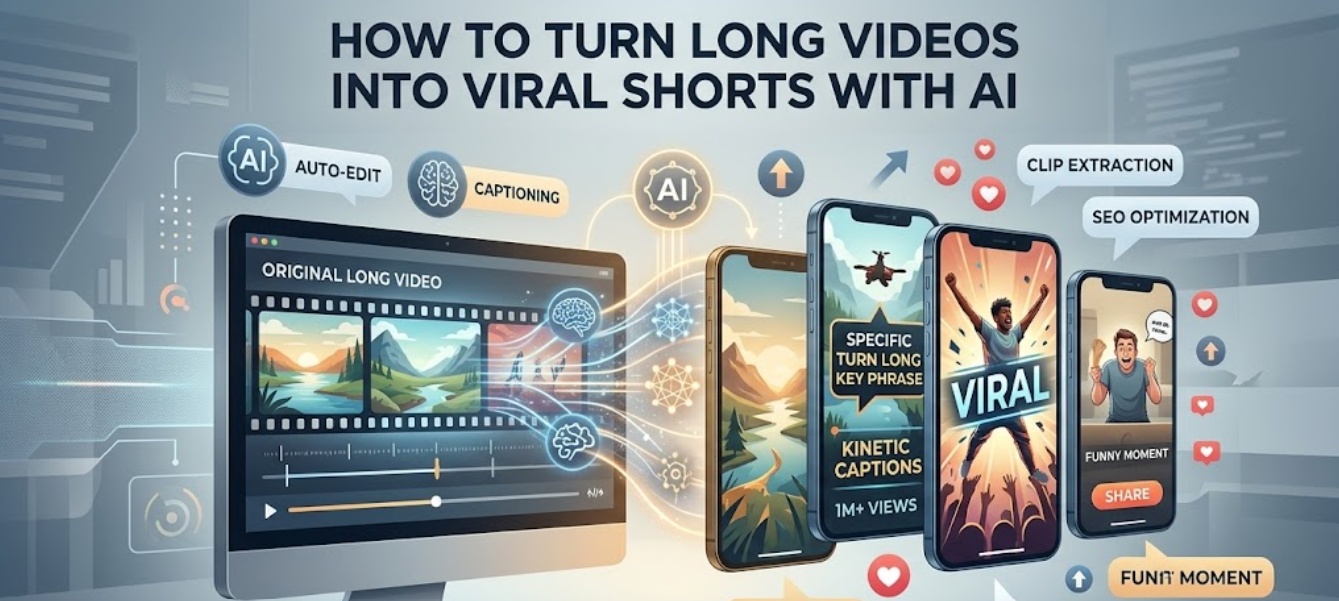
Historically, finding the best moments in a long video and manually reframing them for vertical platforms was a massive operational bottleneck. Today, thanks to natural language processing and computer vision, an ai video clipper can do this in seconds. In this guide, we will break down the anatomy of a viral short, the exact AI workflow, and how to utilize the easy-to-use video generator website CrePal—trusted by creators for over a year— to automate your entire short-form strategy.
Why You Need a Content Repurposing Engine
Relying on manual editing for short-form content is fundamentally unscalable. To compete in today’s digital landscape, you need a system that operates like a content factory.
The algorithm demands high-frequency posting
The foundational mechanics of social media are built on the Attention Economy. Platforms like TikTok, Instagram Reels, and YouTube Shorts require an immense volume of content to keep users scrolling.
According to algorithmic distribution research published in Computers in Human Behavior, account authority and reach are heavily correlated with posting consistency. Posting one highly polished Short per week will almost always lose to posting three high-quality Shorts per day. To feed this algorithmic demand without burning out, you must implement a long to short video ai pipeline that extracts the maximum value out of every minute you record.
The Anatomy of a Viral Clip
Before you feed your raw footage into an AI engine, you need to understand what the AI is actually looking for. A viral short is not just a random 30-second slice of video; it has a very specific narrative architecture.
Context, the “Aha!” moment, and the kinetic hook
Whether you are trying to convert youtube video to tiktok or clip a corporate webinar, every successful vertical video shares three structural pillars:
- The Kinetic Hook (0:00 – 0:03): The viewer must immediately know what the video is about. This requires high-contrast typography on the screen and an immediate, provocative statement.
- Context & Escalation (0:03 – 0:15): The clip must cut out all the “umms,” “ahhs,” and dead air. The narrative must escalate quickly, providing just enough background information to make the payoff hit hard.
- The “Aha!” Moment (0:15 – End): The core value proposition—a shocking fact, a hilarious punchline, or a deep industry insight. Once this moment lands, the video must seamlessly loop back to the beginning.
Step-by-Step AI Clipping Workflow
Here is the exact, button-by-button operational pipeline to transform your long-form content into a month’s worth of short-form assets.
Importing the long-form link or raw file
The first step is ingestion. If your long-form video is already published, simply copy the URL. If it is a raw, unedited recording, ensure it is rendered in at least 1080p. Log into the intuitive, easy-to-use video generator website CrePal, and paste your link or upload your .mp4 into the workspace. The engine will instantly begin transcribing the audio and mapping the visual timeline.
Letting the AI find high-retention moments
This is where heavy lifting happens. Instead of you scrubbing through a two-hour timeline, the AI utilizes sentiment analysis and natural language processing to score the transcript. It actively looks for:
- Changes in vocal pitch (indicating excitement or laughter).
- Keywords that signal a strong opinion or a controversial take.
- Complete narrative thoughts that can stand alone without external context.
Within minutes, the platform will generate a dashboard presenting 10 to 20 distinct, optimized clips cut from your master file.
Applying viral subtitle templates and safe zones
Raw, vertical video with no text will fail on modern feeds. Once your clips are selected, you must optimize them for silent viewing and algorithmic engagement.
- Dynamic Framing: The AI will automatically track the active speaker’s face, ensuring they remain in the center of the vertical 9:16 frame, even if they move around in the original horizontal shot.
- Subtitle Templates: Apply CrePal’s proven kinetic typography templates. These auto-captions highlight the active word in bright colors (like the popular “Hormozi style”), forcing the viewer’s eyes to stay locked on the screen.
- Multilingual Scaling: Want to dominate global feeds? Use CrePal’s integrated multilingual voiceover and translation tools to instantly dub your clipped Short into Spanish, French, or German, multiplying your reach with zero extra recording time.
Best Formats for Short-Form Extraction
While AI can clip almost anything, certain formats yield significantly higher virality scores due to their natural conversational density.
Podcasts, gaming streams, and educational webinars
- The Podcast Pipeline: Using a podcast to shorts ai is the most lucrative workflow on the internet right now. Podcasts are inherently structured around debates, storytelling, and interviews—making them a goldmine for 45-second viral clips.
- Gaming Streams: Twitch and YouTube Live streams are hours long but contain highly concentrated moments of extreme excitement or failure. AI clippers can detect in-game audio spikes and streamer reactions to instantly isolate these high-energy moments.
- Educational Webinars: Turning dry, hour-long corporate presentations into punchy, 30-second “Top 3 Tips” videos allows B2B businesses to perform exceptionally well on LinkedIn and YouTube Shorts.
Manual Edits vs. Full Automation
While the technology is incredibly advanced, relying 100% on blind automation can sometimes lead to context errors.
Why you still need to review the AI’s cuts
AI is a co-pilot, not an autopilot. Sometimes, the AI might clip a sentence that sounds profound but lacks the necessary context from the previous paragraph.
Before hitting export, always use the editor’s transcript-based timeline to manually drag the start and end points of your clip. Ensure the video doesn’t cut off the speaker’s final breath or end awkwardly mid-thought. A quick 30-second manual review of the AI’s selection ensures your final asset looks like it was cut by a seasoned human editor, preserving your brand’s quality standard.
FAQ
How to turn YouTube videos into Shorts for free?
You can easily start for free by utilizing the complimentary trial credits offered by modern generative platforms. Paste your YouTube URL into a trusted video clipping tool like CrePal, let the AI generate the clips and add automated captions, and export your favorite moments directly to your desktop.
What is the best AI for clipping videos?
The best AI clipper is one that integrates facial tracking, transcript-based editing, and built-in kinetic typography templates into a single dashboard. Platforms that also offer advanced features—such as AI avatars for intros or multilingual voiceovers to translate your clips for international audiences—provide the highest ROI for creators looking to scale.
Will YouTube penalize repurposed content?
According to YouTube’s official monetization guidelines, the platform only penalizes “Reused Content” if it lacks unique editorial value or if you are stealing someone else’s unedited work. Taking your own long-form video and using AI to re-edit it, add dynamic captions, and optimize it for a vertical format is fully compliant and highly encouraged by the platform’s distribution algorithm.