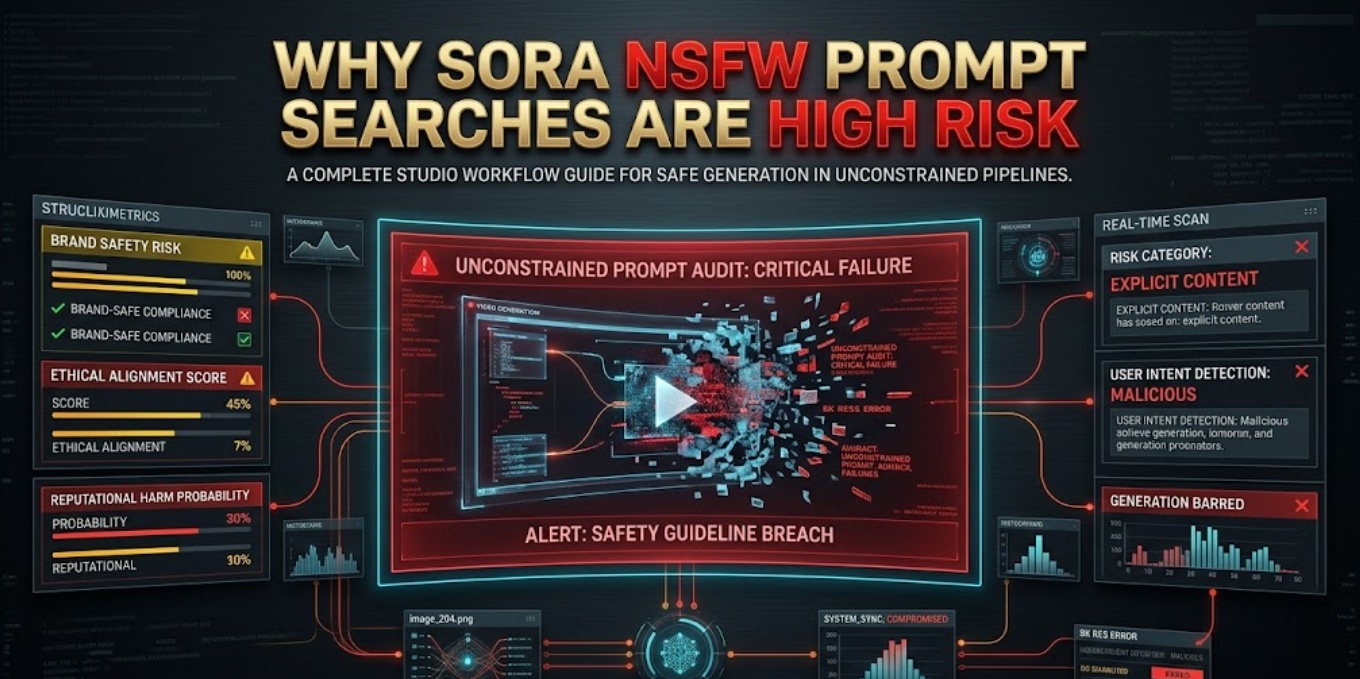
Compliance & Legal Disclaimer [Updated August 2026]: This article provides operational workflow frameworks and risk management strategies for digital studios, filmmakers, and commercial creators utilizing OpenAI’s Sora and Sora 2 video generation architectures. It does not constitute formal legal counsel. Generating, modifying, or distributing mature digital content is governed by strict third-party platform Terms of Service (TOS), intellectual property statutes, and biometric privacy laws. OpenAI enforces zero-tolerance policies regarding sexually explicit content, non-consensual intimate imagery (NCII), and likeness violations. Always consult qualified legal counsel and review host platform policies before generating or publishing sensitive commercial content.
Editor’s Note: Before proceeding, let us be entirely transparent: this article is not a repository of sora nsfw prompts, nor does it contain “jailbreak” syntax, bypass codes, or instructions for circumventing AI safety filters.
When commercial directors, narrative creators, and digital animators search for Sora 2 NSFW prompts, they are rarely attempting to produce illicit material. In most professional studio environments, “NSFW” serves as a proxy search term for high-intensity cinematic concepts—such as moody lingerie commercials, dramatic physical intimacy in romance films, or provocative dark-fantasy character studies. However, attempting to execute mature visual concepts in cutting-edge video models like Sora or Sora 2 requires extreme operational caution. OpenAI’s safety architecture evaluates text inputs and generated video frames with multi-tiered automated classifiers. Relying on unverified community prompt ideas exposes your team to severe account restrictions and legal liabilities. Here is what creative teams must evaluate when navigating adult video prompt safety and policy boundaries.
Why Sora NSFW Prompt Searches Are High Risk
Navigating OpenAI’s flagship video models requires understanding that video generation introduces temporal dimensions that far exceed the complexity of static image generation.
Model policy expectations
OpenAI’s official Usage Policies explicitly prohibit utilizing their models to generate sexually explicit content, pornography, non-consensual sexual content, or content depicting real people in intimate contexts. Sora and Sora 2 operate under automated moderation stack:
- Text Input Screening: Natural language processing models evaluate prompt inputs for prohibited terms, adversarial patterns, and semantic circumvention.
- Visual Frame Auditing: Multimodal vision classifiers audit generated video frames in real time during the rendering process.
- Account-Level Trust Scoring: Repeatedly submitting prompts that trigger safety blocks degrades your account authority, potentially leading to immediate API access revocation or permanent organization bans.
Adult video generation intent
A primary source of AI video policy risks is the sheer unpredictability of generative video physics. A text brief for a NSFW Sora prompt that attempts to describe subtle romantic tension or high-fashion aesthetic framing might seem benign on paper. However, as Sora’s diffusion model calculates motion across frame sequences, the model can inadvertently hallucinate improper physical reveals, anatomical distortions, or wardrobe anomalies. In video, a single policy-violating frame out of a 240-frame sequence will trigger an output block and flag your user account.
Community misinformation
Online forums and social media frequently tout supposed “working Sora 2 NSFW prompts” or “unfiltered Sora templates.” Creators must treat these claims as pure misinformation. OpenAI continuously updates its red-teaming parameters and automated guardrails. Tactics that temporarily bypassed filters in early developer previews are quickly patched. Utilizing community-sourced adversarial language or “jailbreaks” puts your corporate infrastructure at risk for zero operational gain.
What Creators Should Avoid
To protect your studio’s commercial reputation and technical infrastructure, certain prompt structures and creative methodologies must be strictly prohibited across your team.
Real-person or celebrity references
Never include the names of living individuals, public figures, celebrities, or private citizens in your prompt briefs. Attempting to generate a real person’s likeness in a provocative or adult-style context violates federal and state Right of Publicity statutes (including legal frameworks such as California’s AB 2602 and AB 1836). Furthermore, global platforms enforce strict removal mandates under laws like the federal TAKE IT DOWN Act to prevent deepfakes and non-consensual imagery.
Private image scenarios
If your studio utilizes Image-to-Video (I2V) features within Sora AI video prompts—animating a static photograph or visual reference—you must maintain an ironclad chain of custody. Attempting to animate private photographs or unverified human talent without explicit, signed commercial consent forms is illegal. Organizations like StopNCII maintain global cryptographic hash databases designed to flag and block non-consensual imagery across digital ecosystems.
Bypass or jailbreak language
Avoid attempting to trick the AI through obfuscated text, misspellings, foreign language translations of explicit terms, or complex “hypothetical scenario” framing (e.g., “Act as a director filming a movie scene where…”). OpenAI’s classifiers are specifically trained on adversarial prompt injection techniques. Attempting to bypass safety filters is treated as an intentional violation of the Terms of Service, bypassing standard warnings and moving straight to account termination.
Caption: Professional studio dashboards monitor prompt inputs against OpenAI usage policies to prevent accidental account flags.
Safer Creative Planning Alternatives
Instead of attempting to push an adult concept through an unyielding moderation filter, professional creative directors restructure mature briefs into broadcast-safe technical camera instructions.
Non-adult visual direction
Shift the focus of your Sora AI video prompts away from explicit physical descriptors and toward sophisticated visual storytelling. Translate mature emotional intensity into professional cinematography directives:
- Lighting Parameters: Use
dramatic chiaroscuro lighting,low-key rim lighting, orcinematic 35mm film grain. - Framing & Composition: Utilize
medium close-up on character expression,shallow depth of field with blurred background, orslow dolly zoom. - Environmental Mood: Focus on atmospheric elements like
fog-filled room,neon reflections in glass, orhigh-fashion editorial color grading.
Fictional concept notes
Ensure all character briefs explicitly establish a 100% synthetic, fictional scope. Document within the internal creative brief that all depicted subjects are original fictional constructs with mature adult demographic attributes (e.g., “clearly 30+ years old”). This eliminates ambiguity regarding age-safety boundaries monitored by global child safety organizations like the National Center for Missing & Exploited Children (NCMEC).
Review before generation
Never send unverified creative text directly to a rendering pipeline. Commercial studios utilize centralized orchestration environments—such as CrePal—to manage production scripts, sequence camera shots, sanitize prompt structures, and enforce brand safety controls before sending API requests to generative video models. Pre-flight human review ensures that prompt inputs are completely clean before compute time is spent.
Caption: A secure pre-flight workflow sanitizes creative text briefs into technical camera directives before rendering.
Facts to Verify Before Publication
Generating a compliant video draft is only the first step; publishing synthetic media commercially requires navigating complex legal transparency mandates.
First, verify compliance with global synthetic media disclosure laws. Under Article 50 of the European Union AI Act, commercial deployers of AI-generated video must ensure content is marked in a machine-readable format. Modern studios satisfy this requirement by embedding cryptographically signed C2PA Content Credentials directly into the video file’s metadata, proving its origin and editing history.
Second, consider intellectual property rights. Under official guidance from the United States Copyright Office (USCO), purely AI-generated video content that lacks substantial human authorship cannot be protected by copyright. To secure legal ownership over commercial campaigns, your workflow must integrate substantial human creative input—such as custom scriptwriting, manual editing, layer compositing, and direct visual orchestration.
FAQ
Who should monitor Sora policy updates? In a commercial studio, the Lead Technical Director and the Studio Compliance Officer must jointly monitor OpenAI’s policy announcements and API documentation updates. They are responsible for updating internal negative-prompt libraries and adjusting studio SOPs whenever OpenAI modifies its moderation thresholds.
What should happen to saved unsafe prompt notes? Any prompt notes, community research snippets, or test inputs that trigger safety blocks or contain policy-violating text must be immediately removed from shared studio repositories. They should be moved to an encrypted, restricted quarantine file for audit purposes or securely deleted to prevent junior artists from accidentally reusing unsafe tokens.
When should a Sora idea be rewritten entirely? A video concept must be completely rewritten if its narrative core depends on explicit anatomical depictions, non-consensual dynamics, or the simulation of real human beings. If the mood cannot be successfully conveyed through technical camera direction, lighting, and performance pacing, the concept is unsuitable for generative AI video pipelines.
How should teams document rejected client requests? If a client submits a commercial brief demanding explicit content or the unauthorized use of a celebrity’s likeness via NSFW Sora prompts, the account team must formally reject the brief in writing. The rejection, along with the sanitized counter-proposal focusing on safe cinematic direction, should be documented in the studio’s client project archive to demonstrate a clear history of legal compliance.
Conclusion
Searching for sora nsfw prompts reflects a creator’s desire to harness the full, breathtaking cinematic potential of OpenAI’s advanced video models for dramatic visual storytelling. However, attempting to bypass safety filters or deploy explicit prompts in Sora or Sora 2 is a high-risk gamble that endangers your studio’s API access, brand reputation, and legal standing. By replacing jailbreak tactics with a disciplined, boundary-driven production workflow—enforcing strict real-person exclusions, sanitizing briefs into technical camera directives, utilizing orchestration suites like CrePal, and embedding C2PA metadata—creators can safely produce compelling, high-impact video campaigns. In professional AI video production, operational compliance is the foundation of creative freedom.